Historical report preserved from an archived 2008 local news story.
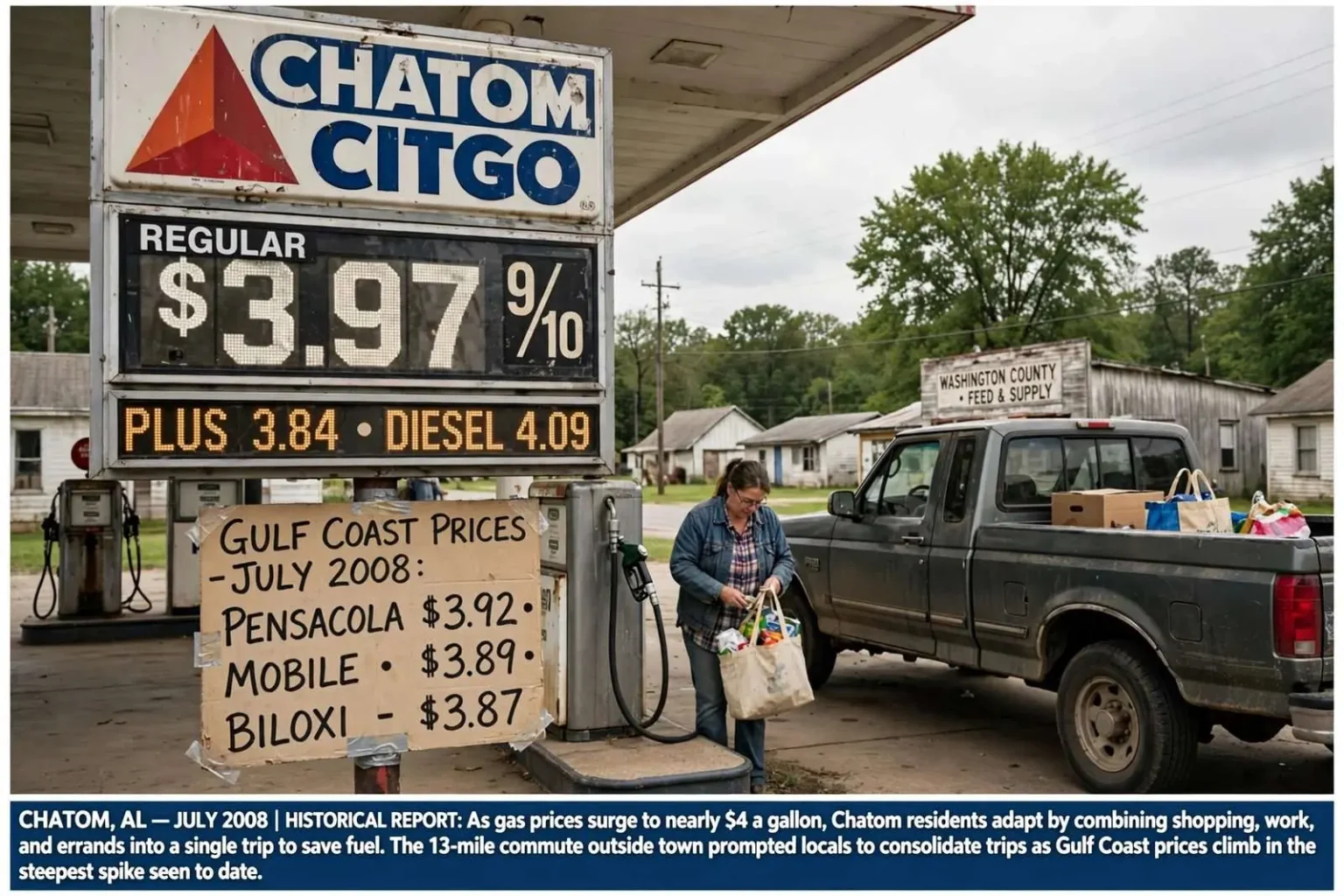
Rising gasoline prices were changing routines for residents of Chatom in Washington County in 2008, according to an archived local news report. One resident who lived 13 miles outside town said she combined shopping, work and other errands into a single trip whenever she came to Chatom in order to adapt to the economy. The report compared gasoline prices across the Gulf Coast, listing prices of $3.92 in Pensacola, $3.89 in Mobile and $3.87 in Biloxi. This article records fuel-price pressures reported in 2008 and is not a statement of current gasoline prices.
The summer of 2008 stands as the high-water mark of gasoline prices in American history to that point. Crude oil climbed past $140 a barrel that summer, national average pump prices breached $4 a gallon for the first time, and communities across the Gulf Coast — where long driving distances are woven into daily life — felt the squeeze with particular force. Washington County, a rural county of roughly 17,000 people sitting along the Alabama-Mississippi line, had no mass transit to fall back on and few alternatives to the personal truck and car. When prices rose, there was no trip to skip, only trips to combine.
Chatom, the county seat, functions as the commercial hub for residents spread across the county’s rural roads. The town’s grocery stores, pharmacies, banks, courthouse offices and schools draw shoppers from communities like Deer Park, McIntosh, Millry and Fairford, many of whom live 10, 15 or 20 miles out along country highways. The resident quoted in the archived report, living 13 miles outside town, described a strategy that became universal in rural America that year: instead of driving to Chatom for work one day, groceries another and the pharmacy on a third, she stacked every errand into one loop. Each consolidated trip saved a round trip of 26 miles — real money in a truck that might average 15 miles per gallon at $3.89 a gallon.
The Math That Changed Rural Routines
For a rural household, the fuel spike of 2008 functioned like a stealth tax. A family commuting 30 miles round trip to work in Mobile or doing a daily school run into Chatom could easily burn 500 to 800 gallons of gasoline a year; at the price levels reported in the archived story, every 50-cent rise in the pump price added $250 to $400 to the annual household budget. Farmers and timber workers across Washington County faced the same arithmetic with diesel, which climbed even higher than gasoline, pushing up the cost of running tractors, log trucks and delivery equipment. The county’s economy — built on timber, small farms and the wages of workers who commute to industries along the Tombigbee River and into Mobile — absorbed those costs with little margin to spare.
The price comparison the archived report made across the Gulf Coast told its own story. At $3.92 in Pensacola, $3.89 in Mobile and $3.87 in Biloxi, the numbers differed by only a few cents across three states — a reminder that fuel pricing is regional, driven by Gulf Coast refinery output, pipeline logistics and wholesale markets rather than by local conditions. For Washington County residents, the practical takeaway was that chasing cheaper gas across county lines rarely paid off; a drive to Mobile for fuel cost more in gasoline than the savings returned. Better to buy local, burn less, and plan ahead.
That is precisely the behavior the Chatom resident described. Rural consumers responded to the 2008 spike in ways that economists documented across the country: combining trips, cutting discretionary driving, shifting to more fuel-efficient vehicles where they could, and favoring closer towns over distant shopping centers. Local merchants noticed the pattern, because every consolidated trip meant fewer spontaneous stops, and a customer who used to come to town three times a week now came once, spent deliberately, and went home.
Washington County: A Commuting County by Necessity
Washington County’s geography explains why fuel prices bite so hard there. The county is one of Alabama’s most rural, anchored by the town of Chatom and the timber operations that have defined its economy for a century. Its workers commute long distances — to the paper mills and chemical plants along the Tombigbee, to offshore and shipbuilding jobs in Mobile, to healthcare and retail work in neighboring counties. Public transportation, already thin across rural Alabama, is effectively absent; a two-car household is not a lifestyle choice but a job requirement. Every mile driven, then, is tied directly to income, and fuel is a cost of working the way electricity is a cost of running a shop.
The county also has a distinctive energy story of its own. Washington County sits atop natural gas fields that have been producing since the 1970s, including storage facilities connected to the region’s gas pipeline network, and energy development has been part of the local economy and tax base for decades. That irony was not lost on residents in 2008: a county that produced energy watched the price of refined fuel at its own pumps climb past levels anyone had seen before. Global oil markets, not local production, set the price, and the archived report’s regional comparison captured how uniformly those markets reached into every corner of the Gulf Coast.
The fuel spike of 2008 turned out to be a peak followed by a historic crash. By the end of that year, the financial crisis had collapsed oil demand, and gasoline prices fell by more than half within months. But the memory of $4 gasoline reshaped rural habits in lasting ways: vehicle purchases tilted toward smaller cars and, later, trucks with better fuel economy; school systems consolidated routes; and employers grew more open to compressed workweeks that saved employees a day’s commute. For Chatom’s residents, the archived report preserves a snapshot of that moment — a 13-mile drive into town that suddenly demanded planning, a shopping list written in advance, and an errand loop designed to squeeze every mile out of every gallon.
What the 2008 Record Means Today
Records like this one do more than preserve nostalgia; they document how rural Gulf Coast communities actually responded to economic pressure. The strategies Chatom residents adopted in 2008 — trip consolidation, local shopping, deliberate planning — became the template for every subsequent price spike, including those that followed hurricanes disrupting Gulf refineries and the global price shocks of later years. Washington County’s experience showed that rural resilience is less about endurance and more about organization: the residents who weathered high prices best were the ones who restructured their routines fastest.
The archived comparison of Gulf Coast prices — Pensacola, Mobile, Biloxi within a nickel of one another — also serves as a reminder of how connected the region’s economy is. A driver in Chatom, a dockworker in Mobile and a tourist in Pensacola all bought gasoline priced by the same Gulf Coast wholesale markets that week. When those markets moved, the entire coast moved with them, and the rural counties felt it first and hardest because they had the least flexibility to absorb it.
For readers encountering this article today, the numbers on the page — $3.92, $3.89, $3.87 — belong to a specific week in 2008 and to the economic history of the Gulf Coast. They record the moment when a Chatom resident’s 13-mile drive into town became a lesson in household economics, and when communities across Washington County learned, in real dollars, how tightly their daily lives were bound to the price of a barrel of crude oil an ocean away.
Life at the County Crossroads
Chatom in 2008 was a town of roughly 1,200 people serving a county four times its size, and its role as county seat concentrated the trips that matter. The Washington County Courthouse handled everything from property records to jury duty. The town’s medical clinics, banking branches, hardware stores and feed suppliers served families whose nearest alternative was a 30-mile drive toward Mobile or a crossing into Mississippi. Students from across the county passed through Chatom’s schools daily on bus routes that ran dozens of miles of rural roads each morning and afternoon. Every one of those functions required fuel, which is why gasoline prices showed up in the county’s life not as an abstraction but as a monthly line item in nearly every household’s budget.
The town’s businesses felt the shift in their own operations as well. Delivery costs rose for the grocery store and the pharmacy; suppliers added fuel surcharges that passed through to small-town merchants; and every service call that dispatched a truck out into the county cost more to make. Small businesses across rural America reported the same squeeze in 2008, and owners responded by adjusting delivery minimums, consolidating supply orders and raising prices modestly — a quiet chain reaction that began with the wholesale cost of diesel and ended in the receipts of customers already cutting back their driving.
Churches and civic organizations adapted too. Washington County’s social life runs through congregations, volunteer fire departments, school ballgames and community suppers, all of which require driving after dark. Families in 2008 began carpooling to church and school events, combining visits to relatives with errand runs, and scheduling activities so that one trip served multiple purposes. The 13-mile resident’s consolidated errand loop was the private version of what the whole community was doing publicly: making the same gas money cover more of the life they were used to living.
The Regional Pump Market Behind the Prices
The three prices in the archived report — $3.92 in Pensacola, $3.89 in Mobile and $3.87 in Biloxi — reflect the structure of the Gulf Coast fuel market. The coast from Houston to Pensacola concentrates one of the world’s largest refining complexes, and gasoline sold at stations in Alabama, Mississippi and Florida typically originates in those refineries and moves by pipeline and barge to regional terminals. Retail prices layer on state fuel taxes — Alabama’s among the lowest in the nation at the time, Florida’s among the higher — along with station margins and local competition. That is why the three cities’ prices clustered within a few cents: the underlying commodity and supply costs were identical, and small differences in taxes and competition explained the rest.
For consumers, the near-uniformity across three states had a practical consequence: there was no cheap-gas arbitrage worth pursuing. A Washington County driver considering a run to Mobile would burn several gallons getting there and back, erasing any per-gallon savings before the tank was full. The report’s comparison, then, was less a shopping guide than a portrait of a single regional market, one whose wholesale prices were set by crude oil costs that summer at levels that made national headlines and reshaped household budgets from Chatom to Biloxi.
The archived story of Chatom’s consolidated trips endures because it captures a universal rural response to a specific economic moment. When gasoline crossed the threshold where driving itself demanded justification, people who lived far from town did what resourceful communities have always done: they planned, they combined, and they adapted. The prices on that Gulf Coast sign have long since changed — but the lesson of the 13-mile errand loop, written down in a Washington County summer, remains part of the region’s working memory every time fuel prices climb again.