Leroy Man Gets Six Months After Washington County Probation Revoked Over Atmore Assault Case
Robert Heath Walker, 53, was ordered to serve six months after a Washington County judge revoked his probation. The revocation followed his guilty plea in an Escambia County assault case that began as an attempted murder charge.
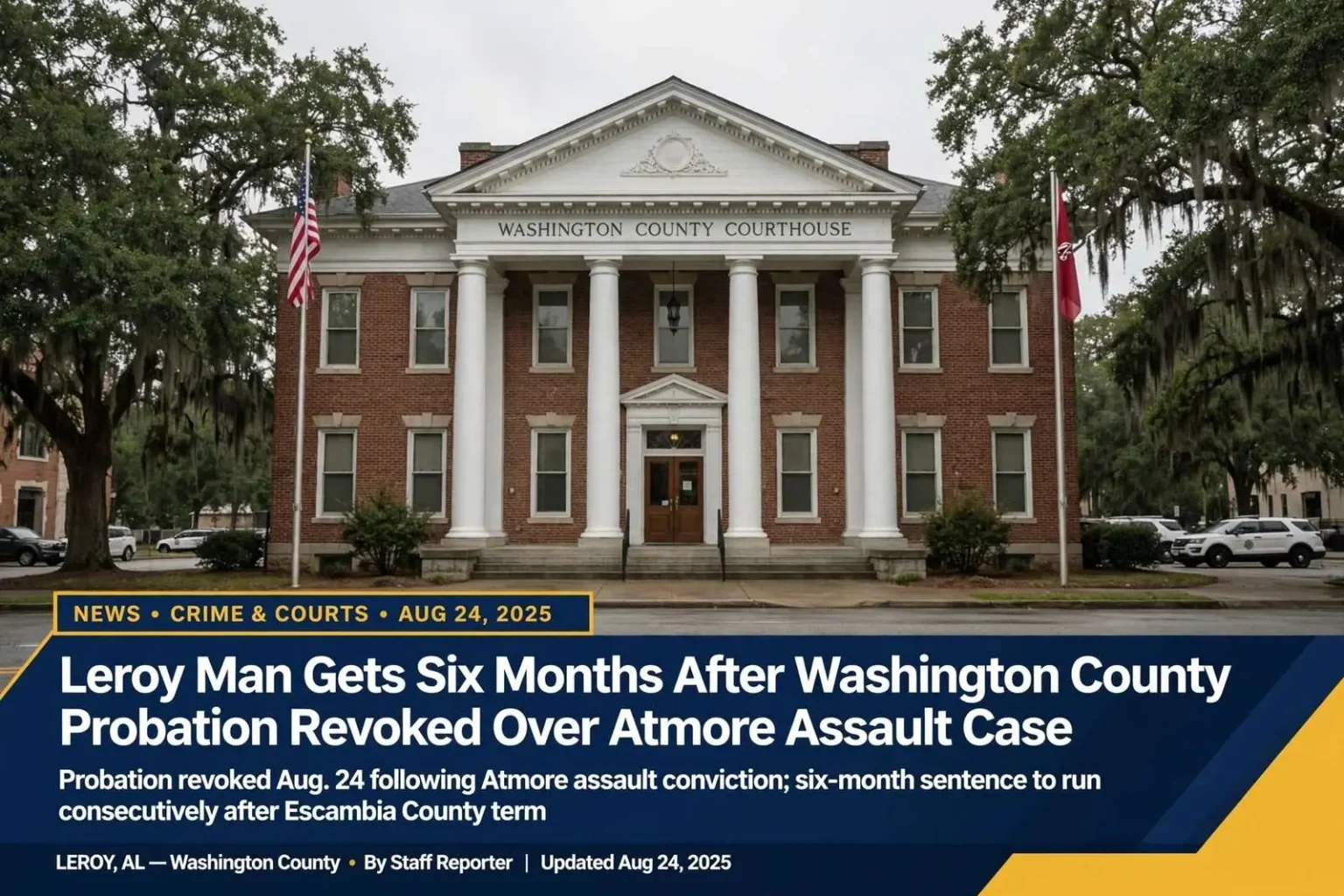
A Leroy man has been ordered to serve six months in jail after his Washington County probation was revoked in the wake of his conviction in an assault case in neighboring Escambia County.
The Revocation Hearing
Robert Heath Walker, 53, appeared before Washington County Circuit Judge Perry Newton on Aug. 24 for a probation revocation hearing.
Court records show Walker pleaded guilty to assaulting a woman in Escambia County following a July incident at an Atmore motel. Newton revoked Walker’s probation and sentenced him to six months in jail, with that sentence to run consecutively to the sentence imposed in the Escambia County case.
A consecutive sentence means the six months begins only after the Escambia County sentence is served, rather than running at the same time. Newton also denied Walker’s request to serve the six-month sentence in the Washington County Jail.
How the Atmore Case Began
Walker was initially charged with attempted murder by the Atmore Police Department after officers found an unconscious woman suffering from traumatic injuries at the Hampton Inn in Atmore on July 2.
Police responded to the hotel after receiving a request to check on the woman’s welfare. Emergency medical personnel transported her to a regional trauma center.
Following an investigation, Atmore police obtained a warrant charging Walker with attempted murder. A joint effort involving the U.S. Marshals Gulf Coast Regional Fugitive Task Force was launched to locate him.
The Surrender
Washington County Sheriff Richard Stringer said one of Walker’s relatives contacted him and reported that Walker intended to surrender. Walker turned himself in at the Washington County Jail on July 3 and was later extradited to Escambia County.
He was initially held without bail under Alabama’s Aniah’s Law, the constitutional amendment approved by voters that expanded the list of offenses for which a judge may deny bail outright. Attempted murder falls within that expanded list, which is why Walker was held without bond rather than given the opportunity to post bail at the outset.
The attempted murder charge ultimately resolved as an assault conviction through a guilty plea — a common path in violent-crime prosecutions, where the charge at arrest reflects what investigators alleged at the time and the final conviction reflects what the parties agreed the evidence would support at trial.
The Probation He Was Serving
At the time of his July arrest, Walker was serving probation in Washington County after pleading guilty to menacing in April 2025.
He was originally charged with third-degree domestic violence following an October 2023 incident in which a woman accused him of threatening her with a handgun. According to court records, Walker fired the weapon between the woman’s legs, causing her to fear for her life. He was released on a $30,000 bond and later pleaded guilty to the reduced charge of menacing.
That probation is what District Attorney Steven Winters moved to revoke. Winters filed a motion on July 6 seeking revocation because of the Escambia County case — five days after the Atmore incident and three days after Walker surrendered.
How Probation Revocation Works
A revocation proceeding is not a new criminal trial. It is a hearing on whether a defendant violated the conditions of a sentence already imposed, and the standard of proof is lower than the beyond-a-reasonable-doubt standard required for a conviction.
A new criminal charge is among the most straightforward grounds for revocation, because remaining free of new offenses is a standard condition of probation in Alabama. Once Walker entered a guilty plea in Escambia County, the factual basis for the Washington County revocation was largely settled.
The judge’s decision to impose the six months consecutively, rather than concurrently, and to deny the request to serve it locally, are both discretionary calls that rest with the sentencing court.
Earlier Court History
Court records show Walker was also charged in 2020 with violating a court-ordered protection order.
In September 2000, he was arrested in Clarke County on a stalking charge after a woman accused him of repeatedly following her. The woman told investigators Walker displayed a handgun during one encounter and said he was “ready for both of them to die.” The stalking charge was later dismissed.
The Pattern Across Three Counties
The case file spans Clarke, Washington and Escambia counties over more than two decades, and it illustrates a recurring feature of rural South Alabama criminal cases: charges filed in one county can carry direct consequences for a sentence being served in another.
Because probation is supervised by the county that imposed it, a defendant who picks up a new charge elsewhere can face two separate proceedings — the new prosecution and a revocation action back home — with the second often resolving quickly once the first produces a conviction.
For victims and for the courts, that structure is designed to ensure that a sentence of probation carries real consequences when its conditions are broken, without requiring the original county to relitigate the underlying facts of the new case.
Where the Case Stands
With probation revoked and the six-month term ordered to run consecutively, Walker’s Washington County obligation follows the completion of his Escambia County sentence. Court records reflect the revocation as final following the Aug. 24 hearing.