MCHD Urges Heat Safety After Sharp Rise in Heat-Related Hospitalizations
The Mobile County Health Department is urging heat safety after surveillance data showed 18 heat-related hospitalizations in a single day amid a record-challenging summer.
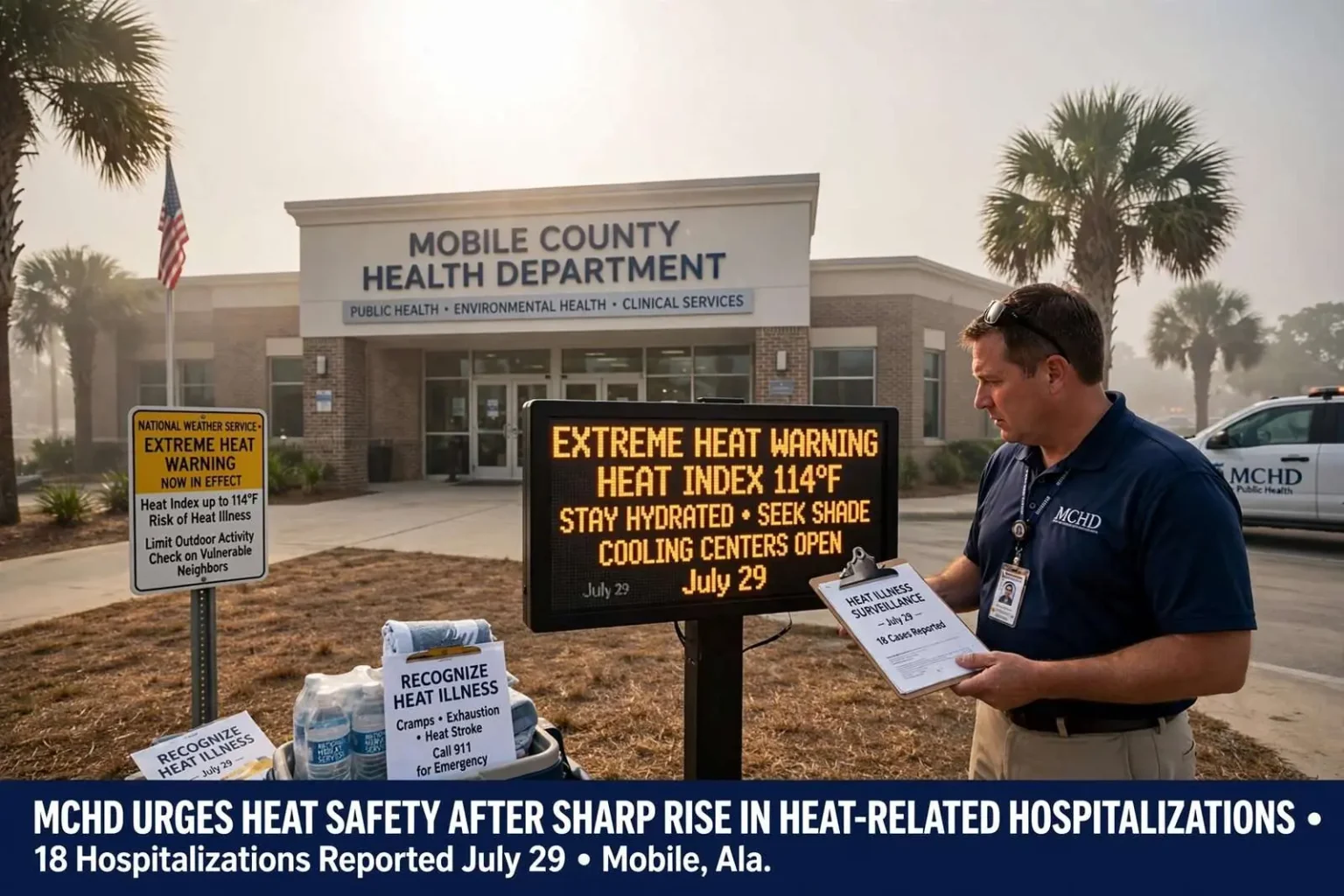
MOBILE, Ala. — The Mobile County Health Department is renewing its call for heat safety after real-time disease surveillance flagged a sharp spike in heat-related illness on July 29, one of the hottest and most dangerous days of an already record-challenging summer.
Using the ESSENCE syndromic surveillance system, which tracks emergency department visits in near real time, the health department identified 18 heat-related illness hospitalizations across Mobile County that day. The spike coincided with a National Weather Service Extreme Heat Warning, as the heat index climbed to approximately 114 degrees Fahrenheit — a level capable of causing heat illness quickly, even among healthy people engaged in normal outdoor activity.
“Days like July 29th are exactly why we watch our surveillance data so closely,” said Dr. Kevin Michaels, health officer for Mobile County. “An 18-case spike in a single day tells us the heat wasn’t just uncomfortable — it was actively putting people in the hospital. Some of these visits appear connected to outdoor work and physical labor, which is a reminder that heat safety isn’t only a personal responsibility, it’s also a workplace responsibility.”
Understanding the Risk
Heat illness ranges from cramps and exhaustion to life-threatening heat stroke, and can progress quickly once the body’s cooling systems are overwhelmed. Health officials say risk is elevated for outdoor and physical laborers such as construction and landscaping workers; young athletes who have not yet acclimated to the heat; older adults and young children, whose bodies regulate temperature less efficiently; and people with chronic conditions like heart disease, diabetes or kidney disease, or those taking medications such as diuretics and beta-blockers that impair the body’s ability to cool itself.
People without reliable air conditioning, including those experiencing homelessness, and anyone new to the region’s heat are also at higher risk, as is alcohol use during extreme heat, which can accelerate dehydration and cloud a person’s awareness of their own symptoms. The through-line in every case is the same: the body cannot shed heat as fast as the environment forces it to absorb it.
On the Gulf Coast, that equation is made worse by humidity. Moist Gulf air keeps sweat from evaporating efficiently, which cripples the body’s primary cooling mechanism. That is why a heat index — what the combination of temperature and humidity actually feels like — matters more to health officials than the thermometer reading alone. A 95-degree afternoon with heavy humidity can stress the body more severely than a drier 100-degree day, and Mobile County summers supply that combination week after week.
What the surveillance system sees
ESSENCE, the Electronic Surveillance System for the Early Notification of Community-based Epidemics, is operated in partnership with hospitals and emergency departments, which feed visit data into the system continuously. Rather than waiting for weekly or monthly summaries, epidemiologists at the health department can watch for abnormal clusters of symptoms — including heat-related illness — as patients arrive. When counts for a single day jump well beyond the expected range, the department can respond with public warnings while the dangerous weather is still in place.
That capability is what turned a routine hot day into an urgent public message on July 29. Eighteen hospitalizations in one county in a single day is a clear signal, and the system’s near-real-time design meant health officials did not have to wait for the summer’s end to understand what was happening. The department treats spikes like this one as actionable intelligence, pairing the data with weather service warnings to time its outreach for maximum effect.
The July 29 warning from the National Weather Service placed Mobile County in the category of extreme heat events, in which the combination of heat and humidity is considered dangerous to anyone without cooling, not merely uncomfortable. Warnings at that level urge residents to limit outdoor activity, check on vulnerable neighbors and take the heat seriously as a health threat rather than a nuisance.
Recognizing heat illness
Health officials urge residents to learn the warning signs of heat illness in themselves and others. Heat cramps — painful muscle spasms, often in the legs or abdomen — are usually the first signal that the body is struggling. Heat exhaustion follows, bringing heavy sweating, weakness, dizziness, nausea, headache and a fast pulse. The critical step at this stage is to move to a cooler location, drink water and rest until symptoms pass.
Heat stroke is the emergency stage. The body’s temperature regulation fails, sweating may stop, the skin turns hot and dry or red, confusion sets in, and body temperature can climb past 103 degrees. Heat stroke can cause permanent injury or death within minutes, and officials say anyone showing those signs needs immediate emergency care. Bystanders should call for help and work to cool the person down — shade, water-soaked cloths, a cool bath — while waiting for emergency responders.
Mobile County’s emergency medical system handles a steady volume of heat-related calls every summer, and the July 29 spike showed how quickly that volume can surge when conditions turn extreme. Officials stress that the window for prevention is much wider than the window for treatment: hydration, shade and sensible scheduling cost nothing, while a missed heat stroke case can cost a life.
Practical steps for residents
The health department’s standing advice for extreme heat is built around a handful of straightforward habits. Drink water frequently throughout the day rather than waiting for thirst, and avoid alcohol and heavily sugared drinks, which work against hydration. Stay in air conditioning when possible — a mall, library or public cooling space counts when home cooling is unreliable. Limit outdoor activity to the early morning and evening hours, and take frequent shaded breaks during any necessary outdoor work.
Never leave children or pets in a parked vehicle, even for a few minutes and even with the windows cracked. Interior temperatures in a closed car can rise to lethal levels in a fraction of an hour, and the department repeats this warning every summer because the deaths it prevents are entirely preventable.
Residents are also asked to check on neighbors and family members who live alone, especially older adults, and to make sure pets have shade and fresh water. Workers who must be outdoors are encouraged to use a buddy system so that someone is always watching for the early signs of heat illness, since confusion is itself a symptom and can keep a struggling worker from recognizing their own danger.
Employers share the burden
Dr. Michaels’ emphasis on workplace responsibility reflects a reality of the Gulf Coast economy: construction sites, roofing crews, landscaping operations, shipyard work, agricultural fields and port facilities all put large numbers of workers outside through the hottest hours of the day. Federal workplace safety guidance calls on employers to provide water, rest and shade, to allow new workers time to acclimate to the heat over a week or more, and to train crews to recognize and respond to heat symptoms in one another.
Acclimation matters more than many employers realize. The body builds heat tolerance over one to two weeks of gradually increasing exposure, which is why new hires and workers returning from time off are among the most vulnerable people on any outdoor crew. The young athletes practicing on county fields face the same physiology, and school and league officials are urged to follow the same acclimation principles during August practices.
The health department’s message on July 29 was aimed at all of these audiences at once: individuals, families, employers, coaches and neighbors. The surveillance data showed the danger was not hypothetical. On one of the summer’s hottest days, eighteen Mobile County residents ended up hospitalized, and the department’s message was plain — the next spike is preventable only if the region takes heat as seriously as the data says it should.
A summer of records
The July 29 spike did not occur in isolation. Health officials described the summer as record-challenging, with repeated stretches of heat and humidity pushing the heat index well past 100 degrees across south Alabama. Each successive hot day strains the same population: residents without dependable cooling, workers with no choice but to be outside, and people whose health conditions make them fragile in any extreme weather. Cumulative heat stress — several hot days and warm nights in a row without relief — is what turns a hot week into a deadly one, because overnight temperatures that stay elevated never give bodies a chance to recover.
For Mobile County, the combination of Gulf humidity, intense sun and a large outdoor workforce makes summer heat a recurring public health event rather than an occasional inconvenience. The health department’s surveillance-based approach represents a shift in how local officials respond: instead of waiting to count cases at the end of the season, the department watches emergency visits as they happen and speaks up the moment the numbers turn dangerous.
What residents should carry forward
The department’s renewed call comes down to a short list of habits that apply all season long. Treat heat warnings from the National Weather Service as action items, not background noise. Drink water before, during and after time outdoors. Schedule outdoor work and exercise for the coolest parts of the day. Look in on older neighbors and anyone living without reliable air conditioning. Keep children and pets out of parked vehicles without exception. And learn the symptoms of heat exhaustion and heat stroke well enough to act on them quickly, because minutes matter once cooling fails.
Residents who must be outside during a heat warning should plan around the heat rather than test themselves against it. Light-colored, loose-fitting clothing, wide brimmed hats and sunscreen all reduce the body’s burden; rest breaks in shade or air conditioning reduce it further. The department’s message is that heat illness is neither random nor unavoidable — the July 29 hospitalizations followed directly from conditions and behaviors, which means the right preparations can keep the next hot day from producing the next spike.
The Mobile County Health Department continues to monitor ESSENCE data through the summer months, and officials say additional warnings will follow whenever the surveillance numbers justify them. In the meantime, the eighteen hospitalizations of July 29 stand as the summer’s clearest demonstration of what extreme heat does to a Gulf Coast community — and of why the department considers heat safety a message worth repeating until the numbers come down.