Atmore Man Charged With Attempted Murder After Shooting Into Occupied Vehicle on Brown Street
Larry Terrell Taylor, 46, faces attempted murder and shooting into an occupied vehicle charges after a Sept. 1 shooting that left a man with two gunshot wounds. An Aniah's Law hearing was set for Thursday.
An Atmore man faced an Aniah’s Law hearing Thursday afternoon after being arrested and charged with attempted murder and shooting into an occupied vehicle in connection with an early morning shooting that left one man with two gunshot wounds.
The Charges
Larry Terrell Taylor, 46, of 138 Harris Street, was arrested by Atmore police following the Sept. 1 shooting.
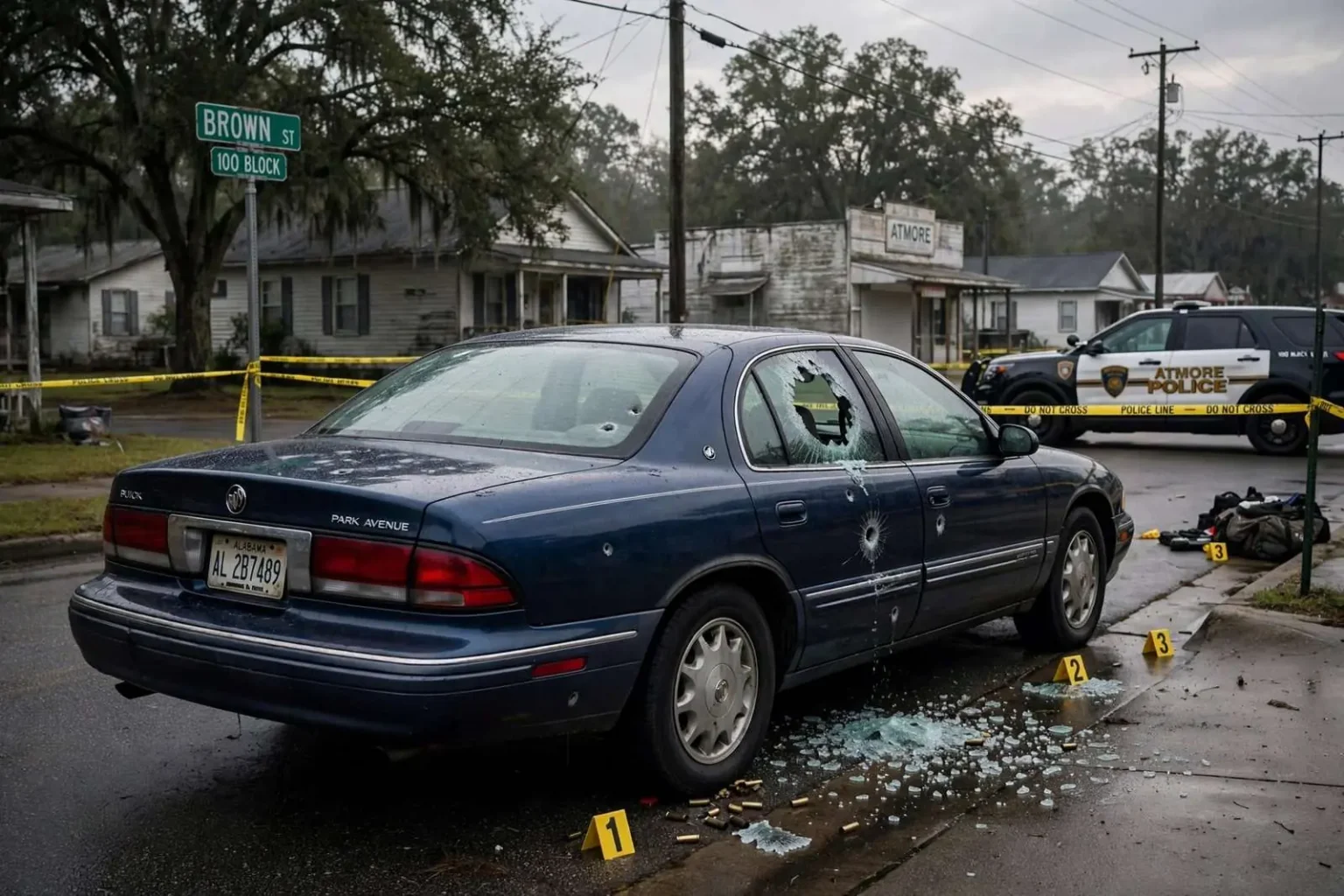
According to police, officers were dispatched to Atmore Community Hospital about 2 a.m. Monday regarding a gunshot victim. Police reported that the shooting itself occurred near the Brown Street area, and the resulting investigation led to Taylor’s arrest.
What Court Records Allege
According to court records, Taylor discharged a 9 mm handgun into a 1996 Buick Park Avenue at 168 Brown Street, striking the victim in the back.
Records state the victim then exited the vehicle and fled on foot, and that Taylor is accused of firing three more shots, striking the victim in the leg.
The sequence described in the records is what supports the two separate charges. Firing into the occupied vehicle is the basis for the shooting-into-an-occupied-vehicle count, a distinct offense under Alabama law. The allegation that additional rounds were fired at the victim after he left the car and was retreating on foot is what elevates the case to attempted murder rather than a lesser assault charge.
The Aniah’s Law Hearing
Taylor was originally given no bond and was scheduled to appear before District Judge Eric Coale on Thursday to determine whether he is entitled to bond.
Aniah’s Law is the Alabama constitutional amendment approved by voters that expanded the list of offenses for which a judge may deny bail outright. Attempted murder is among the offenses covered, which is why Taylor was initially held without bond rather than given a bond amount at booking.
The amendment does not automatically deny bail in covered cases. Instead, it establishes a hearing at which prosecutors may argue that no conditions of release would reasonably ensure public safety or the defendant’s appearance in court. The burden rests with the state, and the judge decides whether to set a bond or continue to hold the defendant without one.
That is the question that was before Judge Coale.
The Investigation
The case began at the hospital rather than at the scene — a common pattern in shootings where a wounded person is transported by private vehicle before police are called. Officers responding to Atmore Community Hospital at approximately 2 a.m. worked backward from the victim to establish where the shooting occurred, identifying the Brown Street area as the location.
That investigative path shapes what evidence is available. Scene evidence such as shell casings and vehicle damage is collected after the fact rather than secured immediately, and the timeline depends heavily on witness accounts and the victim’s own statement.
The Victim
The victim sustained two gunshot wounds — one to the back and one to the leg, according to court records. Police have not released his identity, and no information about his condition beyond the initial report was made available.
What Comes Next
If Taylor is denied bond, he will remain in custody pending further proceedings. If bond is granted, the amount and any conditions of release would be set by the court.
The case would ordinarily proceed to a preliminary hearing and then, if probable cause is found, to a grand jury for possible indictment. As with any criminal case, the charges are allegations, and Taylor is presumed innocent unless and until proven guilty.
South Alabama News will update this story as the case progresses through Escambia County courts.
Update: Multiple Divisions Worked the Scene
The Atmore Police Department has said Taylor is the only suspect in connection with the shooting.
Investigators from the department’s Criminal Investigation Division, Narcotics/Vice Division and Crime Scene Unit responded to actively investigate the scene and the circumstances surrounding the incident. That work culminated in Taylor’s arrest later in the day.
Deploying three separate units to a single shooting is a substantial commitment for a department of Atmore’s size, and it reflects a case that began at a hospital rather than at a scene — meaning the location, physical evidence and witness accounts all had to be established after the fact.
Police have not released the identity or medical condition of the victim.