Mobile Shopping Center Bomb Scare Found to Be Mechanical Issue in 2008
A 2008 WKRG report covered a Dauphin Street shopping-center response after a driver thought a ticking sound in his car was a bomb.
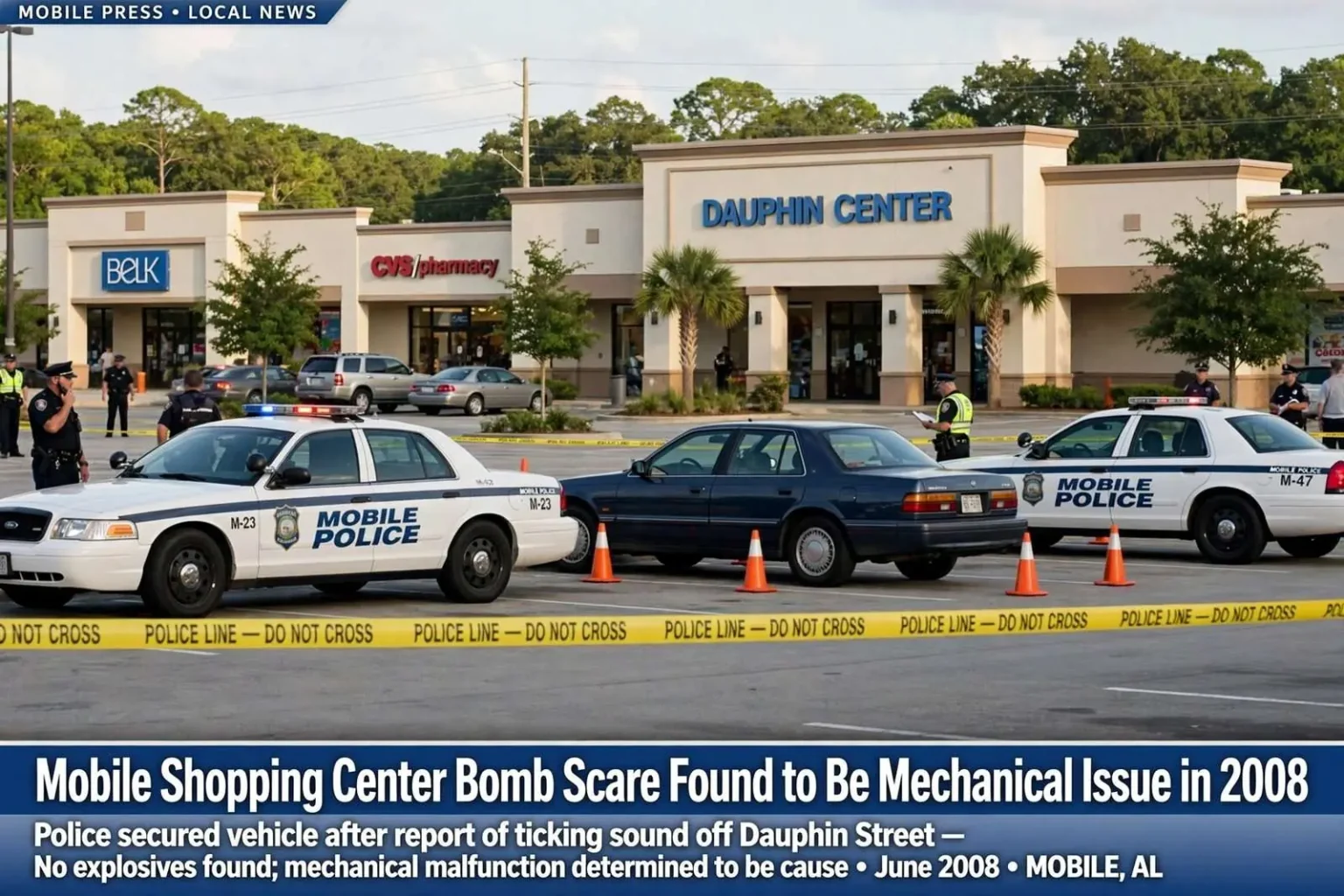
Mobile police responded to a report of a possible bomb in a car at a shopping center off Dauphin Street in June 2008, according to a local station. The driver told officers he believed someone had placed a bomb in his car because it was making a ticking sound.
The report triggered a response that followed the standard playbook for a possible explosive threat. Police secured the area, removed the driver from the vehicle, and emergency crews evaluated him. Once the vehicle was isolated and the driver cleared, officers were able to determine that no explosives were present — the sound, it turned out, had an ordinary explanation.
Police reported that no explosives were found and said the ticking sound was believed to be caused by a mechanical malfunction. A car engine, particularly an older one, produces a range of ticking and clicking noises: cooling-system relays after shutdown, exhaust components expanding and contracting, valve-lifter noise, or a heat shield rattling loose. To a driver already anxious, a rhythmic tick under the dash or hood can sound precisely like a timing device, and June in Mobile — with temperatures pushing vehicles’ cooling systems to their limits — offers plenty of reasons for a car to make unfamiliar sounds.
Vehicle-bomb scares occupy a particular place in police work because they compress every decision into minutes. Dispatchers gathering the initial report must extract the details that determine the response level — whether the vehicle is occupied, who reported it, what specifically was seen or heard, and whether the location is one where crowds gather. Patrol units arriving first establish control before specialized units arrive, and their early choices about distance and access shape everything that follows. In this case, the driver’s account of a ticking sound was specific enough, and the setting public enough, that a full precautionary response was the only defensible course.
How bomb threats are handled
Unattended vehicles and suspected explosive devices are among the most serious calls a police department receives, because the cost of treating one casually can be catastrophic. The protocol that Mobile officers followed in 2008 mirrors what departments across the country practice: establish a perimeter that moves people out of the potential blast radius, remove and evaluate anyone who was near or inside the vehicle, control access to the area, and only then approach and examine the car. Bomb squads and specialized units are called in when the threat cannot be quickly ruled out, and the scene remains restricted until they give the all-clear.
The driver’s removal from the scene served two purposes at once. First, it got him out of danger in the event the vehicle did contain a device — a precaution that is never skipped regardless of how implausible the threat seems. Second, it allowed emergency medical crews to evaluate him for injuries, and it separated him from the scene while officers gathered information about who he was, why he believed his car had been targeted, and whether the report pointed to anything beyond a mechanical quirk. The fact that officers took the time to evaluate him rather than treat the report as a false alarm reflects the seriousness with which such calls are worked from the first minutes.
The setting: Dauphin Street and the shopping center
The location added to the call’s significance. Dauphin Street runs east-west through Mobile, from the historic downtown core — where it anchors the city’s nightlife and entertainment district — westward into residential and commercial stretches lined with neighborhood shopping centers. A shopping center along Dauphin Street is exactly the kind of place where a suspicious-vehicle call carries real stakes: parking lots full of shoppers, adjacent storefronts, and through-traffic that would need to be diverted while the scene was secured. Securing the area meant closing off portions of the lot and street, and anyone in the vicinity that afternoon saw the response unfold in real time.
Mobile in 2008 was a city already familiar with emergency response at scale. The Gulf Coast’s hurricane history meant police, fire and emergency medical agencies in the region trained and drilled together regularly, and that coordination shows in incidents like this one — the seamless handoff between securing a scene, removing a person from danger and getting medical crews involved is exactly the interagency machinery that disaster planning builds. For the businesses around the shopping center, the disruption was temporary, but the visible police presence was a reminder of how quickly an ordinary afternoon can turn into a public-safety operation.
False alarms with real value
Communicating the outcome is the final step, and departments handle it deliberately. Once a threat is ruled out, authorities announce clearly what was found — in this case, a mechanical malfunction rather than a device — because accurate information is the antidote to rumor. Shoppers who were cleared out of a lot, employees who watched the response from behind locked doors, and neighbors who heard the sirens all want to know how it ended, and a prompt explanation prevents the story from growing in the retelling. In 2008, local news coverage played that role, reporting that no explosives were found and giving the community the same assurance the officers on scene had worked to establish.
Incidents that end with a mundane explanation still serve a purpose, and public-safety professionals are quick to make that point. A driver who believed his car had been tampered with did the right thing by reporting it rather than dismissing his own concern, and the police response validated both his caution and the public’s expectation that such reports get taken seriously. Departments consistently urge residents to report suspicious vehicles, packages or behavior rather than self-edit, precisely because the one call that matters cannot be distinguished in advance from the hundreds that turn out to be nothing.
The mechanics of the misidentification are worth understanding, too. Cars tick. Relays click as circuits cool, metal expands and contracts with temperature swings, and small components loosen over years of vibration. In an era when the public’s image of a bomb — shaped by movies and news coverage — is a device that ticks before it explodes, a rhythmic mechanical sound in a parked car is almost perfectly designed to trigger alarm. Bomb technicians responding to such calls routinely find batteries rolling in a trunk, a failing fuel pump, or, as in this case, a mechanical malfunction of the vehicle itself.
Shopping centers themselves have adapted to this environment over the decades. Security teams at retail centers across the Gulf Coast coordinate directly with local police, maintain camera coverage of their lots, and train employees to recognize and report the warning signs — an unattended car left in an odd location, a vehicle that circles repeatedly, a driver who seems out of place. That partnership between private security and public law enforcement is what made the 2008 response workable: the location was known, access points could be controlled quickly, and the businesses around the scene cooperated with the perimeter while officers worked the vehicle.
The 2008 context
The June 2008 call came during a period of heightened national awareness about vehicle-borne threats. The years following September 11, 2001, saw repeated attempted attacks involving cars and improvised explosives in the United States and abroad, and law enforcement agencies everywhere had incorporated vehicle-threat protocols into their training. Shopping centers, in particular, were identified in national security guidance as locations where such a device would cause maximum harm, which meant mall and shopping-center security teams across the country — including in Mobile — had reviewed evacuation plans and suspicious-vehicle procedures in the years before this incident.
For Mobile police, the episode was one more example of a routine afternoon in a Gulf Coast city: a call comes in, the response is executed, and the truth turns out to be ordinary. But the record of how it was handled is instructive. The area was secured before anyone approached the car. The driver was removed and evaluated. No assumptions were made in either direction — neither dismissing the report as paranoia nor escalating beyond what the situation warranted. The result was a resolution that took no chances with public safety while avoiding the kind of overreaction that turns a scare into a panic.
That balance — treating every threat as real until proven otherwise, while communicating clearly when it is not — remains the standard for handling suspicious-vehicle calls. Mobile residents who encounter a car, package or situation that seems wrong are still advised to keep their distance, avoid touching or moving the object, and call law enforcement rather than investigating themselves. The 2008 episode off Dauphin Street ended with nothing more dangerous than a car in need of a mechanic, but the habits it reinforced are the ones that protect a community when the next report is not so easily explained.
This is a historical summary of a 2008 public-safety response. It is not a current alert.