
Government Shutdown Impacts Mobile’s National Weather Service Office
As the federal government shutdown continues, Mobile's National Weather Service office remains staffed but is feeling the effects of the funding lapse.
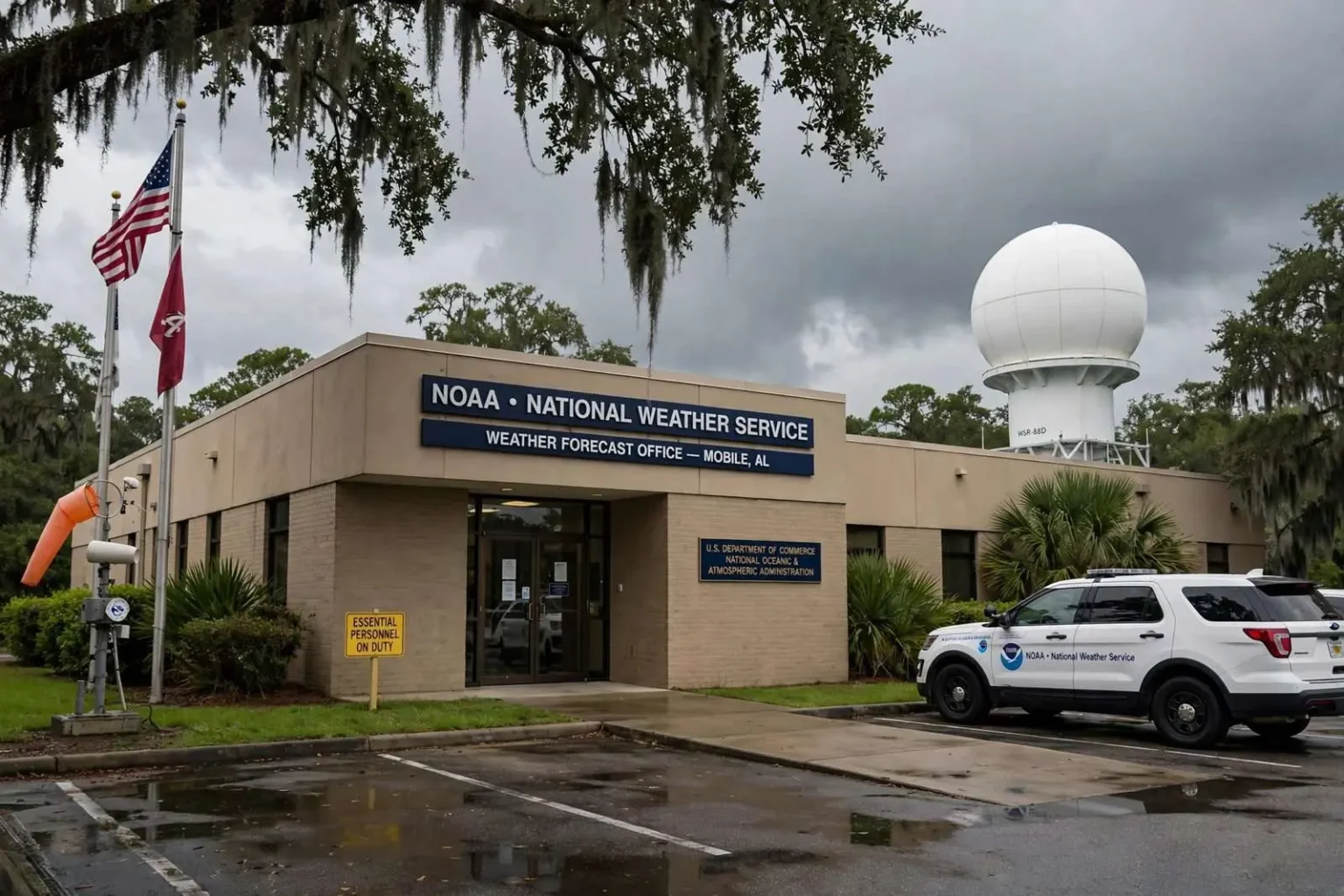
As the partial federal government shutdown reached its 27th day, thousands of Alabama workers were feeling the effects, either through furloughs or missed paychecks. The shutdown, the longest stretch of its kind in years, has touched federal employees across the state — from air traffic controllers and TSA officers to park rangers and research staff — with many working without pay and others sent home under furlough orders while negotiations drag on in Washington.
One agency feeling the squeeze is NOAA, the National Oceanic and Atmospheric Administration, and more specifically the National Weather Service. The Weather Service’s forecasting operations are deemed essential to public safety, which means its meteorologists and hydrologists keep working through a shutdown — but their paychecks do not keep arriving, and support staff and non-critical programs bear the brunt of the disruption. The longer the shutdown goes, the greater the strain on the agency’s workforce and the programs that sit behind the forecasts residents see every day.
Locally, that means the National Weather Service office in Mobile is being impacted. The office, responsible for forecasts and warnings across southwest Alabama and neighboring parts of the Florida panhandle, is one of the few federal operations in the region still fully staffed. Its forecasters continue to issue daily forecasts, can still put out warnings if needed, and would be able to survey damage if a storm were to move through — the core functions that keep residents informed and safe regardless of what is happening with the federal budget.
The distinction between “staffed” and “unaffected” is important. Forecasters in Mobile are working their regular shifts knowing the checks that should have arrived have not, a financial strain that touches mortgages, childcare and everyday expenses for families across the Gulf Coast. Stories of federal employees relying on food banks, delayed bills and short-term loans have become common in communities with a large federal presence, and the Gulf Coast is one of them, with Coast Guard personnel, federal law enforcement officers and civilian agency staff all affected.
What the public sees, meanwhile, looks much like normal. Forecasts for the Gulf Coast appear on time each morning, warnings go out the moment they are needed, and river, marine and beach forecasts continue to be updated. That continuity is by design: the National Weather Service’s mission is to protect life and property, and its forecasting operations are structured so that no budget dispute can interrupt them. Behind the scenes, though, the agency is running with the same people doing the same work — just without the certainty of when they will be paid.
What the Mobile office does
The National Weather Service’s Mobile office serves a corner of the country where weather is never a background concern. Its forecast area takes in the Alabama Gulf Coast, Mobile Bay and the delta region, inland counties across southwest Alabama, and a stretch of the Florida panhandle — territory that faces hurricanes in summer and fall, severe thunderstorms and tornadoes in spring and fall, and occasional winter weather that the Gulf Coast is uniquely unprepared to handle. The office also issues marine forecasts for the bay and coastal waters, where commercial and recreational boating is a way of life.
Forecasters there are the ones who decide when a tornado warning is issued for a Baldwin County subdivision, when a freeze warning goes out for the truck farms of south Alabama, and when rip current statements warn swimmers away from Gulf Shores and Orange Beach beaches. Damage surveys after tornadoes — the teams that fan out to rate a storm’s strength and map its path — are another critical function, one that determines everything from insurance claims to emergency management decisions. The office confirmed it would still be able to carry out those surveys even during the shutdown.
The cost of a shutdown nobody sees
The public-facing continuity masks slower-moving damage. During extended shutdowns, the Weather Service has historically had to curtail non-critical activities: routine training, some maintenance visits, long-term projects and community outreach all tend to slip. Hiring freezes mean vacancies go unfilled, stretching the forecasters who remain across shifts that were already demanding. Weather balloon launches, the twice-daily observations that feed forecasting models worldwide, have in past shutdowns been reduced at some offices — a small cut with measurable effects on forecast accuracy downstream.
For the families of the forecasters, the strain is immediate and personal. Federal workers affected by the shutdown range from the newest hires to career employees, and many live paycheck to paycheck like anyone else. Local businesses in communities with federal installations have stepped in with free meals, deferred payments and emergency assistance, and charitable organizations across the Gulf Coast have opened support programs for furloughed and unpaid workers. It is a strange position for employees whose jobs are deemed too essential to pause but not essential enough to pay.
Alabama’s federal workforce in the balance
The shutdown’s reach across Alabama extends far beyond the Weather Service. Thousands of the state’s federal employees — including workers at the state’s military installations, federal courthouses, the Marshall Space Flight Center in Huntsville and agencies scattered across the state — have been caught between furloughs and unpaid work. In the Huntsville area alone, thousands of NASA and contractor employees have faced disrupted pay, and across south Alabama the Coast Guard, which falls under the Department of Homeland Security, has been among the most visible examples of a workforce on duty without pay.
The economic effects compound locally. When thousands of households suddenly cut spending, restaurants, retailers and service businesses feel it within weeks, and communities with dense federal employment see the slowdown first. State and local officials have limited tools to intervene, since federal pay decisions rest entirely with Washington, but many have pushed for quick resolution while local organizations fill the gap with food drives and emergency funds.
Why weather forecasting is deemed essential
The National Weather Service’s exemption from shutdown furloughs is rooted in its role as the nation’s official source for severe weather warnings. Federal law and contingency planning treat the agency’s forecast and warning operations as necessary to protect life and property, so its meteorologists remain on duty even when most of their agency’s administrative and research sides are idle. The same logic keeps air traffic controllers and TSA screeners on the job — roles where an interruption would put public safety directly at risk.
For Gulf Coast residents, the practical takeaway during the shutdown is that the weather information they rely on has not gone anywhere. Forecasts, warnings and river and marine products continue as usual out of the Mobile office, and any resident with questions about an approaching storm can still count on the same alerts they received before the shutdown began. The people producing those forecasts are working without a paycheck, but the mission continues — through day 27 and, if necessary, beyond.
Negotiations in Washington will determine when the paychecks resume, and back pay for affected workers has historically followed once shutdowns end. Until then, the National Weather Service office in Mobile, like weather offices across the country, will keep doing what it does every day: watching the Gulf, watching the skies, and making sure the Gulf Coast knows what is coming.
How Gulf Coast offices have adapted
Veteran employees of the Mobile office have seen shutdowns before, and the agency’s contingency planning has refined how essential operations run during funding lapses. Offices across the country operate under detailed shutdown plans that spell out exactly which activities continue and which stop, ensuring that the forecast desk, the warning coordination functions and hydrology programs keep running. The plan also determines which employees are designated essential, which is why forecasters work while administrative support, outreach coordinators and some technical staff are furloughed.
The community role of the office continues in altered form as well. The meteorologists who would ordinarily visit schools, speak to civic groups and lead storm spotter training classes are among those whose public-facing work pauses during a shutdown — engagements that matter for preparedness in a region where a single hurricane season can reshape a coastline. Those activities resume once funding is restored, and the office’s warning coordination efforts return to their usual rhythm.
For the region’s emergency managers, continuity at the Weather Service is the linchpin of their own planning. County emergency management agencies along the Gulf Coast build their alerting, sheltering and response decisions around NWS forecasts and warnings, and a gap in that flow would ripple into every jurisdiction the Mobile office serves. The office’s assurance that it can issue warnings and conduct storm surveys on schedule is what allows those local partners to keep their own plans unchanged during the shutdown.
The end of the shutdown, whenever it comes, will bring its own wave of work: processing back pay, restarting deferred programs and digging out from the administrative backlog that accumulates when a workforce is running on emergency footing. For now, the Gulf Coast’s weather office carries on in the only mode it knows — open, staffed and watching the horizon.


