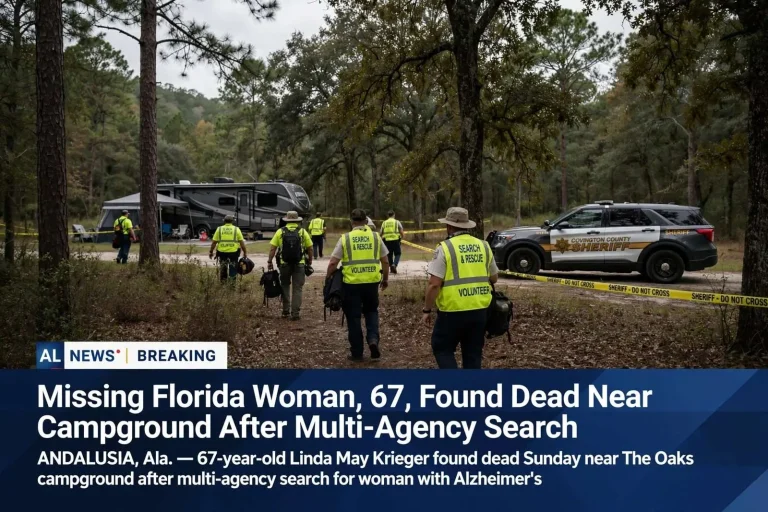
Two Missing Washington County, Florida Girls Found Safe, Sheriff Says
Two 7-year-old girls reported missing in Chipley, Florida, have been found safe, according to the Florida Department of Law Enforcement.
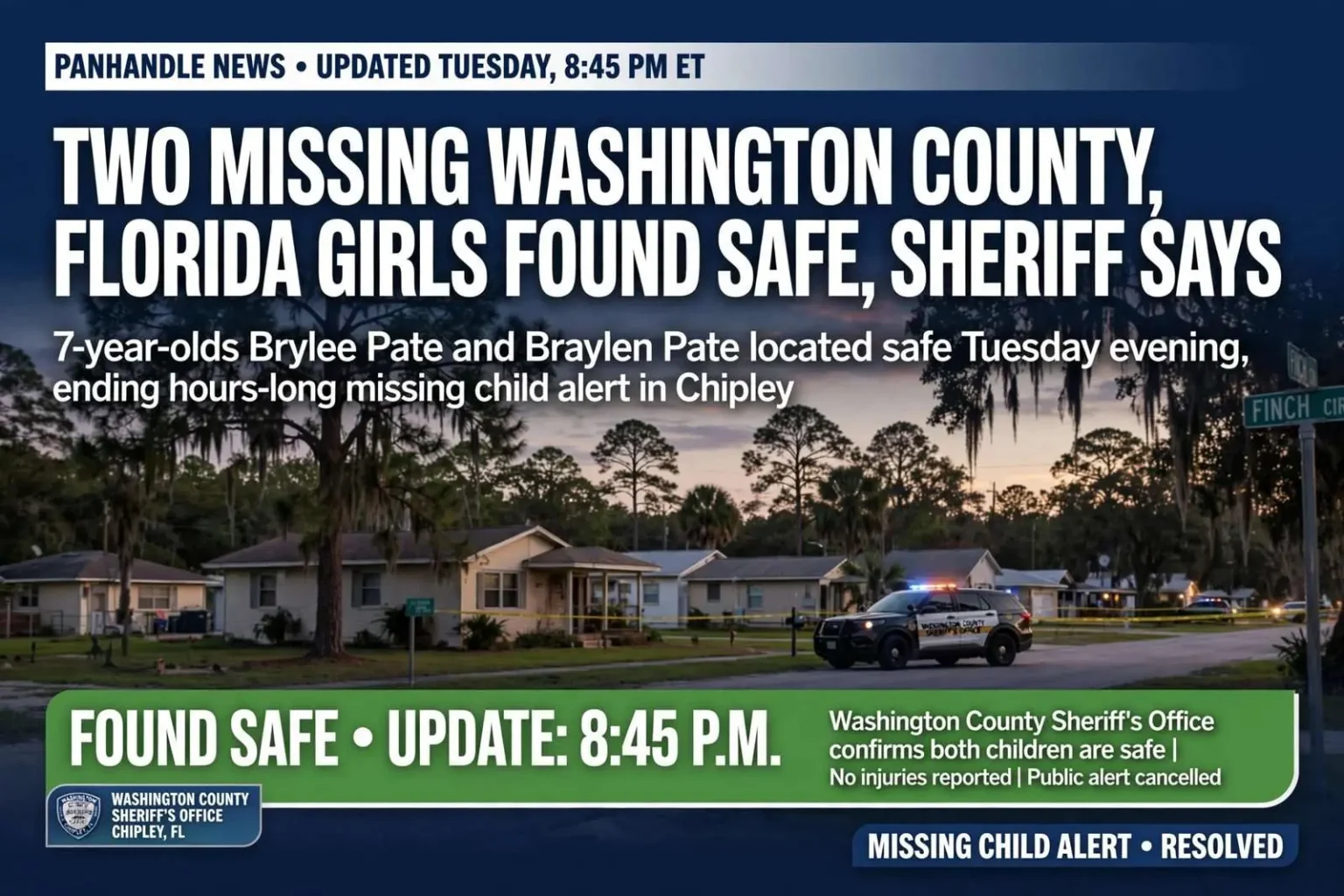
UPDATE (8:45 p.m.): According to the Florida Department of Law Enforcement, 7-year-old Brylee Pate and Braylen Pate have been found safe, ending an afternoon of worry across Washington County and the Panhandle.
Earlier Tuesday, a missing child alert had been issued for the two 7-year-old girls, sending the details of their disappearance to phones, television screens and highway signs across the region. The Washington County Sheriff’s Office said the girls were last seen in the area of the 2600 block of Finch Circle in Chipley, Florida, a residential neighborhood not far from the center of the small Panhandle city.
Investigators said the girls might have been with Vanessa Cotroman and could possibly have been traveling in a 2020 blue Nissan Altima. Those details — the possible companion and the vehicle — became the focus of the alert, because a vehicle description is the single most useful piece of information the public can act on when a child alert goes out.
How a missing child alert works in Florida
Florida runs one of the most developed missing child notification systems in the country. The Florida Department of Law Enforcement coordinates alerts that differ in scope depending on what investigators know. An AMBER Alert, the most urgent tier, requires evidence that a child has been abducted and is in imminent danger, and it triggers broadcast interruptions and highway dynamic signs. A missing child alert, the tier used in this case, covers endangered or missing children when the specific criteria for an AMBER Alert have not yet been met, and it pushes the child’s description to media outlets, law enforcement networks and the public.
Either way, the mechanism is the same at its core: get an accurate description of the children, anyone they might be with and any vehicle involved into the hands of thousands of eyes within minutes. In a county like Washington, with a population of roughly 25,000 spread across small towns and rural crossroads, that means every neighbor, passing motorist and store clerk becomes part of the search. Alerts distributed statewide also matter, because children and the people they are with can travel dozens of miles in an hour on Interstate 10, which crosses Washington County just south of Chipley.
The first hours are the most important in any missing child case. Sheriff’s deputies begin by canvassing the neighborhood where the children were last seen, interviewing family members and neighbors, and checking the immediate surroundings — sheds, wooded lots, drainage ditches and nearby homes. Simultaneously, information goes to FDLE, which can widen the alert and bring state resources, including regional investigators and communications support.
The response in Chipley
For the 2600 block of Finch Circle, the alert turned an ordinary Tuesday into an afternoon of concerned door-knocking. Residents of the neighborhood reported seeing deputies moving street by street, and the news spread quickly through Washington County’s close-knit community networks — church groups, school parents and the social media pages where small-town Florida follows local news in real time.
The Washington County Sheriff’s Office serves a county where rural distance shapes law enforcement. Deputies cover long stretches of two-lane roads connecting Chipley with communities like Vernon, Wausau, Caryville and Ebro, and mutual aid flows easily between the sheriff’s office, Chipley police and neighboring Holmes, Jackson and Bay county agencies when a child is involved. The 850-638-6111 number listed on the alert is the sheriff’s office main line, and it was staffed for tips as the search progressed, with 911 reserved for immediate sightings.
Investigators had two leads to work: the possible presence of Vanessa Cotroman with the girls and the possibility that they were traveling in a 2020 blue Nissan Altima. Vehicle descriptions drive the public side of the search, because thousands of people can spot a specific car long before any official can. That is why alerts repeat the vehicle details again and again, and why the found-safe announcement, when it came, closed the loop on every one of those searches.
What a found-safe announcement means
The 8:45 p.m. update brought the outcome everyone hoped for: both girls were found safe. In the world of missing child cases, that ending is not guaranteed, and law enforcement officials across Florida stress that the public’s role in alert response — reporting sightings, sharing accurate information and refraining from speculation — contributes directly to those good outcomes.
When children are located, the focus shifts immediately to their welfare. Deputies check the children for injuries or signs of mistreatment, reunite them with family or place them in protective care if circumstances require it, and follow up with investigators to understand how and why they ended up away from home. Details of the reunion and of any further investigation are typically not made public when minors are involved, which is why official updates often end with the single sentence that matters most: the children are safe.
The Washington County Sheriff’s Office and FDLE did not release additional information about the circumstances of the disappearance in the initial found-safe announcement, and agencies generally decline to discuss specifics involving young children. What the community saw was the simplest possible resolution: an alert that went out in the afternoon was answered by nightfall.
Washington County and its small-town network
Washington County sits in the middle of the Florida Panhandle, a rural county of small farms, pine forests and tight-knit towns along the Interstate 10 corridor between Tallahassee and Pensacola. Chipley, the county seat, is a city of a few thousand residents where word travels fast and where a missing child alert is felt personally — everyone knows someone with young children, and everyone understands the fear those hours hold for a family.
The county’s position on I-10 cuts both ways. It gives residents convenient access to the Panhandle’s larger cities, and it gives any missing persons case a wide geographic footprint, since a vehicle can be in Bay County, Dothan or Tallahassee within an hour or two. That reality is baked into how Panhandle law enforcement handles missing children: local deputies secure the home area while state alerts cover the region, on the assumption that the search may not stay within county lines.
Area agencies practice for exactly this kind of incident. School resource officers can account for enrolled children quickly, deputies know the families and addresses in their patrol zones, and FDLE’s regional operations center in Panama City coordinates the state-level response. The system is designed so that a report taken on Finch Circle within minutes becomes a description on screens across Florida.
A reminder for families
Episodes like Tuesday’s alert-and-resolution are also occasions when sheriffs’ offices repeat familiar prevention advice: know where children are at all times, keep current photographs available, and report a child’s absence immediately rather than waiting. There is no waiting period in Florida to report a missing child, and investigators consistently say early reports give them the best chance of a quick, safe recovery.
Residents who see future alerts are asked to read the vehicle and description details carefully, share them accurately and call in anything that matches. Tuesday’s outcome — two 7-year-olds found safe the same day — is what that cooperation is for, and Washington County got to see it work from the first alert to the last update.
Behind the scenes of a child search
While the public sees the alert and the outcome, the intervening hours are a dense coordination effort. A command structure forms quickly: a case investigator takes charge of the timeline, deputies are assigned to canvass and interview, and communications staff manage the flow of tips so that every sighting report is run down and logged. Family members are interviewed early and repeatedly, not out of suspicion but because they know the children’s habits, recent moods and possible destinations.
Technology plays a growing role. Reverse 911 and wireless emergency alerts push notifications to phones in the search area, school notification systems can reach parents across a county, and law enforcement databases let agencies in neighboring counties see the alert details instantly. Social media accelerates all of it, for better and worse — accurate shares multiply the search force, while rumors can send deputies chasing bad leads, which is why agencies ask the public to repeat only what official alerts contain.
The people who answer tip lines are trained for the variety of what comes in: a motorist sure they saw the car, a neighbor remembering an earlier sighting, a relative with a suggestion about where to look. Each call is passed to investigators who decide what to check first. In a case that resolves the same day, many of those follow-ups are still in motion when the found-safe call comes in, and they are stood down as quickly as they were launched.
Closing the loop with the public
Agencies across the Panhandle make a point of announcing recoveries as promptly as cancellations. An alert that goes out statewide and is never resolved leaves a lingering unease, and it trains the public to wonder whether every subsequent alert is worth acting on. Closing the loop — “the children have been found safe, thank you for your help” — keeps the system credible, and credibility is what makes thousands of strangers read the next vehicle description carefully.
Tuesday’s case in Chipley ended with that announcement, attributed to the Florida Department of Law Enforcement, confirming that Brylee Pate and Braylen Pate were safe. For the neighborhood on Finch Circle, for the deputies who spent the afternoon knocking on doors, and for everyone across the Panhandle who read the alert and kept an eye on blue Nissan Altimas, it was the resolution those systems exist to produce.