Mobile Police Reported 2008 Azalea City Credit Union Robbery
Mobile Police said two armed, masked men robbed the Azalea City Credit Union on Dauphin Street on April 21, 2008, according to an archived WKRG update.
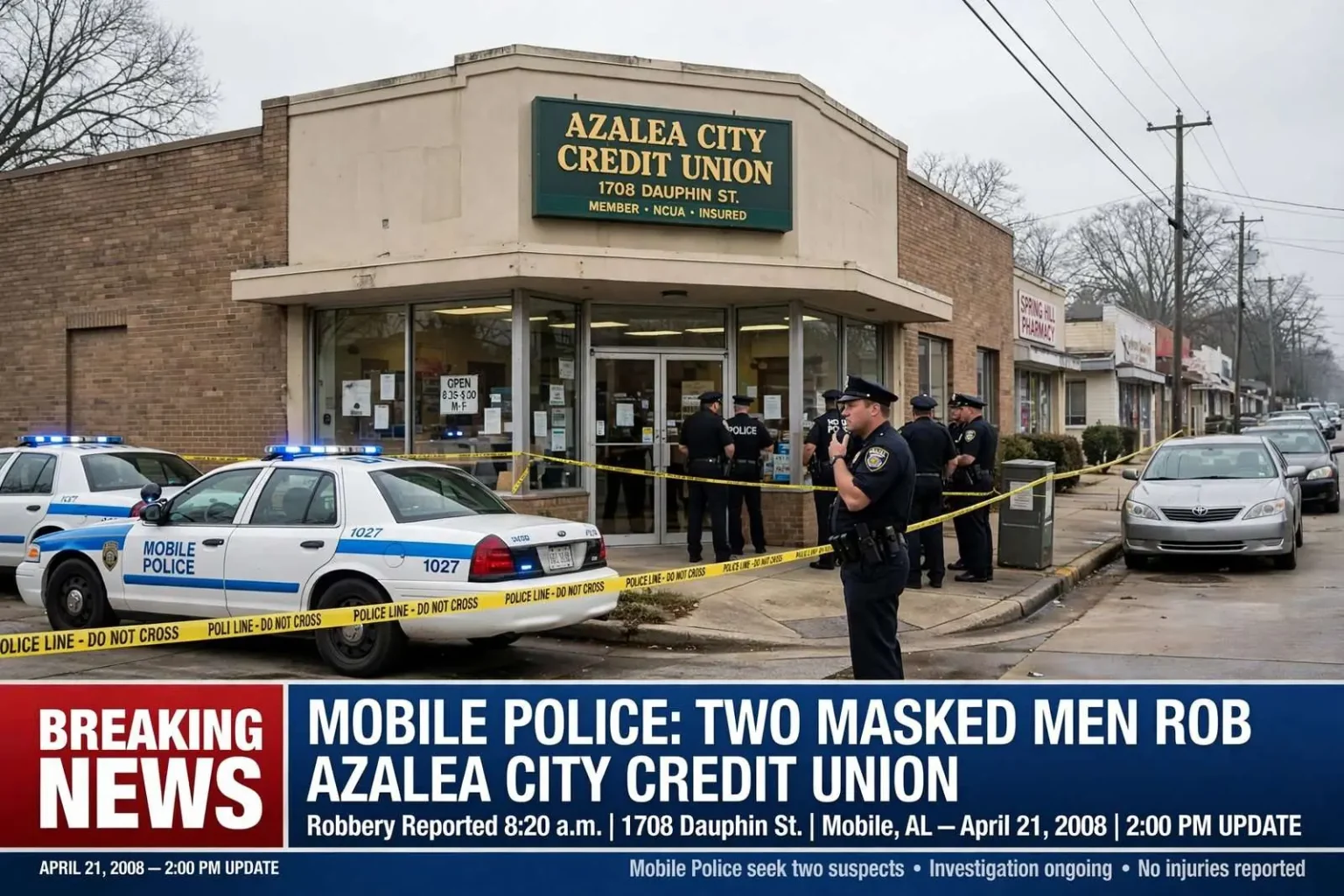
Originally reported April 21, 2008. This article records a historical crime report from archived local news coverage; the time-limited request for tips in the original is not presented as a current alert.
Mobile Police said two armed, masked men robbed the Azalea City Credit Union at 1708 Dauphin St. on the morning of April 21, 2008. In its 2 p.m. update that day, the local station reported that the robbery occurred about 8:20 a.m., near the start of the business day, when the credit union’s Spring Hill Avenue corridor branch would have been opening to early customers. Police described the two suspects as Black men in their early 20s, both about 5 feet 11 inches tall, wearing ski masks and hooded sweatshirts during the robbery.
The report was a same-day breaking-news update, assembled in the hours after the robbery as detectives worked the scene and interviewed witnesses. It reported that the men were being sought at the time, but the archived account does not state whether anyone was later identified, arrested, or convicted in connection with the holdup. What remains is the record of the morning itself: a credit union branch on Dauphin Street, two armed and masked robbers, and a police department beginning the search before most of the city had heard the news.
The scene of the robbery
The 1700 block of Dauphin Street sits in Mobile’s Spring Hill commercial corridor, a stretch of the historic avenue lined with small businesses, banks, and professional offices serving the surrounding neighborhoods. A credit union branch differs from a bank in its membership structure — serving depositors tied to a common bond such as an employer or community group — but on a weekday morning it operates much like any financial institution, with tellers, members, and cash drawers that make it a target for armed robbery. A robbery shortly after 8:20 a.m. would have caught staff and any early members by surprise at the beginning of the day’s business.
Armed robberies of financial institutions set off a predictable and urgent police response. Officers secure the scene and check for injuries, canvass the neighborhood for witnesses, and collect surveillance footage from the branch and neighboring businesses, while federal partners become involved because bank and credit union robbery is a federal offense investigated alongside local police. Investigators work quickly in the first hours, knowing that suspects who flee on foot or by car can cover ground fast in the traffic of a morning commute.
How such robberies are investigated
In a case like the 2008 holdup, detectives would pursue several standard avenues. Witness descriptions — here, two Black men in their early 20s, about 5 feet 11 inches, in ski masks and hooded sweatshirts — are cross-checked against known offenders and against tips called in after media reports. Surveillance video from the branch, nearby shops, and traffic cameras is reviewed for the suspects’ arrival and getaway. Physical evidence from the scene, from notes to threats made during the robbery, is preserved, and investigators look for patterns connecting the crime to other area robberies, since robbers of financial institutions often strike repeatedly.
Because credit unions are insured federally, the FBI has jurisdiction in such robberies and typically works them jointly with local police. Cases can move in unexpected ways: a suspect identified weeks later through a tip, a pattern caught by an analyst linking several holdups, or an arrest made on an unrelated charge that closes the case as a byproduct. The archived 2008 report closes before any of that, which is why the historical record shows the search underway but no outcome.
Mobile’s Dauphin Street corridor
The robbery took place along one of Mobile’s oldest and most traveled arteries. Dauphin Street runs east to west across the city, from the bars and storefronts of the downtown entertainment district through midtown’s commercial strips and into the Spring Hill Avenue area’s residential and small-business neighborhoods. The 1700 block, where the credit union branch stood, sits among the midtown businesses that generations of Mobilians have used for banking, groceries, and services — the kind of block where employees and customers know each other by name and where a sudden robbery rattles a community as much as a ledger.
By 2008, the corridor had seen the changes reshaping American midtowns: some businesses departing for the suburbs, others hanging on, and neighborhood associations working to keep the strips viable. A daytime armed robbery at a neighborhood financial institution drew attention precisely because it violated the sense of ordinary safety that such blocks depend on, and same-day coverage in the local media reflected how seriously the community took it.
Credit unions and their communities
Azalea City Credit Union, as its name suggests, served a Mobile-area membership from its Dauphin Street location. Credit unions play a distinctive role in the financial life of cities like Mobile: they are member-owned nonprofits, often serving people connected to a particular employer, union, church group, or community, and they frequently provide accounts and loans to working families whom larger banks have historically underserved. A robbery at a credit union therefore strikes a small institution with a close-knit membership, where tellers may know depositors by name and the loss of a sense of security is felt personally.
The financial impact of a robbery on such an institution extends beyond the cash taken. Insurance claims, security upgrades, and the emotional toll on staff — who are trained to comply during a holdup precisely because their safety matters more than the money — follow in the days and weeks after. Institutions that experience armed robberies often reopen within a day or two, a return to routine that is itself a statement to the neighborhood.
The breaking-news record
The 2008 report survives as an example of same-day breaking news in the era before social media dominated such coverage. A station’s mid-afternoon update — the 2 p.m. report that corrected the timeline to about 8:20 a.m. and added suspect descriptions — represented the news cycle working in real time: initial word of an armed robbery, followed by police briefings that filled in details as detectives confirmed them. Residents who saw the morning alert checked the afternoon update to learn what police knew and whether anyone was in custody.
Archived reports like this one preserve the law enforcement record as it stood at a moment in time. They carry the descriptions police released, the timeline they established, and the appeals for tips they made, but they cannot tell readers what happened afterward — whether the ski-masked pair were ever caught, whether any case was made, or how the branch and its staff fared in the years since. This article retains that historical account as it was reported on April 21, 2008, without suggesting that the suspects described remain at large or that the case is an open matter today.
Armed bank robbery as a federal crime
One reason investigations of credit union and bank robberies proceed the way they do is the structure of the law itself. Robbery of an insured financial institution is a federal crime, and the FBI investigates alongside local police, with federal prosecutors able to pursue charges that carry substantial prison terms. That partnership brings resources to a case like the 2008 Dauphin Street holdup — federal agents, laboratory support, and databases that track serial robbers across jurisdictional lines — and it means the case does not end at the city limits if the suspects flee.
The penalties are severe by design. Federal sentencing for armed bank robbery runs to decades in prison, with enhancements for brandishing or firing a weapon and for taking hostage-like actions during the crime. Prosecutors and investigators use that weight deliberately, both to incapacitate repeat offenders and to deter the small number of criminals who target financial institutions, which is why arrests in such cases are often announced jointly by the local police chief and the FBI’s local field office.
What witnesses and the public can do in such cases
The investigative playbook depends heavily on the public. Descriptions released to the media — like the ones in the 2008 report — exist to jog memories: someone who saw two men in hooded sweatshirts in the neighborhood that morning, a worker who noticed a car idling oddly near the branch, a resident whose home security camera caught the getaway. Tips flow into police departments and the FBI through phone lines and, in later years, online forms, and anonymous tipsters can qualify for rewards offered through crime-stopper programs in the Mobile area.
Law enforcement guidance in an active robbery is equally clear: people nearby should stay away from the scene, not follow suspects or attempt to intervene, and call 911 with details while memories are fresh. Employees of financial institutions are trained to comply with demands, activate silent alarms when safe, and observe carefully — details like height marks on door frames, clothing, speech, and direction of flight have solved many cases. The first hour after a robbery is critical, which is why the same-day coverage in 2008 emphasized that the men were being sought while the trail was fresh.
Preserving the historical record
Articles like this one serve readers differently than breaking news does. The original April 2008 report was written to be acted on: it asked the public to watch for two specific suspects and to call in tips. Fifteen years on, its value is as a record — of the crime, the response, the neighborhood’s institution, and the way Mobile’s newsrooms covered a frightening morning in midtown. Read today, it documents a moment in the life of Dauphin Street and the work of Mobile Police on a case whose ultimate outcome the archive does not preserve.
That limitation is worth stating plainly, because historical crime reporting can mislead if read as current news. The archived account does not establish that the case was unsolved, that the suspects were never caught, or that danger persisted on Dauphin Street; it simply records what was reported on the day of the robbery. The credit union branch, the block, and the corridor have all continued to change in the years since, as Mobile’s midtown has grown and evolved around them.