Mobile Residents Faced Tax Day Filing Deadline in 2008
A 2008 WKRG report noted the tax filing deadline for Mobile-area residents and outlined possible penalties for filing late.
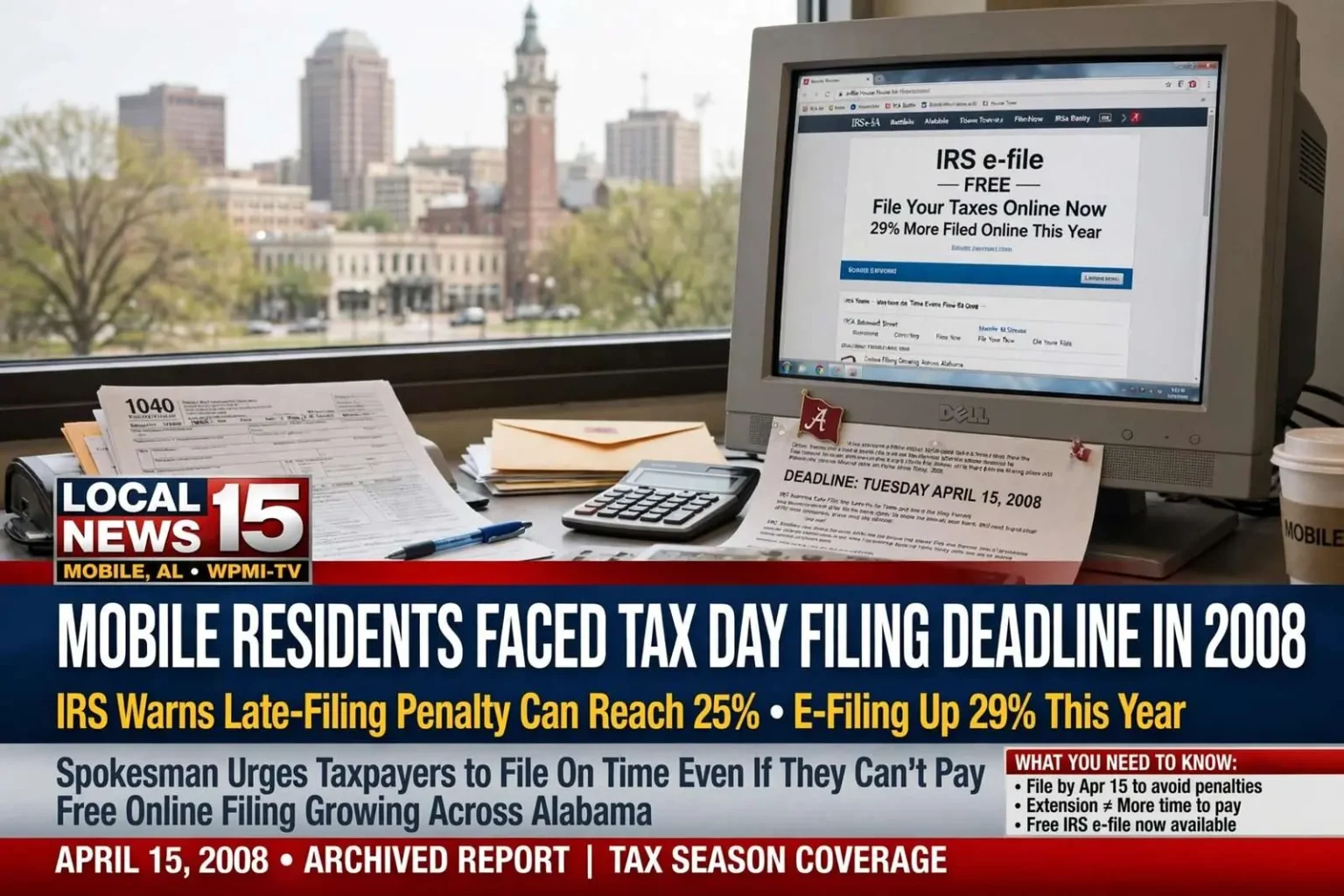
Mobile-area taxpayers faced the annual federal tax filing deadline in a 2008 local news report that preserved the practical warnings of the season. The story, from an archived broadcast of the April filing period, centered on advice from the Internal Revenue Service about what happens to taxpayers who miss the deadline, and on the growing number of Alabamians who were choosing to file their returns electronically rather than on paper.
IRS spokesman Dan Boone said the late-filing penalty could reach as much as 25 percent of the amount owed on a return. That figure described the accumulation of monthly charges assessed against taxpayers who neither filed on time nor sought an extension, and it made the deadline a matter of real money rather than paperwork ceremony. The warning was aimed squarely at procrastinators: filing late without arranging anything with the IRS is the most expensive way to handle a delay.
The report also said use of the IRS free online filing service had risen 29 percent that year. The increase reflected a shift that was transforming tax season across the country, as electronic filing moved from a novelty to the default way Americans submitted their returns, and as the government’s free-filing option made that route available to taxpayers who did not want to pay for commercial software or a preparer.
Why the late-filing penalty is steep
The penalty structure that Boone described in 2008 was built to give taxpayers a strong reason to file even when they cannot pay. The failure-to-file charge accumulates month by month on unpaid balances, and by the time it reaches its maximum of 25 percent of the amount owed, a delayed return has become significantly more expensive than the taxpayer ever intended. Filing on time, by contrast, caps the exposure and starts the clock on any payment arrangements.
The distinction between filing and paying is the point that IRS spokespeople make every filing season. Taxpayers who owe money but cannot pay in full by the deadline are generally better off filing the return on schedule and contacting the IRS about payment, because the penalty for not filing is substantially harsher than the consequences of owing with a return on file. Interest continues to accrue on unpaid tax either way, but the compounding penalties that Boone warned about apply most severely to returns that never arrive.
Extensions complicate the picture for many filers. Requesting more time to file gives a taxpayer additional months to prepare the paperwork, but it does not extend the date on which payment is due. A taxpayer who files an extension in April and pays nothing still owes interest, and potentially penalties, from the original deadline forward. The 2008 report’s emphasis on the 25 percent ceiling was a reminder of how quickly a postponed tax season becomes a costly one.
Electronic filing comes of age
The 29 percent rise in use of the IRS free online filing service captured an inflection point in American tax administration. Through the 2000s, electronic filing had grown steadily from a service used by professional preparers into something individual taxpayers managed themselves from home computers. By the 2008 filing season, the shift was visible in the numbers, and Mobile-area filers were part of it.
Electronic filing offered advantages that the IRS promoted and taxpayers discovered quickly. Returns filed electronically are processed faster, refunds arrive in days or weeks rather than the months that paper processing could take, and the software catches many of the arithmetic and entry errors that slow down mailed returns. Confirmation that the IRS received a return eliminated the uncertainty that accompanied a sealed envelope in the mail.
The free-filing option added access to those benefits for taxpayers who met the program’s eligibility terms. A partnership between the IRS and participating software companies made free preparation and filing available to qualifying filers through the agency’s website, and rising usage figures like those in the 2008 report showed that word was spreading. For households watching their budgets in a difficult economic year, a free and faster path to a refund had obvious appeal.
Why the 2008 filing season mattered locally
The timing of the 2008 report gave its subject extra weight on the Gulf Coast. The filing deadline arrived in a year when the economy was visibly weakening, and the season coincided with the federal economic stimulus program, which sent rebate payments to eligible taxpayers who had filed a return for the prior year. Filing, in other words, was not only a legal obligation that spring; it was the gateway to money many Mobile households were counting on, which made the warnings about missing the deadline more consequential than usual.
The region’s taxpayers also carried the aftermath of the 2005 hurricane seasons in some of their filings. Disaster-related deductions, insurance settlements and rebuilding expenses had complicated returns for families and businesses across the Alabama coast in the years after the storms, and the 2008 season continued that pattern for taxpayers still sorting out recovery-related tax questions. Local IRS outreach and volunteer assistance programs existed in part to help filers navigate exactly that kind of complexity.
For wage earners with simpler returns, the practical questions were the ordinary ones: where to find help, whether to file electronically, and what to do if the numbers did not work out by the deadline. The 2008 report answered the last of those with the IRS spokesman’s warning about penalties, and it pointed the others toward the free online option whose adoption was climbing that year.
Getting help in the Mobile area
Filing-season assistance in the Mobile area came through the channels that the IRS and its partners maintain in communities across the country. Volunteer programs staffed by trained helpers provide free return preparation for qualifying taxpayers, particularly seniors and households with modest incomes, and IRS offices and outreach events extend the agency’s reach during the crunch weeks before the deadline. Those services matter most to the filers least able to absorb a 25 percent penalty.
Preparers and tax professionals in the area absorbed much of the local volume as well. For taxpayers with rental property, small business income or the aftermath of a disaster, professional preparation was the established route, and electronic filing had become standard practice inside those offices years before it dominated do-it-yourself filing. The rising free-filing numbers in 2008 represented the second wave: individual filers moving online on their own.
The report’s local audience faced the same April calendar as filers nationwide, but the stakes on the Gulf Coast in 2008 were sharpened by the economy. A refund, a stimulus payment or simply the avoidance of a compounding penalty carried more weight in household budgets that spring, which is why a local station devoted airtime to a spokesman’s warning about a penalty ceiling and a statistic about online filing.
The historical record and today’s rules
The archived report preserves a snapshot of the 2008 filing season: an IRS spokesman named Dan Boone, a warning that late-filing penalties could reach as much as 25 percent of the amount owed, and a 29 percent rise in use of the IRS free online filing service. Those details describe tax administration as it stood then, and the article retains them as local historical coverage of that filing season.
Tax rules, deadlines and filing options have changed in the years since, as they do continually. Penalty structures, filing dates, free-filing eligibility and electronic services are all subject to revision, and the specific figures quoted in 2008 should not be relied on for present-day decisions. Readers with current tax questions should consult present-day IRS guidance or a qualified tax professional rather than the archived numbers.
What endures from the 2008 report is the advice at its core, which has stayed consistent across filing seasons: file on time even if you cannot pay, ask about arrangements rather than simply not filing, and take advantage of free electronic options if they fit your situation. The deadline that Mobile-area taxpayers faced in 2008 returns every spring, and so does the arithmetic that makes meeting it worthwhile.
What missing the deadline actually costs
The 25 percent ceiling that IRS spokesman Dan Boone cited in 2008 is best understood through the way those charges accumulate. A taxpayer who ignores the deadline accrues penalties month after month on the unpaid balance, and the total climbs toward its maximum over the months that follow. On a return with a substantial balance owed, reaching that ceiling means paying a quarter of the tax bill again in penalties, before counting the interest that runs alongside the penalties.
The contrast with filing on time is what the IRS emphasizes each season. A return filed by the deadline, even one accompanied by no payment at all, avoids the harshest charges and opens the door to installment arrangements and other options the agency offers to taxpayers who engage with it. The filing, in this sense, is the taxpayer’s best protection; the deadline penalizes silence, not just debt.
Local tax preparers in Mobile and across Baldwin and Mobile counties spent the final days of each April fielding exactly these questions. Their standard counsel mirrored the spokesman’s: send the return, or an extension, and communicate with the IRS about anything unpaid. The taxpayers who ran up the largest penalty totals were rarely the ones who owed the most; they were the ones who let the calendar pass without filing anything at all.
Looking back on the 2008 season from the present
Reading the 2008 report today is a look at a tax system in transition. The 29 percent jump in free online filing marked the moment when individual electronic filing stopped being an early-adopter behavior and became the mainstream, a transition completed in the years that followed as paper returns dwindled. The penalty warnings, by contrast, have a timeless quality: the same April advice appears in every era’s coverage, because the deadline and its costs never go away.
For Mobile-area readers, the report is also a record of the community’s economic moment. The spring of 2008 brought recession anxieties, a federal stimulus program, and households still working through the aftermath of the 2005 hurricanes, all of which converged on a routine annual task. The local news value of an IRS spokesman’s warning lay in that convergence.
The article preserves the archived report as historical coverage. Tax law changes constantly, and no figure in the 2008 story, neither the penalty ceiling nor the usage statistic, should be treated as current guidance. Present-day filers should rely on current IRS publications and deadlines, and should remember the one lesson of 2008 that has never changed: the cheapest way through tax season is to file on time.