Suspended Judge Ordered From His Home as Wife Files for Divorce
A judge ordered suspended Clarke County Circuit Judge Stuart DuBose to vacate his Jackson home and barred him from threatening his wife, their daughters or her attorney, then sealed the file and stepped aside.
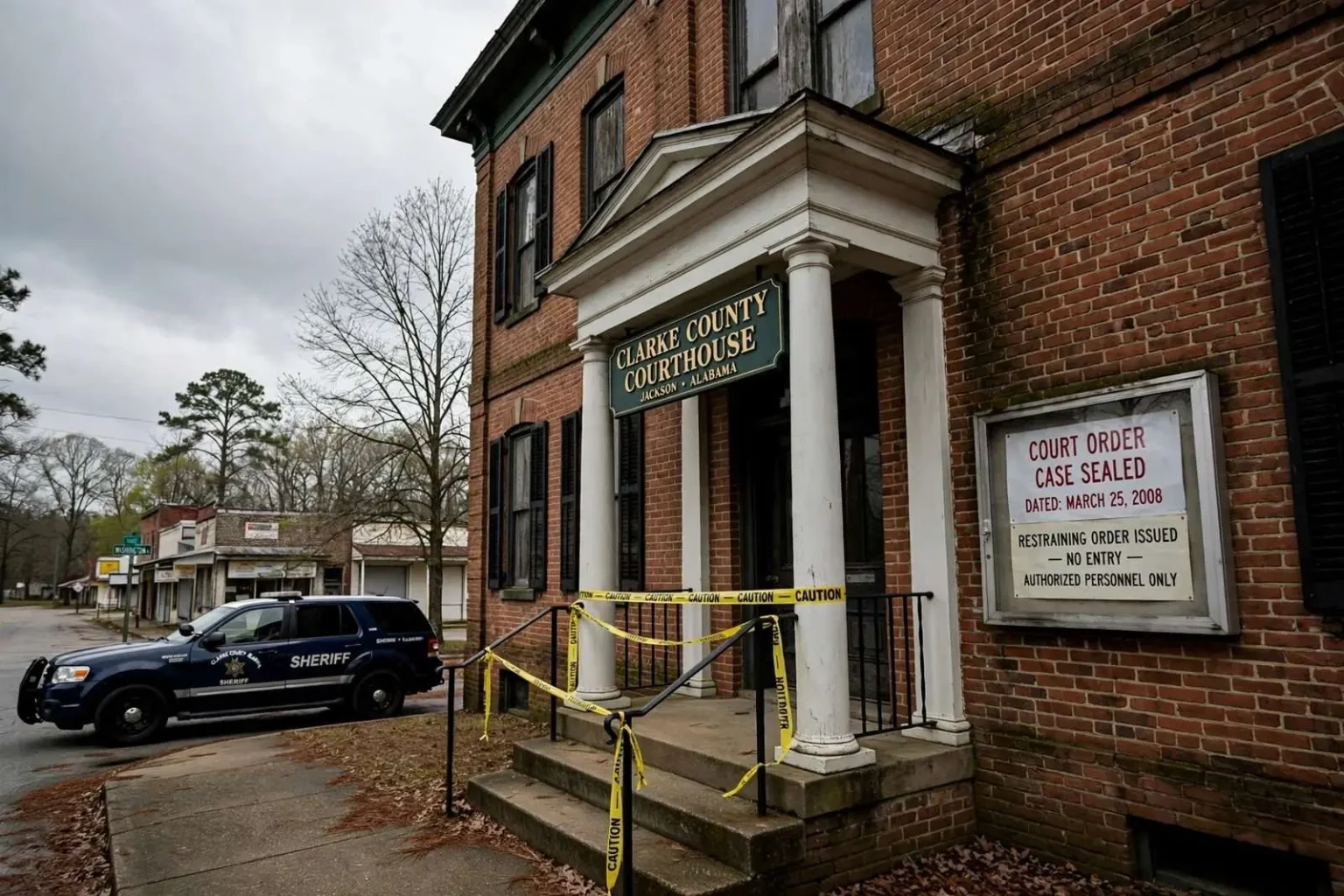
Suspended Clarke County Circuit Judge Stuart C. DuBose was ordered on Tuesday, March 25, 2008, to vacate his home in Jackson and was warned against “intimidating, threatening, hurting, harassing or in any way putting” his wife, their two daughters or her attorney in fear of their lives.
Judge Thomas Baxter issued the order in connection with a divorce petition filed the same day by Allyson T. DuBose. Her allegations, Baxter ruled, appeared to justify a restraining order against the judge. The order added a personal legal crisis to a professional one: DuBose was already suspended from the bench, already facing a 60-charge ethics complaint, and now stood before a family court with his marriage and his access to his own home in dispute.
The file is sealed
Baxter ordered the case file sealed, along with the transcript of the hearing that produced the order, with the sole exception that the proceedings remain available to DuBose and his attorneys. Sealing family-court records is common in Alabama divorces, where allegations about children, finances and private conduct are routinely kept from public inspection; here it also kept the newest chapter of a very public saga behind a courthouse counter.
Having issued the orders, Baxter then recused himself from any further action in the case and asked the Alabama Supreme Court to assign another judge — a necessary step, given that Baxter was the presiding judge of the same circuit in which DuBose sat, and that the parties, lawyers and courthouse staff all knew one another. Small-circuit judicial recusals work that way: in a three-county circuit, the pool of judges qualified to hear a matter involving one of their own is the pool of judges who work down the hall from him.
The wife’s attorney, from Spanish Fort, declined to comment on pending litigation. One of DuBose’s lawyers was not immediately available. With the file sealed and the lawyers quiet, the public record of the day’s events amounted to the orders themselves — a vacated home, a restraining order and a change of judges.
A case closing in from two directions
The divorce petition and the restraining order arrived almost simultaneously with a new demand in the judicial ethics case that had already cost DuBose his courtroom. Attorneys for the Alabama Judicial Inquiry Commission asked that DuBose respond within seven days to questions about his claim of diminished capacity. The commission argued it was entitled to know who had evaluated or treated him for the impairing condition his lawyers had described — a demand aimed at the heart of the defense, since an unsubstantiated capacity claim cannot be tested without the treating professionals.
Two weeks earlier, DuBose had answered the commission’s 113-page, 60-charge complaint by denying every count while asserting that he had suffered from diminished capacity that affected his ability to make rational decisions throughout the period covered by the allegations. His attorneys said treatment and evaluation of his mental and physical health were ongoing and reserved the right to supplement his defense.
The prosecutor assigned to the case — a former district attorney serving as a supernumerary prosecutor — had noted how rarely such a defense is raised, and the prosecution contended that diminished capacity was not an acceptable defense to the charges at all. In judicial discipline, where the question is fitness for office rather than guilt of a crime, the argument ran, a judge either did the things described in the complaint or he did not; a diagnosis could explain conduct but not erase it. The JIC’s demand for the names of treating professionals was the procedural next step in that fight.
How the saga unfolded
DuBose had taken office roughly 14 months earlier, in January 2007, after winning a bitterly contested 2006 Democratic primary against another Jackson attorney and facing no Republican opponent. In a solidly Democratic circuit — Choctaw, Clarke and Washington counties, Alabama’s 1st Judicial Circuit — the primary was effectively the election, and the campaign had been fought hard across three rural counties where a circuit judgeship is among the most powerful offices on the ballot.
Grievances from his private practice followed him onto the bench and produced a jurisdictional standoff between the Alabama State Bar and the state Supreme Court over who had authority to discipline him. The dispute — which forum, bar grievance committee or Supreme Court, could act on a sitting judge’s pre-bench conduct — delayed accountability while the underlying complaints accumulated, a wrinkle in Alabama’s overlapping disciplinary systems that the DuBose case would eventually force the courts to untangle.
His conduct as a judge generated the complaint that ultimately mattered. Investigators gathered testimony that he had stewed publicly about Mobile judges and lawyers he believed were conspiring against him, that he had told colleagues “people who are trying to get me” would not find him going gently into that good night, and that he had described his own capacity for retaliation in language too coarse to reproduce. The pattern described in the testimony — grievance-driven, conspiratorial, threatening in tone — formed the core of the commission’s case that the judge was unfit for the courtroom he commanded.
He remained suspended with pay, drawing his salary while judges borrowed from Washington, Choctaw, Monroe and Marengo counties covered his docket. The borrowing arrangement is the standard remedy when a circuit loses a judge mid-term: neighboring circuits lend trial judges, the docket keeps moving, and the taxpayers of the affected circuit continue paying a suspended salary for a judge who cannot sit. In Jackson, Grove Hill and Chatom, the practical effect was a courthouse operating on loaned authority for months.
The end
The case went to trial before the Alabama Court of the Judiciary — the panel of judges, lawyers and lay members empowered to censure, suspend or permanently remove a judge from office. The court sits in Montgomery, hears judicial discipline cases in public after the JIC’s confidential investigative stage, and occupies a constitutional position unlike any other body in the state: it is the forum where Alabama’s elected judges answer for conduct that would be unremarkable in a private citizen but disqualifying on the bench.
A unanimous verdict against DuBose would mean permanent expulsion from the bench. The standard the court applies leaves little middle ground in the graver cases — a judge either retains the fitness to preside or does not, and the charges gathered against DuBose, from the retaliation threats described in investigators’ testimony to the grievances that shadowed his 14 months in office, pointed toward the severe end of the panel’s range of outcomes.
The court removed him from office later in 2008, closing a chapter that had consumed the courts of Alabama’s 1st Judicial Circuit — Choctaw, Clarke and Washington counties — for the better part of two years. By the time the removal was final, the story had traveled from a contested Democratic primary in 2006 through a jurisdictional turf fight, a suspension, a 60-charge complaint, a divorce filing with a sealed file in Jackson and finally a unanimous judgment of unfitness in Montgomery.
Judicial discipline specialists noted that removal cases of this scope were rare in Alabama history, and the trial itself — open to the public, transcripts released, testimony from the borrowed judges who had watched the conduct firsthand — gave the three rural counties a documentary record of the two years their courts had spent in limbo.
What the case left behind
The DuBose saga became a fixture of conversations about Alabama’s judicial discipline machinery, and not only for its colorful details. It illustrated the seams between the systems that are supposed to police the bench: the State Bar for lawyer conduct, the Judicial Inquiry Commission for judicial conduct, and the boundary disputes that can arise when a sitting judge’s misdeeds predate his election. For most of 2007 and 2008, each institution pointed at the others while a suspended judge continued to collect a salary.
It also demonstrated the resilience of the borrowed-judge system. The circuits of southwest Alabama cover enormous rural distances, and when Clarke County’s circuit seat went silent, judges from Washington, Choctaw, Monroe and Marengo counties kept the dockets moving — arraignments held, cases tried, the machinery of justice preserved in a three-county circuit that had elected no one to operate it.
For Jackson, the county seat where DuBose had practiced law before winning the bench and where the domestic case played out, the removal ended a period in which the local courthouse generated more statewide headlines than any courthouse its size in Alabama. The circuit court he had won in 2006 would be filled again — by appointment, then by election, in the cycle Alabama law prescribes — and the docket that judges had borrowed their way through would return to a judge the voters chose.