‘It will take your life in a minute’: Washington County pushes for Highway 45 safety changes
More than 75 people have died on Alabama's 60-mile stretch of Highway 45 in five years, prompting Washington County leaders to push for safety improvements.
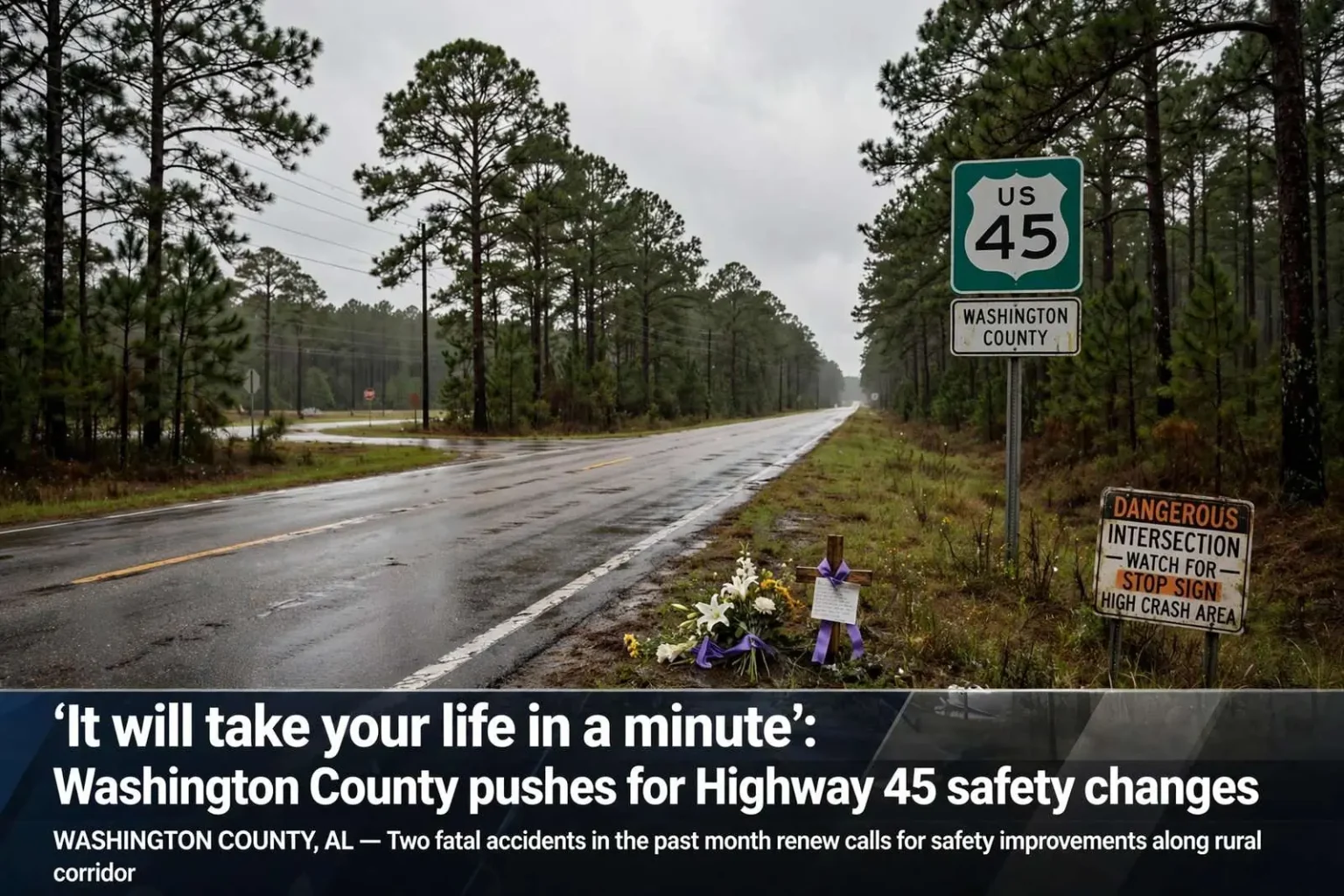
WASHINGTON COUNTY, Alabama – Two fatal accidents along Highway 45 in the past month have renewed urgency among Washington County residents and officials calling for the dangerous roadway to be made safer. The crashes have put a spotlight on a corridor that locals have warned about for years, and one that they say has grown steadily more dangerous as traffic volumes climb.
More than 75 people have been killed over the past five years along the roughly 60 miles of U.S. Highway 45 that run through Alabama, according to local officials. The highway cuts through the heart of Washington County and connects a string of small communities whose residents depend on it for everything from school runs to commuting, farm traffic and freight. What was once a quiet two-lane road through pine country has become one of the region’s busiest rural corridors.
Washington County Sheriff Richard Stringer said traffic has at least doubled along the corridor in the last two to three years, and he has spent years trying to get the attention of state leaders in Montgomery. Growth spilling north from Mobile and heavier truck traffic have combined to pack the highway with vehicles it was never engineered to carry, the sheriff said, while the road itself remains largely unchanged.
A Family’s Loss Fuels the Fight
Among those pushing for change is Liz Outlaw, who lost her granddaughter, Hannah Wright, in March. Wright was a passenger in a car that, police said, failed to stop at the intersection of University and Highway 45. The crash transformed Outlaw’s grief into advocacy, and she has since become one of the most persistent voices calling for safety improvements at the crossings where so many lives have been lost.
Outlaw is asking for a flashing light or lights at the crossing where her granddaughter was killed. Signalized warnings, she and other residents argue, would give drivers a visible cue at intersections where sight lines and high speeds make ordinary stop signs easy to miss – especially at night, in fog or in the heavy rains that sweep through southwest Alabama.
Residents along the corridor describe a routine of near misses: cars pulling out of side roads into fast-moving traffic, drivers braking late for intersections they barely notice, and the constant rumble of log trucks and commuters sharing narrow lanes with school buses.
State Leaders Drawn In
Stringer said he recently sent a letter about his concerns to Gov. Kay Ivey, who referred the matter to the Alabama Department of Transportation. The referral put the highway’s future formally on the desk of the agency that controls design, funding and construction decisions on U.S. 45, and local officials say they intend to keep the pressure on until answers come back.
State Representatives Shane Stringer and Brett Easterbrook are also working to schedule a meeting with the governor and the ALDOT director. The lawmakers, whose districts cover parts of the corridor, have been briefed by sheriffs, mayors and bereaved families along the route, and they say a face-to-face conversation with state leadership is the next step in moving the highway up the state’s priority list.
Local officials acknowledge the challenge: Alabama has thousands of miles of two-lane highways, and safety projects compete for limited dollars across all 67 counties. But they argue that Highway 45’s fatal-crash record and its rapid traffic growth make the case for prioritization now, before more families endure what the Wright and Outlaw families have gone through.
What ALDOT Says
In a statement, ALDOT said it has a system to rank the state’s two-lane roads by deficiency. The ranking process weighs crash history, traffic volumes, roadway geometry and other factors to decide where limited safety dollars go first, and the agency uses it to build its improvement schedules year by year.
While U.S. 45 ranks lower because of its total traffic count and the high cost – estimated above $300 million – to widen it, the agency acknowledged the need to reduce crashes. Widening the full corridor to four lanes would be one of the most expensive road projects in the region’s history, and officials say the price tag alone has kept such a proposal off the state’s near-term construction program.
ALDOT said it plans to analyze locations for turn lanes to cut down on rear-end collisions from left turns, and to add pavement scoring along the centerline to warn drivers who drift across it. Turn lanes address one of the highway’s most common crash patterns – a vehicle slowing to turn left while traffic behind it fails to stop – while centerline rumble strips have proven effective nationwide at preventing head-on collisions caused by drowsy or distracted drivers.
The agency said there are no current plans to widen the highway but it will keep working with local officials to improve safety. For corridor advocates, that commitment is both welcome and incomplete: they see the turn lanes and rumble strips as useful first steps, but they continue to press for intersection warnings, better lighting and, ultimately, a wider road.
A Road That Changed Faster Than It Could Be Rebuilt
U.S. 45 has long served as the spine of Washington County, threading through communities whose economies, schools and churches line its shoulders. For generations the road carried modest local traffic at moderate speeds. The past few years have changed that equation, as population growth in the Mobile area pushes commuters north and industrial traffic grows along the route.
Safety engineers describe the resulting problem in plain terms: traffic volumes and vehicle speeds have outgrown the road’s original design. Intersections designed for a slower, lighter flow of cars now mix farm equipment, logging trucks, school buses and high-speed commuter traffic. Small design deficits – narrow shoulders, short turn bays, limited sight distance – compound into lethal conditions when something goes wrong at 60 miles an hour.
Sheriff Stringer has documented the pattern from the law enforcement side, where deputies respond to crashes that too often follow the same script – a left turn, a stop sign, a moment of inattention, and a violent impact on a road with no margin for error.
What Residents Can Do Now
In the meantime, officials are urging drivers to treat the highway with the caution its record demands. Law enforcement agencies along the corridor have emphasized seat belt use, slower speeds through communities and extra care at side-road intersections, particularly after dark. Deputies say many of the corridor’s worst crashes involve one or more of those basic factors.
Residents who want to support the push for improvements can add their voices through local officials and public comment opportunities as ALDOT’s analysis moves forward. Advocates say a documented record of community concern strengthens the county’s case when state projects are prioritized, and they are encouraging families affected by crashes to share their experiences with state representatives.
Both Outlaw and Stringer said they have no intention of giving up the fight, and urged drivers to use caution on what Stringer called a very dangerous highway. The next milestone will come when the proposed meeting between local leaders, the governor and the ALDOT director takes place – a session corridor advocates hope will produce a timeline, not just sympathy.
Until then, the flashing lights Outlaw has asked for remain an aspiration, the turn lanes remain a plan under analysis, and the people who live along Highway 45 keep watching the road with a wary eye. For them, the issue is not statistical – it is personal, measured in neighbors and family members, and they say they will keep pushing until the highway catches up with the traffic it now carries.
The Cost of Waiting
Every month that passes without changes carries a human price that Washington County officials say they already know too well. Fatal crashes along the corridor have drawn emergency responders from multiple volunteer departments, closed the highway for hours at a time and left small communities grieving in clusters, sometimes losing more than one resident from the same school or church in a single year.
Local leaders point out that interim safety measures – flashing beacons, better signage, designated passing zones and targeted enforcement – can be deployed far faster and cheaper than a full widening project. They argue that the same ingenuity ALDOT applies to major construction should be applied to quick wins along Highway 45 while the bigger questions are studied.
The corridor’s economy makes those stakes concrete. Logging trucks, poultry operations, school buses and commuters all share the same two lanes, and when the road closes after a serious wreck, detours can add dozens of miles to a trip in a county with few alternate routes. Residents describe rearranging their daily routines around the highway’s danger zones – avoiding certain intersections at certain hours, or driving miles out of the way to make a left turn safely.
County officials have also raised the human factor behind the wheel: deputies say the doubled traffic means more impatient passing, more tailgating and more drivers running stops they have made a thousand times before. Enforcement helps, they say, but a single sheriff’s office cannot patrol sixty miles of highway around the clock – which is why they keep returning to the state for engineering fixes that work even when no deputy is watching.
Advocates say the goal is simple and long overdue: make Highway 45 safe enough that a trip to school, work or church is unremarkable again, and make sure the next message about the corridor is about construction, not another funeral.