Industrial training facilities near Calvert, AlabamaIndustrial development near Calvert.

Historical report, published from archived local news coverage.

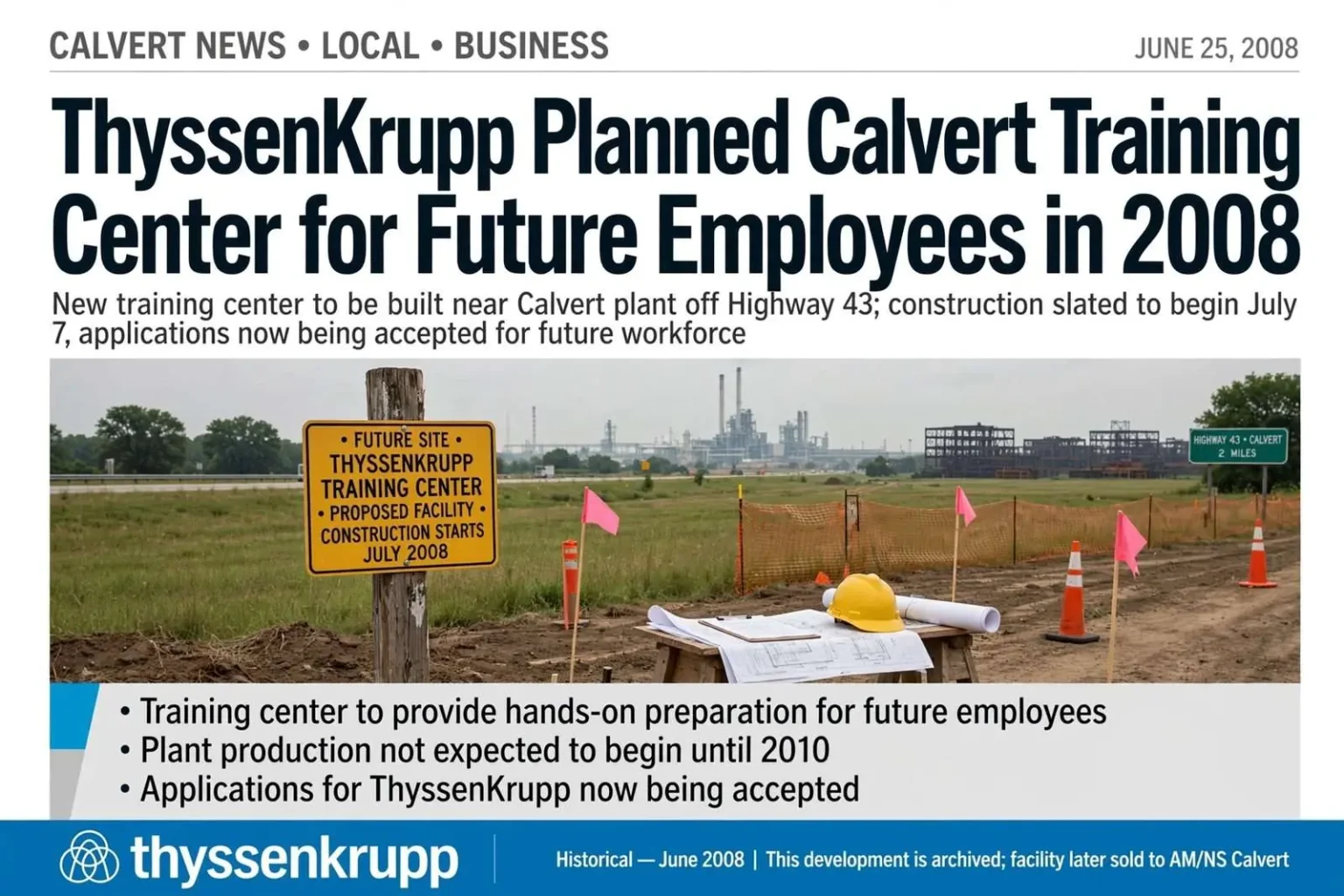
In June 2008, ThyssenKrupp was planning a new training center near its Calvert plant site to provide hands-on preparation for future employees, according to an archived local news report. The center was to be built just off Highway 43 near Calvert. Construction was expected to begin July 7 and take about a year. At the time, the steel plant was not expected to begin production until 2010. The station also noted that applications for ThyssenKrupp were being accepted. This is a historical development and hiring report; the application information and timeline are no longer current.

The training center announcement landed in the middle of one of the largest industrial construction projects in Alabama’s history. ThyssenKrupp, the German industrial conglomerate, had selected a 3,600-acre site in Calvert — in north Mobile County along the Tombigbee River — for a combined steel mill and stainless steel facility representing an investment of more than $4 billion, at the time among the largest single private investments ever made in the state. The project promised roughly 2,700 permanent jobs at full operation, plus thousands of construction jobs during the build-out, and it set off a regional scramble among community colleges, workforce agencies and school systems to prepare local residents for the work.

Building a dedicated training center off Highway 43 near Calvert was the workforce side of that promise. Rather than waiting for the mill to open and training workers on the job, ThyssenKrupp’s planners understood that modern steelmaking — with its computerized control rooms, heavy machinery, cranes and continuous casting operations — requires employees who arrive already versed in industrial safety, equipment operation and process fundamentals. A hands-on facility near the plant site allowed future hires from Mobile, Washington and Baldwin counties to practice on real equipment and simulate production line conditions during the two years or more between groundbreaking and first steel.

Why Calvert Won the Project

ThyssenKrupp’s site selection was a nationwide competition that Alabama won in 2007, and the Calvert site’s advantages explain why. The Tombigbee River provided barge access for the movement of massive equipment, raw materials and finished product; proximity to the Port of Mobile connected the plant to Atlantic and Gulf shipping; and the region’s existing industrial base meant skilled trades, contractors and suppliers were already close at hand. State and local incentives — widely reported at more than $800 million in tax abatements, infrastructure spending and workforce development funding — sealed the deal, then the largest incentive package Alabama had ever assembled. Governor Bob Riley’s administration had made the project a centerpiece of its economic development strategy, following the template set by Mercedes-Benz’s Tuscaloosa County plant and Hyundai’s Montgomery facility.

The economic stakes for north Mobile County were transformative. Communities like Calvert, Mount Vernon and Citronelle — areas of woods, small farms and river towns an hour’s drive from Mobile — suddenly found themselves adjacent to one of the largest construction sites in North America. Land values rose, roads filled with construction traffic, and local officials planned for growth in housing and services. For workers across the region, the mill represented the kind of heavy-industry wages that had grown scarce: steel jobs paying well above the area’s median income, with benefits, in an area where such employers had been leaving for decades rather than arriving.

See also  Duplex Fire Off Rhea Avenue in Mobile Extinguished Without Injuries

The training center fit into a broader workforce machinery being built around the project. Alabama Industrial Development Training, the state’s respected workforce program that had prepared workers for Mercedes, Hyundai and Honda, coordinated with the two-year college system — including Bishop State Community College in Mobile — to recruit and screen applicants and deliver preparatory coursework. Applications being accepted, as the archived report noted, meant the pipeline was open: residents could apply for consideration as production and maintenance workers years before the plant’s furnaces ever fired, giving the company time to select and train its first crews properly.

What a Steel Training Center Actually Trains For

Modern integrated steelmaking is as much a control-systems job as a muscle job, and training centers built for plants like Calvert’s reflected that reality. Future production workers needed instruction in furnace operations, continuous casting, rolling mills, and the safety protocols that govern an environment of molten metal, overhead cranes and moving coils. Maintenance crews needed skills in hydraulics, electrical systems, instrumentation and heavy equipment repair. The hands-on component — practicing on actual machinery and simulators rather than diagrams — was the point of a dedicated facility, because errors at a steel plant are measured in damaged equipment, lost production and injuries.

The timeline in the archived report shows the deliberate sequencing. With construction of the training center expected to begin in July 2008 and take about a year, trained workers would begin coming off the program roughly as the plant itself approached mechanical completion — and with production not expected until 2010, the company built in a margin to hire, train and integrate crews gradually. That sequencing mattered enormously for the region, because it meant the jobs were real and foreseeable: a worker who applied in 2008, completed screening and training, could expect a production job as the plant came online.

The broader lesson of the Calvert training center is how modern megaprojects manage workforce risk. A $4 billion plant is only as good as its operators, and companies like ThyssenKrupp learned from earlier industrial arrivals in Alabama that building the workforce ahead of the plant is cheaper and safer than staffing up after opening. The center off Highway 43 — announced while the mill was still a construction site — was that lesson applied: an investment in people planned with the same seriousness as the investment in furnaces and rolling lines.

See also  Fairhope Regroups After Lone $5.4 Million Bid Sinks Soccer Complex Plans

The Calvert Legacy in Alabama’s Economy

History recorded what followed. The Calvert complex opened and produced its first steel in 2010, became one of the Gulf Coast’s most significant industrial employers, and in 2014 was sold into a joint venture that reorganized it as AM/NS Calvert, operated by ArcelorMittal and Nippon Steel. Through those transitions the plant remained a cornerstone of Mobile County’s industrial economy, employing roughly 2,000 workers and supporting thousands more through contractors, transport and services. Later expansions added new production lines, and the site’s presence helped recruit additional industry to the region, reinforcing Mobile’s emergence as a Gulf Coast manufacturing and logistics hub.

The training center’s story, preserved in this archived report from June 2008, captures the project at its most hopeful stage — the moment when the construction was underway, the hiring pipeline was open, and a community was preparing itself for an industrial future. For residents of north Mobile County and the surrounding counties, it was the first tangible sign that the promises of the megaproject were becoming programs they could apply for, train in, and eventually work.

Readers encountering this article today should understand it as history: the timelines, application information and hiring details reported in 2008 are long obsolete, and the plant that rose near Calvert has changed names and ownership since. What remains true is the pattern the report documented — that Alabama’s largest industrial recruitment wins have always been accompanied by deliberate workforce preparation, and that the training center built off Highway 43 was where the Calvert project’s promise turned into careers for the people of the Gulf Coast.

The Construction Boom That Came With the Mill

The training center was a small piece of a construction effort that reshaped north Mobile County’s landscape. At peak, thousands of construction workers — many bused in from across the Gulf Coast, others drawn from out of state — worked the Calvert site, erecting structures that dwarfed anything the region had seen: a blast furnace shipped in massive modules, a melt shop, casting facilities, rolling mills and the dock works on the Tombigbee that received equipment too large for highways. Local trucking companies, concrete suppliers, piping contractors and tradespeople of every kind found years of work, and motels from Saraland to Mount Vernon filled with a rotating population of skilled builders.

The county and its municipalities spent those years upgrading infrastructure to match. Road improvements along Highway 43 and U.S. 43 connectors, water and sewer extensions, and emergency services planning all accelerated to serve the site. School officials tracked the influx of families, and county commissioners fielded regular briefings on the project’s progress. For rural north Mobile County, the two years between the training center’s groundbreaking and the plant’s opening were an unaccustomed experience of being at the center of statewide attention — the kind usually reserved for Montgomery or the port.

See also  Bomb Threat Forces Evacuation of AL.com's Downtown Mobile Headquarters; Eight Mile Man Arrested

The training center itself employed instructors drawn from industry and the state’s workforce system, and its graduates carried credentials that held value across the industrial economy. Workers who trained for Calvert found their skills applicable to the shipyard, the chemical plants, the paper mills and the growing aerospace work along the Gulf Coast. That portability was part of the design: Alabama’s workforce programs built around marquee employers deliberately created general industrial competency, so that even workers who did not end up at the anchor plant came out of the pipeline more employable than they went in.

Lessons the State Carried Forward

The Calvert experience became a reference point for every Alabama recruitment that followed. State economic developers could point to a functioning model: recruit the anchor project, assemble the incentive package, stand up AIDT training well before the hiring surge, and let the community colleges build curricula around the employer’s specifications. Companies evaluating Alabama sites — from aircraft suppliers in Mobile to automotive plants across the state — were shown the Calvert playbook as evidence that the state could deliver a trained workforce on a megaproject schedule. The training center off Highway 43 was Exhibit A in that presentation.

The project also left lessons about the costs and risks of megaproject incentives, which economists have debated since. The plant’s sales fell short of early projections, ThyssenKrupp restructured its Americas steel business, and the eventual joint-venture sale in 2014 reorganized what the state had recruited. Yet the employment base, the industrial tax revenue and the region’s strengthened supplier network persisted through every transition, and AM/NS Calvert’s subsequent expansions validated the original site logic — river access, port proximity and a trainable workforce — that brought ThyssenKrupp to the Tombigbee in the first place.

For the people who applied in 2008, though, the history compresses into a simpler story: a German steelmaker announced a plant, the state opened a training pipeline near Calvert, and residents of Mobile and its neighboring counties signed up. Some spent careers there. Others took the training into other industries. All of them passed through a facility that existed for one purpose — to turn a rural stretch of Highway 43 into a place where Gulf Coast workers could learn to run one of the world’s most advanced steel mills before it ever made its first coil.