Boston’s Bang Camaro Bring Their Wall-of-Sound Metal Show to the Port City
Boston rock collective Bang Camaro, known for its huge lineup and old-school arena metal sound, is bringing its wall-of-sound live show to the Mobile area.
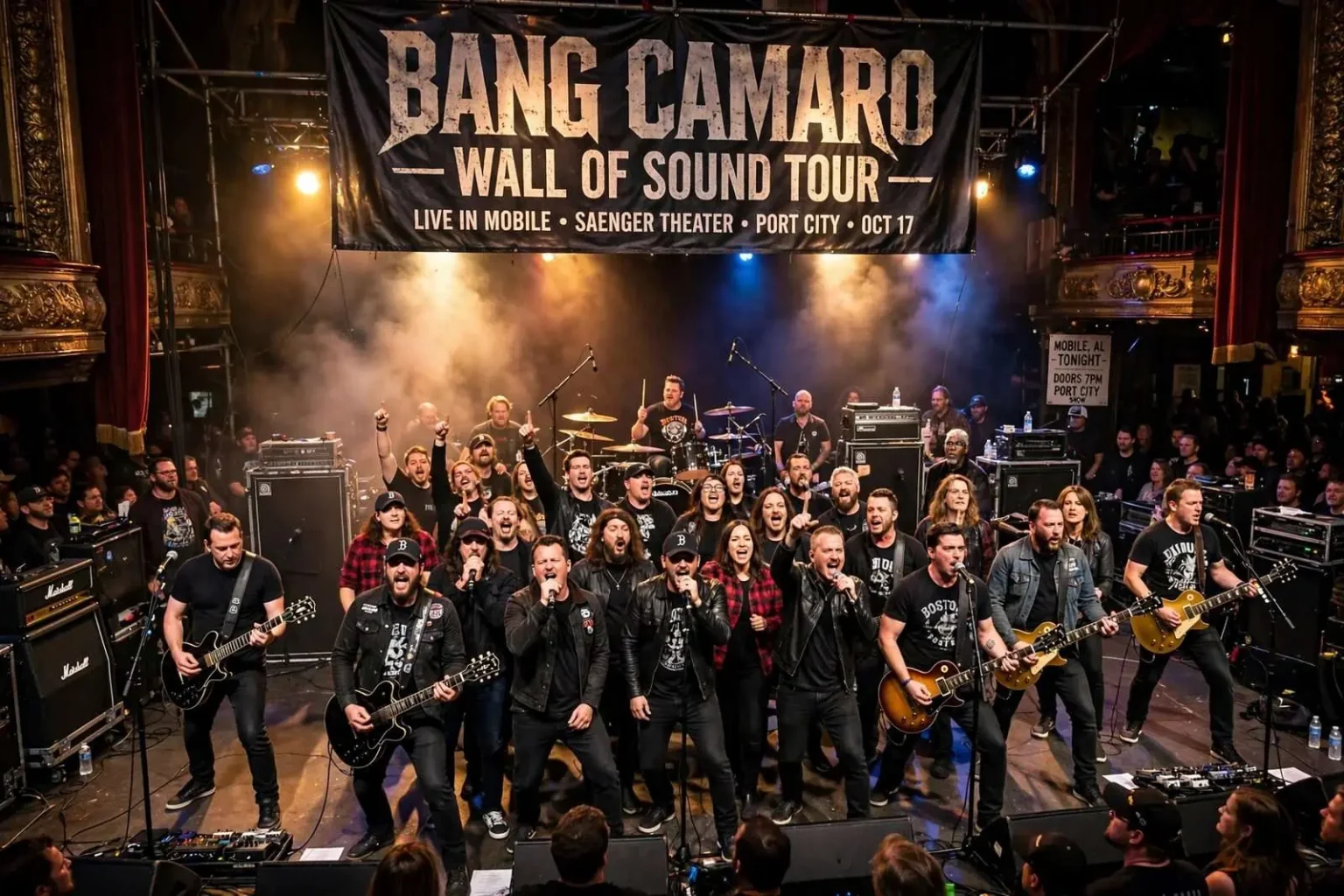
A different kind of army is making its way into Mobile: the roughly 30-member rock collective known as Bang Camaro, a Boston-born band that has built a reputation for burying audiences under a wall of old-school, arena-style metal sound. The band’s shows are less concerts than controlled spectacles, with a rotating chorus of singers crowding the stage alongside a core of guitarists and a rhythm section engineered for maximum volume. For Mobile audiences accustomed to the standard four- or five-piece touring act, the sheer scale of the production is the draw.
Standing out in Boston
Bang Camaro’s rise is notable in part because of where it came from. The Boston music scene that produced the band has long been dominated by hardcore punk and Celtic punk acts, styles that share little in common with the glam-tinged, riff-heavy metal Bang Camaro built its name on. Boston’s clubs and college venues have historically favored the urgent, stripped-down energy of punk, and the city’s storied rock lineage — from arena giants of the seventies to the alternative explosion of the nineties — has often left little room for outright throwback metal.
Standing out in that environment took a distinct approach, and the band found it by leaning hard into an unapologetically retro metal sound, complete with soaring vocals and a stage show built around spectacle as much as musicianship. Rather than compete with the punk acts on their own terms, Bang Camaro embraced the excess that punk defined itself against: layered guitar harmonies, gang vocals, and choruses engineered to be shouted by hundreds of voices at once. The contrarian bet paid off, carving out a niche that no other act in the city’s crowded scene occupied.
From regional curiosity to national draw
That approach has paid off well beyond New England. What started as a regional curiosity has turned into a band with a national following, thanks in part to a large, ever-shifting lineup of musicians and vocalists that can swell past 30 members depending on the show. The band’s roster model is part of its identity — members come and go based on who is available for a given tour, and audiences never quite know which combination of voices will take the stage. The unpredictability has become a selling point, turning each show into a one-time configuration that cannot be repeated.
Founding members Alex Necochea and Bryn Bennett have talked about how the band’s scale and sound were built specifically to recreate the feeling of arena rock’s heyday, when big riffs and bigger choruses ruled the radio. The duo set out to bottle the experience of hearing a massive rock chorus in a stadium and reproduce it in clubs far smaller than the music was written for, an inversion that gives audiences the sensation of a bigger-than-life show pressing up against the walls of a small room.
The wall of sound arrives on the Gulf Coast
Now that sound is headed to the Gulf Coast. Bang Camaro’s brand of throwback metal theater is set to bring its wall-of-sound live show to the Mobile area, giving local fans of classic rock spectacle a chance to see firsthand what has been turning heads on the national touring circuit. Shows of this size require stages that can hold them, and the logistics of moving dozens of performers are part of what makes a visit from the collective a rarity rather than a routine booking. Local fans of retro metal have followed the band’s recordings and live clips online for years, and the opportunity to experience the volume and spectacle in person is a different thing entirely.
What it means for the Port City scene
For longtime followers of the local scene, the visit is a reminder that Mobile continues to draw touring acts that might otherwise bypass the Gulf Coast in favor of larger markets. For decades, touring bands plotted routes between New Orleans, Atlanta, and Florida, skipping the Gulf Coast entirely, and Mobile audiences drove to those cities for national acts. That calculus has shifted over the years as local venues upgraded their facilities and promoters proved the city could fill rooms for the right shows, pulling touring circuits to add the Port City as a stop rather than a detour.
Bands built around a big, communal live experience like Bang Camaro’s tend to translate well to any crowd willing to sing along, and local promoters have increasingly worked to bring that kind of national talent to Port City stages. The collective’s model almost demands audience participation, with vocal lines written for crowds to shout back at the stage, and Mobile’s audience — steeped in the same classic rock radio canon that shaped the band’s sound — is the sort of crowd the material was written for. Shows that reward singing along convert curious walk-ins into fans, which is part of why promoters value bookings that encourage the whole room to join in.
The metal revival’s moment
Bang Camaro’s success rides a broader wave of nostalgia for the big-rock sound of the eighties, when guitar solos anchored the singles and vocal harmonies climbed over choruses rather than burying them. That revival has been building across the touring circuit for years, with tribute acts, reunited hair-metal bands, and new groups playing unironic arena rock all finding audiences in markets far from the genre’s old strongholds. What distinguishes Bang Camaro from a nostalgia act is that the band never existed in the era it celebrates — the music is new, written and performed in the style of a time when this kind of spectacle filled stadiums rather than revival tours.
The band’s communal structure also reflects a do-it-yourself ethic that has defined independent rock for decades. Dozens of members means dozens of schedules, and booking a tour is closer to organizing a reunion than routing a standard band. That the project works at all, let alone tours nationally, is a testament to the infrastructure of veteran Boston musicians the collective draws from — players with day jobs and other bands who rearrange their lives when the tour dates go up.
More voices, more guitars
Whether or not you grew up on classic arena rock, Bang Camaro’s pitch is straightforward: more voices, more guitars, and a sound built to fill a room. The band’s catalog is stacked with choruses designed for exactly the kind of communal shouting that only works when the crowd becomes part of the arrangement, and the stage fills accordingly. First-time attendees are often struck by how little separation exists between the band and the audience, since the vocal lines practically hand the melody to the crowd from the first chorus onward.
For Mobile audiences looking for something louder and more theatrical than the usual weeknight show, this is one worth paying attention to. Port City venues have hosted their share of national touring acts in recent years, but few arrive with the scale and spectacle of a thirty-piece rock collective, and fewer still make audience participation the centerpiece of the performance. Fans of classic metal, arena rock, or simply loud guitars played by an unusually large number of people at the same time will find the show difficult to forget — and local promoters hope the turnout proves, once again, that Mobile’s crowds show up when the right act comes to town.
Boston’s long shadow on American rock
Understanding what makes Bang Camaro unusual requires understanding the city that produced it. Boston has sent an outsized share of bands into the American mainstream, from the platinum-selling arena rock of Aerosmith and Boston to the Pixies’ quiet-loud template that shaped alternative rock, to the Celtic-punk celebrations of the Dropkick Murphys that still own the city’s identity for many listeners. The city’s dense network of colleges feeds a constant supply of new bands into its club circuit, and that turnover breeds specialization — scenes within the scene, each with its own venues, audiences, and unwritten rules.
Hardcore and punk have dominated that ecosystem for decades, and the style rewards economy: three chords, two minutes, no ornamentation. A glam-inflected metal collective with thirty members is almost a deliberate provocation in that setting, an argument that excess has its own integrity. The band’s longevity suggests the argument landed, first with Boston audiences starved for spectacle, then with the national touring audience that discovered the band as word spread through the retro-rock revival.
The economics of a 30-member band
Part of what makes the collective’s national touring notable is that a band of its size is an economic anomaly. Touring revenue that supports a five-piece band barely dents the costs of moving thirty performers, gear, and bodies down the highway, which is why most large ensembles confine themselves to regional shows and festivals. Bang Camaro has navigated the problem by keeping its touring roster flexible, bringing out a core traveling unit augmented by local members and guest vocalists where possible, and by treating each configuration as part of the show rather than a compromise.
The approach mirrors the large-choir and orchestra-in-residence models of the independent rock world — bands like Polyphonic Spree built similar audiences by making scale the attraction. For the musicians, participation is less a career than a commitment, a standing engagement with a musical community that convenes when the calendar allows. That structure produces the joyful looseness audiences describe after the band’s shows, where the stage feels less like a performance than a party the audience has been invited into.
A night out in Mobile
For local fans weighing whether the show fits the budget of a weeknight, the band’s track record argues for the splurge. Collectives of this size do not pass through mid-sized Gulf Coast markets often, and the communal sing-along experience that defines the band’s live reputation is difficult to replicate through recordings. Mobile’s mid-sized venues have proven capable of hosting productions of this scale, and the audience that turns out will be part of the ongoing case that the Port City deserves its place on national touring routes.