Chatom Dealership Ends Bible, Shotgun and Flag Promotion After Ford Steps In
Chatom Ford has ended its July 4th promotion offering a Bible, shotgun and flag with every vehicle after Ford Motor Company asked it to stop.
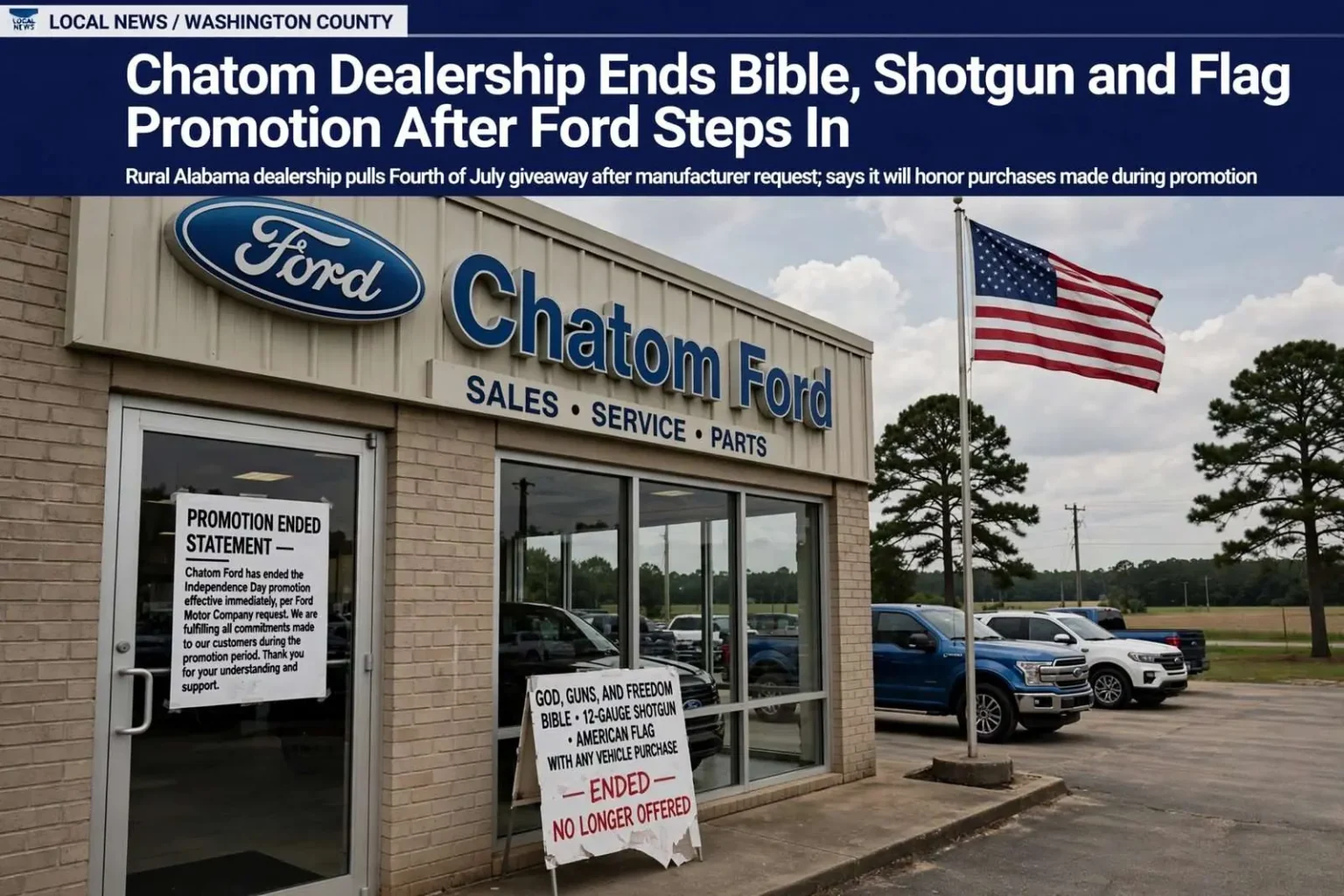
A Washington County car dealership has pulled a Fourth of July promotion that offered every buyer a Bible, a 12-gauge shotgun and an American flag, after Ford Motor Company asked the store to stop running the advertisement. Chatom Ford announced the end of the campaign in a post on its Facebook page.
“We were running a promotion celebrating this country’s independence. Ford Motor Company has asked us to stop running the advertisement,” the post read. “They manufacture the products we are franchised to sell, so we are complying with their request. We appreciate everyone’s support. All the phone calls and messages were so greatly appreciated. We will fulfill all commitments we made to our customers.”
The announcement ended a promotion that had drawn attention well beyond Washington County. Offers that blend firearms with vehicle sales are rare enough that word travels fast, and the dealership’s Facebook post reached an audience far wider than its local customer base, drawing both supporters who flooded the store with encouraging calls and national outlets that picked up the story.
The Original Offer
The dealership had advertised the three items as a gift with the purchase of any vehicle, new or pre-owned, in a Facebook post that opened with the line “GOD, GUNS, AND FREEDOM.” The promotion had been scheduled to run through July 31, framing every July purchase as a bundle of the three symbols the ad invoked.
According to the dealership, participants had to be at least 18 years old, hold a valid ID, be legally able to purchase a vehicle, and pass all checks required to own a firearm in their state of residence. Those conditions placed the shotgun portion of the giveaway inside the ordinary legal framework for a firearm transfer, the same background-check requirements that govern any retail sale.
Promotions of this kind sit at the intersection of small-town commerce and cultural identity. In rural Alabama, where hunting tradition runs deep and firearm ownership is widespread, the offer was calculated to resonate with the dealership’s market rather than to shock it. The Bible, the shotgun and the flag were presented as a matched set of commitments the store assumed its customers shared.
Why Ford Stepped In
The corporate response turned on the franchise relationship. Ford Motor Company does not own its dealerships; it licenses them, granting the right to sell vehicles under the Ford name in exchange for adherence to brand and marketing standards. When a franchisee’s promotion generates national attention that the manufacturer does not want associated with its brand, the manufacturer has leverage, and Chatom Ford’s post acknowledged exactly that dynamic.
“They manufacture the products we are franchised to sell, so we are complying with their request,” the dealership wrote. The statement was matter-of-fact rather than resentful, and it reflected the practical reality of rural dealership economics: a small-town Ford store depends on its franchise, its allocation of new vehicles and its standing with the factory in a way that leaves little room for a public standoff.
National manufacturers routinely police how their brand appears in local advertising, and promotions involving firearms occupy particularly sensitive ground for a corporation selling to a national market. The request from Dearborn did not allege anything illegal about the sale; it asked the store to stop advertising it under the Ford name, and the store agreed.
Community Response
The dealership’s Facebook post struck a grateful tone toward the reaction the promotion had generated. “We appreciate everyone’s support. All the phone calls and messages were so greatly appreciated,” the post read, indicating that the volume of response from the community had been overwhelmingly supportive of the store itself.
Chatom, the county seat of Washington County, is a small town where the local dealership functions as more than a retailer. It is one of the institutions of community commerce, a sponsor of youth programs and a business where the buyers are neighbors. The promotion’s supporters saw the request from the manufacturer as an intrusion on local custom, while the store itself chose compliance without recrimination.
Honoring the Deals Already Made
The dealership said it will honor commitments already made to customers who bought vehicles while the promotion was active. That pledge closed the loop on the practical question the announcement raised: buyers who purchased a vehicle during the promotion window, before the July 31 scheduled end, would still receive the Bible, shotgun and flag the advertisement promised.
Fulfilling those commitments required the store to complete the firearm transfers through the same legal channels as before, with identification and background checks for each recipient. The assurance also served a business purpose: in a small market, a dealership’s word on a promise is part of its reputation, and reneging on sold deals would have cost more goodwill than ending the promotion itself.
The pattern is a familiar one in franchise disputes that never quite become disputes. A manufacturer objects to a local promotion, the store complies, and the store simultaneously signals to its community that its own obligations stand. Customers keep their deals, the brand keeps its distance from the controversy and the franchise relationship survives to sell another season of trucks.
Gun Promotions in Rural Retail
Dealership-and-firearm promotions are not unique to Alabama, but they surface periodically across rural America, particularly around patriotic holidays. Stores in several states have run similar giveaways over the years, each generating the same cycle: local enthusiasm, national media attention, corporate discomfort and a quiet end. The economics are simple, since a shotgun bundle costs a fraction of a vehicle’s margin, and the marketing appeal in a hunting culture is obvious.
What distinguishes each case is the response of the manufacturer and the franchisee. Some stores proceed without comment from above; others, like Chatom Ford, receive a request and comply. The dynamics depend on how widely the promotion travels, how the manufacturer balances its rural customer base against its national image and how the franchisee weighs factory goodwill against local publicity.
Washington County’s own character shaped how this one unfolded. The county, one of Alabama’s oldest, is a place where hunting seasons structure the fall calendar and where firearm safety and ownership are taught across generations. The promotion was legible to its audience as an affirmation of local values rather than a stunt, and the community response bore that out.
The Fourth of July Context
The promotion was designed around Independence Day, the holiday that anchors summer commerce in small towns across the country. Vehicle sales events tied to the Fourth are a long-standing dealership tradition, typically built on red, white and blue imagery and financing specials. Chatom Ford’s version simply pushed the theme further than most, naming its symbols directly and attaching physical items to them.
That directness is what carried the story beyond the county line. In an era when a single Facebook post can reach a national audience overnight, a local promotion can become a national story without ever leaving town, and the dealership experienced that dynamic in real time as calls and messages arrived from far beyond its usual market.
The episode closed the way most such episodes do: with the store keeping its word to its customers, the manufacturer’s brand shielded from further association and the community’s goodwill intact toward a business it knows well. For Chatom Ford, the July that began with “GOD, GUNS, AND FREEDOM” ended with a quieter message, one that thanked its neighbors and promised to make good on every deal.
Washington County and Its Markets
Washington County sits in southwest Alabama, stretching between the Mississippi line and the Mobile suburbs, with Chatom as its county seat. The county is rural and deeply rooted, its economy built on timber, agriculture and small-town commerce, and its residents drive significant distances for major purchases. A dealership in Chatom serves not just the town but the surrounding communities, from Millry to McIntosh to the crossroads settlements along U.S. 43 and state routes that stitch the county together.
In markets like this, vehicle buying is relationship commerce. Families return to the same dealership across generations, trade trucks on sight and expect the owner to stand behind the deal in person. Promotions are spoken about at church and at the feed store, and a campaign that resonates with local identity builds the kind of loyalty advertising money cannot buy.
That context explains both why the promotion ran and why its ending drew such a reaction. The offer spoke the community’s language, and the community responded with phone calls and messages when the manufacturer asked the store to stand down. The store, in turn, treated its neighbors’ response as the story’s real meaning.
Franchise Relationships Explained
The American dealership system gives manufacturers enormous indirect power over how their vehicles are marketed. Dealerships are locally owned businesses, often family enterprises operating for decades under a franchise agreement, but the agreement governs everything from facility standards to advertising conduct. A manufacturer’s request, delivered privately, carries the weight of allocation decisions, facility requirements and ultimately the franchise itself.
For a small rural store, the calculus is never close. New vehicle inventory, warranty work and factory incentives all flow through the franchise relationship, and a public dispute with the manufacturer would jeopardize the store’s core business for years. Compliance, delivered graciously, preserves everything that matters while costing only a promotion that had already served its purpose.
Chatom Ford’s public handling of the request became a case study in that balancing act. The store named the manufacturer’s request plainly, explained its reasoning in one sentence, thanked its customers and reaffirmed its commitments. No grievance was aired, no controversy was extended, and the dealership’s relationship with both the factory and the town emerged intact.
What Comes After
Once the promotion ended, the store’s regular business resumed: trucks and cars sold, service appointments kept and the ordinary rhythm of a small-town dealership moving forward. The commitments made during the promotion window were fulfilled as promised, and the July 31 end date arrived early by corporate request rather than by the store’s choice.
The story leaves a portrait of rural Alabama commerce in miniature. A local business designed a promotion for its own market, a national brand managed its national image and both sides resolved the tension without the community losing anything except the giveaway itself. In Washington County, where the dealership’s customers are also its neighbors, that outcome was the only one that preserved what the promotion was really about: the store’s standing at the center of its town.