Former County Treasurer Vivian Beckerle Entered the Race Against Jo Bonner
Former Mobile County treasurer Vivian Beckerle announced in March 2006 that she would seek the Democratic nomination for Congress in Alabama's First District, challenging two-term Rep. Jo Bonner.
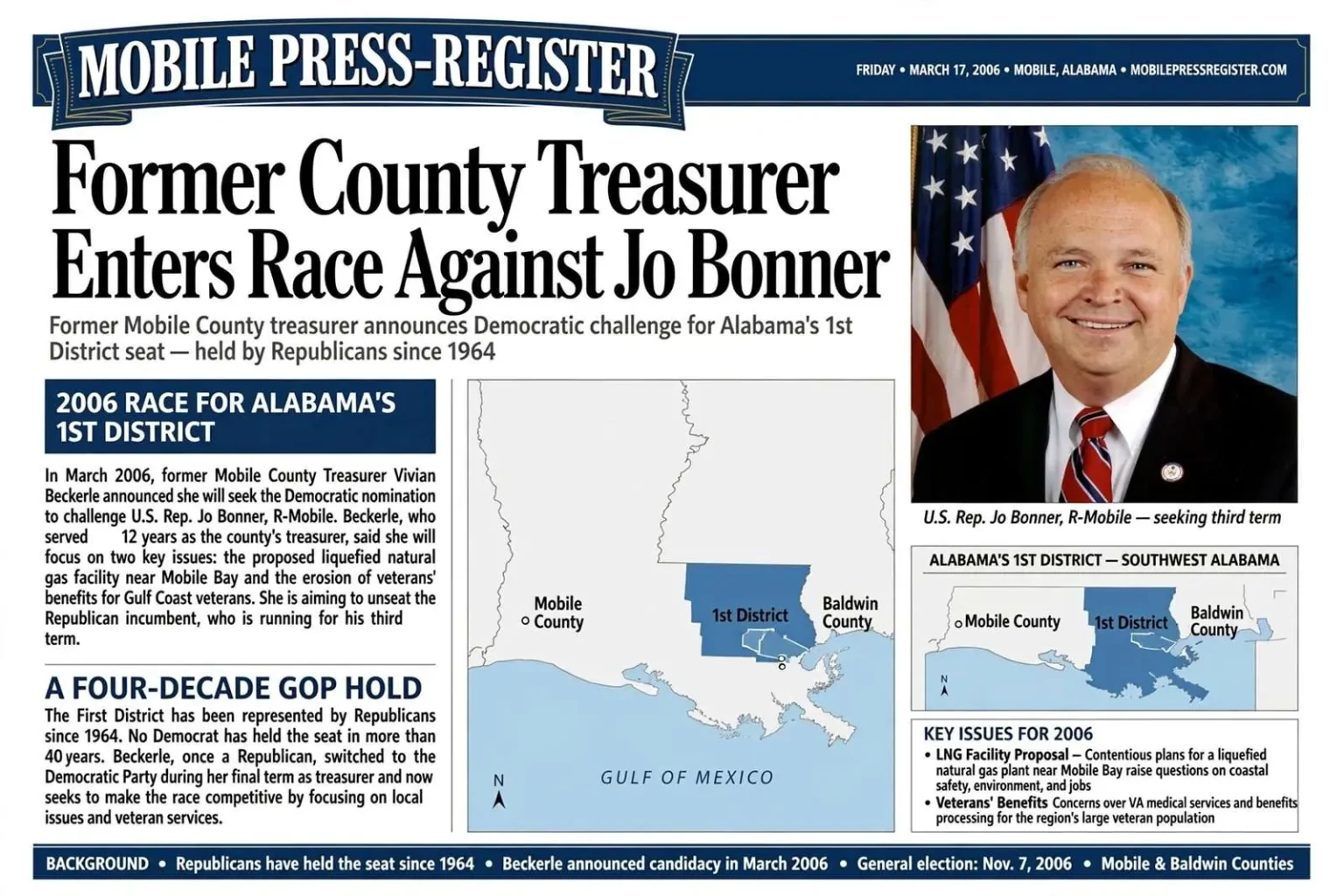
Former Mobile County treasurer Vivian Beckerle announced in March 2006 that she would seek the Democratic nomination for Congress from Alabama’s First District, taking on a seat that had been in Republican hands for more than four decades.
The seat was held by U.S. Rep. Jo Bonner, R-Mobile, who was seeking his third two-year term that year.
A party switch and a long-shot bid
Beckerle’s candidacy carried an unusual biography. She had been a Republican herself for most of her 12 years as county treasurer. About midway through her final term, she switched to the Democratic Party. She then ran for general administrator of Mobile County as a Democrat and lost.
Her husband and law partner, Bob Beckerle, was chairman of the Mobile County Democratic Party.
She did not pretend the race would be easy.
“This is a big undertaking,” Beckerle said of her congressional bid. “I think we need to do this. All my adult voting years that chair has been sat upon by a Republican. There have been several Democratic challengers along the way. We’ve just never been able to secure the seat. We do not need to concede it. We need to work for it.”
The history bore her out. The First District had been Republican since 1964, when retired Congressman Jack Edwards won the seat on a GOP ticket headed by unsuccessful presidential nominee Barry Goldwater, part of the realignment that turned the Deep South from a Democratic stronghold into Republican territory.
Edwards held the district through five decades of change in Mobile, and when he stepped down, the seat passed to fellow Republican Sonny Callahan, whose years in office continued the streak before Bonner won the seat in 2002. By the time Beckerle entered the race, a Democrat had not held the First District in more than forty years, and no Democratic challenger since 1964 had come close.
The issues she named
Among the matters Beckerle said she hoped to see addressed in the campaign were the liquefied natural gas plant then under consideration for the Mobile County area and the erosion of benefits for veterans of the U.S. military.
The LNG question was live and contentious in South Alabama at the time. Proposals to site facilities for receiving and regasifying imported liquefied natural gas drew arguments about energy supply and industrial jobs on one side and about safety, siting and coastal environmental risk on the other.
Mobile Bay and its shipping channel had emerged as a candidate location for such facilities because of the existing port infrastructure and the pipeline connections that run north from the coast. Supporters pointed to the investment and the promise of energy diversity; opponents raised questions about the security zones such facilities require on busy waterways, the effect on commercial and recreational fishing, and the wisdom of placing industrial infrastructure near residential shores. The debate stretched through the mid-2000s and pulled in federal agencies, state regulators and local governments, and it was exactly the kind of coastal-policy fight a First District candidate could not avoid.
Beckerle’s second named issue, the treatment of veterans, carried its own local weight. South Alabama is home to a large veteran population, anchored by the VA medical facilities serving the Gulf Coast, and complaints about benefits processing, coverage and services were a recurring theme in the district’s politics. A candidate arguing that veterans’ benefits had eroded was speaking to a constituency spread across every neighborhood in the district.
The district she set out to win
Alabama’s First District in 2006 stretched across the southwestern corner of the state, taking in Mobile and Baldwin counties and the surrounding Gulf Coast region. Its politics had been reshaped twice over the preceding half-century: first by the realignment of the 1960s that flipped the once-solidly Democratic South, and again by decades of suburban and coastal growth that gave the district one of the state’s most reliable Republican electorates.
Mobile itself, the district’s anchor city, had a long Democratic history in city and county government even as its voters sent Republicans to Washington, a split that local Democratic candidates had tried for years to turn into congressional victories. Baldwin County, on the eastern shore of Mobile Bay, was by then among the fastest-growing and most Republican counties in Alabama. Any Democratic path to victory ran through persuading the region’s conservative-leaning independents that a local candidate mattered more than the letter beside the name.
That was the arithmetic Beckerle accepted when she announced. Her candidacy rested on the belief that a known local officeholder could split that coalition, and on the argument she made in her announcement: that decades of one-party representation had made the seat complacent, and that the people of the district deserved a race for it either way.
The treasurer’s résumé
Beckerle arrived at the race with a decade of countywide officeholding behind her. As Mobile County treasurer, she had been one of the officials responsible for the county’s money — collecting, depositing and accounting for the revenue that funds county government — a role that gave her a credential in financial management that few congressional challengers could match.
Her 12 years in the office also gave her name recognition across the county, the essential ingredient for any candidate seeking a seat whose boundaries reach beyond Mobile itself into Washington, Mobile, Baldwin and the other counties of southwest Alabama. And her tenure spanned her party switch, which made her both a familiar figure to Republicans who had once supported her and a known quantity to the Democrats she now hoped would nominate her.
The switch itself was a political risk she acknowledged. Voters who forgive a party change in a county office often weigh it more heavily in a congressional race, and her earlier loss as a Democratic candidate for county general administrator showed that the move had not been cost-free. Her answer to that history was to run anyway, arguing that the district deserved a contest and that Democratic voters deserved a nominee.
The national backdrop of 2006
The timing of her announcement placed her bid in a midterm year that would prove difficult for Republicans nationally. Democrats were campaigning hard on public frustration with the war in Iraq, federal spending and the scandals then emerging in Washington, and House races across the country were more competitive than they had been in a decade. Alabama, however, ran several lengths behind the national mood in 2006, and the state’s congressional map remained firmly Republican from the Tennessee line to the Gulf.
For First District Democrats, the question each cycle was the same: whether a credible nominee could make the race about local issues rather than about the party label. Beckerle’s candidacy was built on that strategy — local officeholder, local issues, local name — with the argument that voters who sent her to the county treasurer’s office twice could send her to Washington too.
What the race meant for the district
Challengers like Beckerle perform a function in one-party districts that their win-loss records rarely capture. A contested race forces the incumbent to raise money, hold town halls and answer questions; it gives the minority party’s voters a reason to go to the polls; and it keeps a local Democratic organization alive for the next cycle. Her argument that the seat should never simply be conceded was directed at exactly that reality.
The 2006 cycle’s Democratic field for the First District nomination drew attention because of her countywide experience, and her husband’s role as county party chairman made the family a center of local Democratic politics in the years when the party’s fortunes in the region were at their lowest ebb.
Her candidacy also illustrated the particular difficulty Democrats faced in the Gulf Coast district during those years. The party’s strongest organizations were concentrated in Mobile County, while the district’s growth was flowing into Baldwin County, where Democratic precincts were few and falling. A nominee had to run up a large margin in the city and county of Mobile simply to offset the deficits elsewhere, and then persuade the swing precincts of Washington County and the smaller communities that a Democrat could represent their interests in a Washington where their party held neither the presidency nor, at the time, either chamber of Congress.
Against that backdrop, her decision to run was itself the message she intended to send: the First District would not go uncontested, and the argument she made in her announcement — that the seat should be worked for, not conceded — was the argument she hoped outlasted the election itself.
Whatever the November result, the announcement in March 2006 marked the continuation of a long Democratic effort to reclaim the Gulf Coast’s congressional seat, and the issues she chose — coastal industrial development and veterans’ benefits — were the issues the district would keep debating long after the ballots were counted.