Reading Reed Between the Lines: A Rival’s Blessing in Senate District 33
Reports that Joe Reed would back Vivian Figures against Herman Thomas cut across four decades of Mobile political rivalry, and turned on a single legislative vote about a building's name.
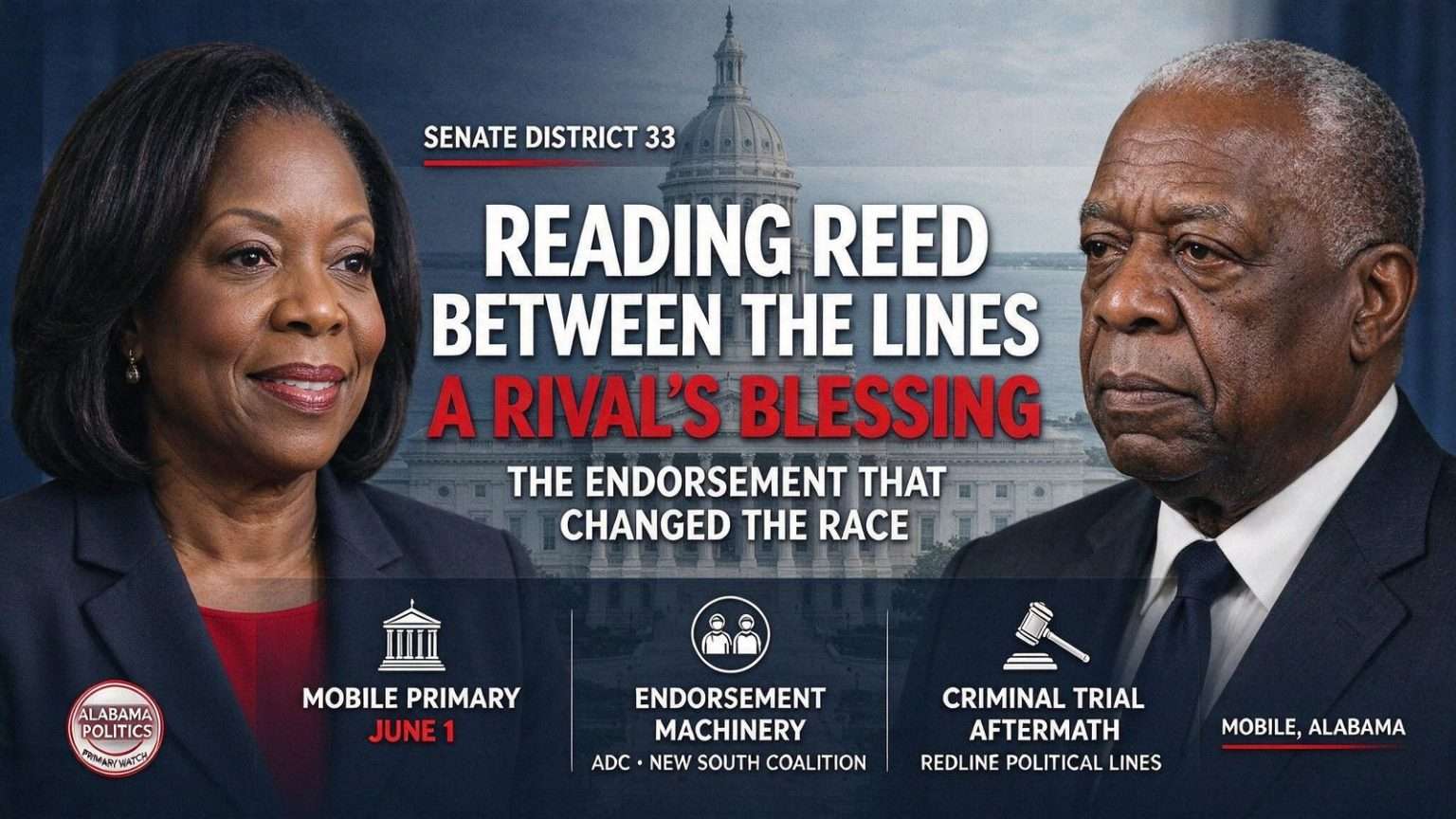
Reports circulating over the weekend held that Dr. Joe Reed — the most durable power broker in Alabama Democratic politics, a leading figure in the Alabama Education Association and the long-time head of the Alabama Democratic Conference — would support state Sen. Vivian Figures in her campaign for a fourth full term in Senate District 33.
If confirmed, the news would be both pleasant and surprising for Figures, because on nearly every historical reading, Reed should have been somewhere else. He should have been standing with her opponent. Instead, the reports suggested that one of the state’s most consequential political operators was prepared to let a decades-old feud stand down, at least in this one Mobile district.
Understanding why the endorsement mattered requires understanding who Reed is. For more than four decades, Reed has operated at the intersection of the state’s largest teachers’ organization and its oldest Black political organization, and the combination has made him a figure no Alabama politician of either party treats lightly. Legislators calculate his reaction before they file a bill. Candidates seek his blessing before they seek anyone else’s.
Senate District 33, anchored in Mobile, is the seat Figures inherited in tragic circumstances and has held ever since. A fourth full term would place her among the longest-serving senators in the Mobile County delegation, and the shape of her re-election race was being determined in real time as the primary approached.
The reports carried extra weight because of what Reed’s apparatus can do in a Democratic primary. The Alabama Democratic Conference’s endorsement machinery, built over decades in churches and civic clubs across the state, has decided countless down-ballot races by itself. A decision to deploy it against an incumbent is a serious event; a decision to withhold it is nearly as consequential, and far quieter.
The Old Rivalry
Figures has long been associated with the New South Coalition, the organization founded in part by her late husband, Michael Figures, and the principal rival to Reed’s Alabama Democratic Conference for influence among Black voters in Alabama. The two organizations have competed for endorsements, sample-ballot primacy and political oxygen for decades.
The rivalry is not a small thing in Alabama politics. Both groups produce sample ballots that circulate in churches, neighborhoods and precincts, and appearing at the top of the wrong organization’s list — or absent from the right one — can decide low-turnout primaries. Generations of candidates have structured their campaigns around the two organizations’ competing machinery.
Reed’s closest political allies in Mobile County were state Reps. James Buskey and Yvonne Kennedy, and it is in those two relationships that the depth of the Figures-Reed estrangement becomes clear. This was not an abstract institutional rivalry. In Mobile, it had a face, a history and a set of unresolved wounds.
Figures defeated Buskey in the 1997 special election to fill the Senate seat left vacant by her husband’s sudden death from an embolism. The resulting wounds, in the description of people who watched them form, never fully scarred over. Buskey had served in the House for years and expected to move up; instead the widow of the incumbent entered the race, carried the emotional weight of the moment, and won.
Kennedy, meanwhile, stepped down as president of Bishop State Junior College amid the criminal investigation into financial operations at the school — a probe run out of the office of Mobile County District Attorney John Tyson Jr. that produced dozens of charges. Kennedy herself was never accused of wrongdoing, but the episode left lasting bad feeling between her supporters and Tyson’s office.
Bishop State, a historically Black community college in Mobile, saw its leadership shaken as investigators worked through scholarship programs, payroll and procurement. For Kennedy’s circle, the damage was personal as well as institutional: a career in education and politics shadowed by an investigation in which she was never charged.
Why That Chain Matters
Tyson’s office later brought the charges against former judge Herman Thomas, and it is here that the various threads — Reed, Kennedy, Buskey, Figures and the District Attorney’s office — braid together into a single political knot.
Thomas was acquitted last fall of all counts alleging he paddled young inmates in exchange for leniency. The trial had been one of the most disturbing in recent Mobile County memory, and the testimony cut close to the Senate District 33 political family. Figures’s son Akil testified for the prosecution, saying he was among those paddled. Figures testified for the prosecution as well.
Thomas then announced he would run against Figures — a decision that, on its face, joined two separate storylines: a defeated defendant seeking a political rematch of sorts against the family that helped put him on trial, and an incumbent senator whose testimony had made her a target.
As an ally of Kennedy and Buskey — both of whom had their own long histories with Figures and with Tyson’s office — Reed would have been expected to bring his considerable resources to bear for Thomas. The ADC’s sample ballot, its precinct workers, its quiet network of support: all of it would have been naturally aimed at unseating Figures.
Regardless of where Reed himself landed, Kennedy and Buskey were considered likely to aid the Thomas campaign, at least quietly. Their grievance predated the trial and would outlast the election, and neither had any obvious reason to help the senator who defeated one of them and whose orbit included the prosecutor of the other’s ally.
The Vote That May Explain It
There is probably more to the story, but one detail keeps surfacing. Figures voted for a legislative resolution that restored Reed’s name to the Acadome, the athletic arena at Alabama State University in Montgomery.
The university’s board, locked in a long feud with Reed, had stripped his name from the building. The Legislature’s action reversed the board, and Gov. Bob Riley allowed it to become law without his signature — a low-drama end to a high-drama dispute over an honor that Reed’s allies considered an insult to withdraw.
A Democratic source with knowledge of both local and Montgomery politics said Reed appreciated Figures’s vote — and was displeased that Thomas had ignored his advice not to run for the seat. In other words, the candidate Reed was expected to back had declined to take the one piece of advice that mattered most, and the rival he had spent decades opposing had cast a vote that mattered to him personally.
That, in a sentence, is how Alabama politics has often worked: a decades-old rivalry, a courthouse scandal, a family tragedy and a criminal trial, all potentially outweighed by a vote about whose name goes on a gymnasium. Personal loyalty and personal slight have always counted for more in the State House than party platform, and the District 33 race of that spring offered a textbook illustration.
It also illustrated Reed’s method. His influence rests less on public endorsement ceremonies than on decisions made quietly — which races to engage, which to ignore, which debts to collect and which to forgive. A decision to stand down in District 33 was worth as much as an active endorsement, because it removed the most formidable obstacle Figures might otherwise have faced.
The Rest of the Field
Victor Crawford, a veteran Democrat and son of the late Mobile civil rights attorney Vernon Crawford, was expected to enter the District 33 race later in the month. Crawford carried a respected family name in Mobile’s Black political community, and his entry would give the primary a third dimension beyond the Figures-Thomas contest.
Michael Figures had once been an associate in the elder Crawford’s law firm — another thread in a political world where nearly everyone had, at some point, worked in the same room. Mobile’s Black political leadership has always been a small, interlocking circle, and the 1997 special election that put Vivian Figures in the Senate had redrawn the lines within it in ways that were still being negotiated more than a decade later.
Neither Reed nor Figures immediately responded to requests for comment, which surprised no one. In matters involving the ADC, silence is frequently the message, and both parties had reason to let the weekend reports stand without confirmation.
The Democratic primary was set for June 1. Whatever the final lineup, the contest would be settled in that low-turnout election, where organizational muscle — the ADC’s, the New South Coalition’s, the churches’ — traditionally decides who survives. Figures held the seat, and the weekend’s reports suggested she might hold it with one fewer enemy working against her.
For an incumbent, that arithmetic mattered more than any endorsement. A primary in which the ADC actively opposed her, Buskey and Kennedy quietly aided her opponent, and a well-known defendant campaigned on a grievance would have consumed money, energy and political capital she preferred to spend elsewhere. Removing any one of those three threats changed the race’s character entirely — from a fight for survival to a campaign she could run on her own terms.