University of South Alabama Baldwin County
McGriff Enters Race for Baldwin County’s State Senate Seat
Baldwin County Republican Party chairman Don McGriff announced a bid for the state Senate seat vacated by Bradley Byrne, joining a crowded special-election field.
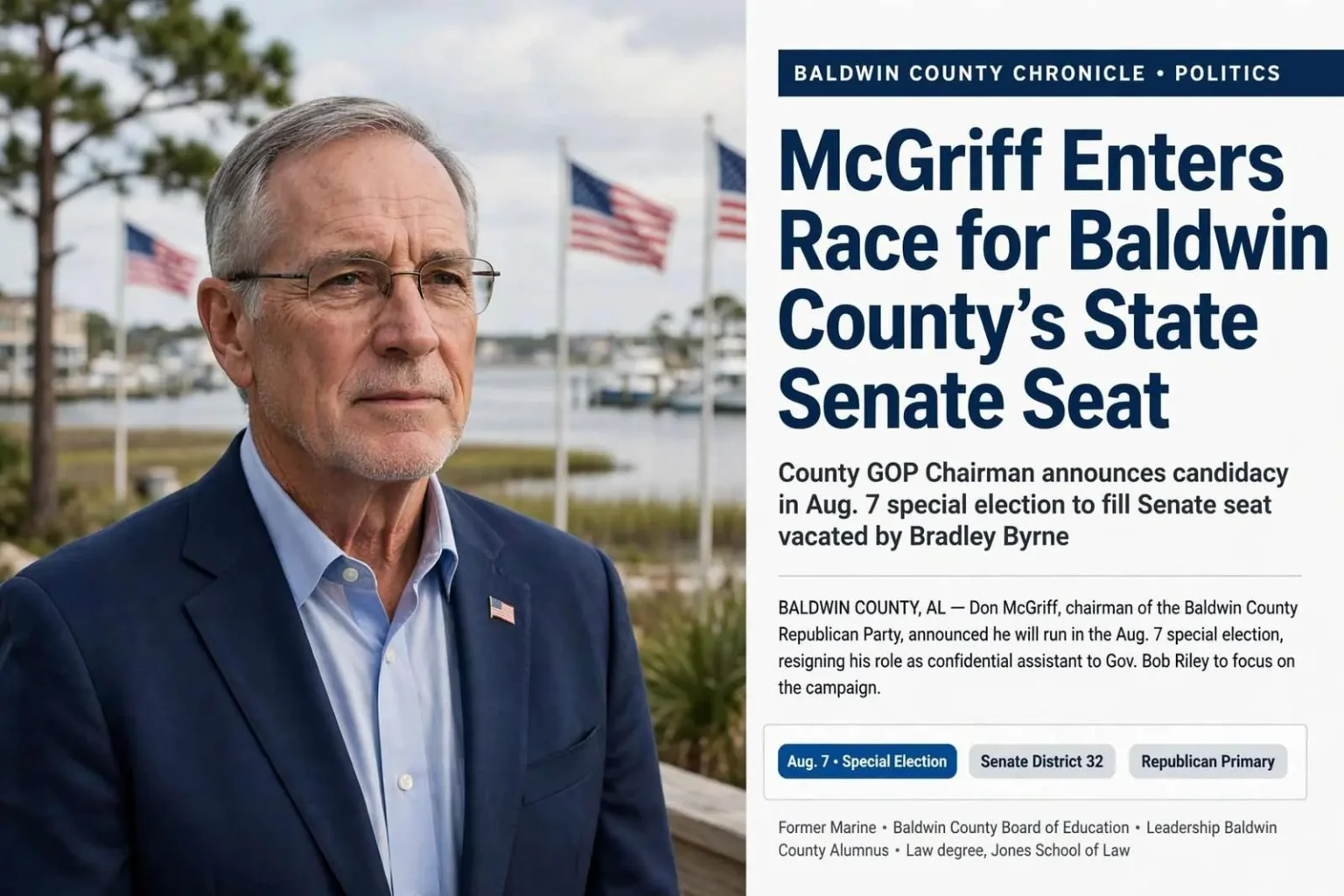
Don McGriff, chairman of the Baldwin County Republican Party, announced that he would run in the Aug. 7 special election to fill the state Senate seat vacated by Bradley Byrne, entering a crowded Republican field for one of the county’s most closely watched races. The announcement put the county party’s own chairman on the candidate side of a contest that was already drawing some of the most established names in Baldwin County politics, and it guaranteed that the seat’s future would be decided among Republicans in a district where the party’s nomination has long been the decisive hurdle.
Byrne had left the seat to become chancellor of the state’s two-year college system, opening a contest that quickly drew several established Baldwin County figures. Byrne, a Mobile-area attorney and former state school board member who had built a reputation in the Senate for education policy work, moved to the postsecondary education post in state government, and Governor Bob Riley’s call for a special election set the calendar that candidates on both sides of the bay had to plan around.
Special elections in Alabama move on a compressed schedule set by the governor’s writ, which compresses campaign timelines into a matter of weeks rather than months. Candidates in that window lean heavily on the organizations and name recognition they already hold, and turnout in a summer special election tends to be driven by the most engaged voters — precisely the electorate where a county party chairman with decades of civic visibility starts with an advantage. The calendar also leaves little room for error: qualifying deadlines, campaign finance filings and the first rounds of candidate forums all arrive in quick succession once the election date is announced.
The district’s geography made the race a true Baldwin County contest. Senate District 32 encompasses the county from the Eastern Shore communities along Mobile Bay to the fast-growing Gulf-front cities, and its voters have historically been among the most reliably Republican in Alabama. A county of that political makeup meant the Aug. 7 special election functioned as the true general election, with the winner positioned to hold the seat for years to come.
A Resignation on Principle
McGriff said he had most recently served as a confidential assistant in the office of Gov. Bob Riley but had resigned that post in order to run. “I do not believe it is fair to the taxpayer to receive a state or county pay check while running for another public office,” McGriff said. “It just goes against my principles.”
The resignation drew a clear line between McGriff and candidates who campaign from their existing government posts. Statehouse candidacies often unfold while the officeholder continues drawing a public salary, a practice legal in most cases but frequently criticized. By stepping down before announcing, McGriff put the issue in front of voters directly and framed his candidacy around a personal ethic rather than a policy platform, a message tailored to a county where taxpayer watchdog politics run strong.
His position in the governor’s office had also given him a window into state government that few local candidates enjoy. Confidential assistants handle the flow of policy, appointments and constituent concerns across a governor’s administration, and the experience meant McGriff had watched the Legislature work from the inside — the committee process, the budget negotiations and the personal relationships that determine what actually passes in Montgomery.
A Long Record in the County
McGriff came to the race with a lengthy public and civic resume. He had served on the Baldwin County Board of Education and had previously been the Republican nominee for lieutenant governor. He led the county party through the most recent gubernatorial and congressional election cycles.
Each line of that record carried weight with a different slice of the county’s voters. Service on the county school board connected him to the classroom-level debates over growth, funding and school construction that Baldwin County’s rapid population gains had made constant. A prior run for lieutenant governor gave him statewide campaign experience and a network of donors and supporters beyond the county line. And years chairing the county Republican Party meant he had personally organized the political machinery that would now be asked to send him to Montgomery — a position that brought both advantages and the challenge of competing against fellow Republicans he had helped elect.
A former Marine, McGriff had lived in Baldwin County for 35 years following his honorable discharge. He pointed to a background in business and engineering as the foundation of his approach to the office.
“My business experience has given me a strong work ethic, my work on many local civic boards has given me an understanding for community service, and my time spent with the governor and in the capitol has given me a solid respect for and understanding of the legislative process,” he said, adding that he was confident he could be “a productive and effective voice for Baldwin County.”
Civic Roots Across the Eastern Shore
McGriff was a Rotarian, an alumnus of Leadership Baldwin County and a member of Baldwin County United, and had served on the board of the Eastern Shore Chamber of Commerce. The affiliations traced the geography of his public life: Rotary’s Eastern Shore clubs have long been where the area’s business and civic leaders meet weekly, Leadership Baldwin County functions as the county’s civic boot camp for emerging community figures, and Baldwin County United brings together volunteers around quality-of-life issues across the county.
The Eastern Shore Chamber board seat put him at the center of the economic development conversation in Daphne, Spanish Fort and Fairhope, the communities where Baldwin County’s population growth has been most concentrated and where questions of infrastructure, annexation and commercial development dominate local politics. A state senator from Baldwin County walks into the Montgomery budget process carrying those same local debates, and candidates who had sat on the chamber side of the table made that experience a selling point.
Education and Preparation
McGriff held a law degree from the Jones School of Law and had studied at the University of Alabama and the University of South Alabama. The academic path combined two of Alabama’s major public universities with a law school in Montgomery, where classroom study of the legislative branch sits a short drive from the Statehouse where it operates.
His military service remained a touchstone of his biography as well. Former Marines on the campaign trail tend to frame their candidacy around discipline and mission focus, and in Baldwin County — home to a substantial population of veterans drawn by the Gulf Coast’s military installations across the bay and to the west — that biography line resonates with a broad slice of the electorate. Thirty-five years of continuous residence also mattered in a county where newcomers now outnumber longtime families in many neighborhoods, and where a candidate who remembers the county before its growth boom can speak to both audiences at once.
For voters weighing a crowded field, credentials of that kind serve as a signal of preparation rather than a promise of outcomes. A law degree matters in a legislature that writes and rewrites the state’s legal framework, an engineering background speaks to the infrastructure problems that dominated Baldwin County’s agenda, and study across multiple Alabama campuses reflected a career lived inside the state’s public institutions.
What the Race Meant for the County
Special elections for legislative seats rarely draw the attention that countywide races do, but the contest to succeed Bradley Byrne was different for two reasons. First, Byrne had been an unusually prominent state senator, and his departure for the two-year college chancellorship left a gap in Montgomery representation that several ambitious figures believed they could fill. Second, Baldwin County’s explosive growth had made the county one of the most consequential political units in Alabama, with new subdivisions, new schools and new roads arriving faster than the state’s budget cycles could keep pace with.
The issues separating the Republican field were, in the main, questions of emphasis rather than ideology: which candidate would push hardest on road funding for the county’s overtaxed highways, who would best protect the education funding formulas that Baldwin County’s schools depended on, and who could deliver on the coastal-specific concerns — insurance costs, tourism infrastructure and the health of Mobile Bay — that a Baldwin County senator carries to Montgomery alongside the county’s usual priorities.
McGriff entered the race arguing that his combination of military discipline, business experience, school board service and insider knowledge of the Riley administration made him the candidate best prepared to be effective from the first day of a legislative session. With the Aug. 7 election set and a crowded field forming around him, his campaign leaned on the theme that had run through every stage of his public life — service to Baldwin County, grounded in the belief that preparation in the private and civic sectors translates directly into results in the Statehouse.