Artur Davis Brought a Campaign for Governor to Mobile — and a Pronunciation Lesson
The congressman told about 100 Mobile Democrats that Alabama's past need not dictate its future, made education his central theme, and asked the city's television anchors to note that his name is Artur.
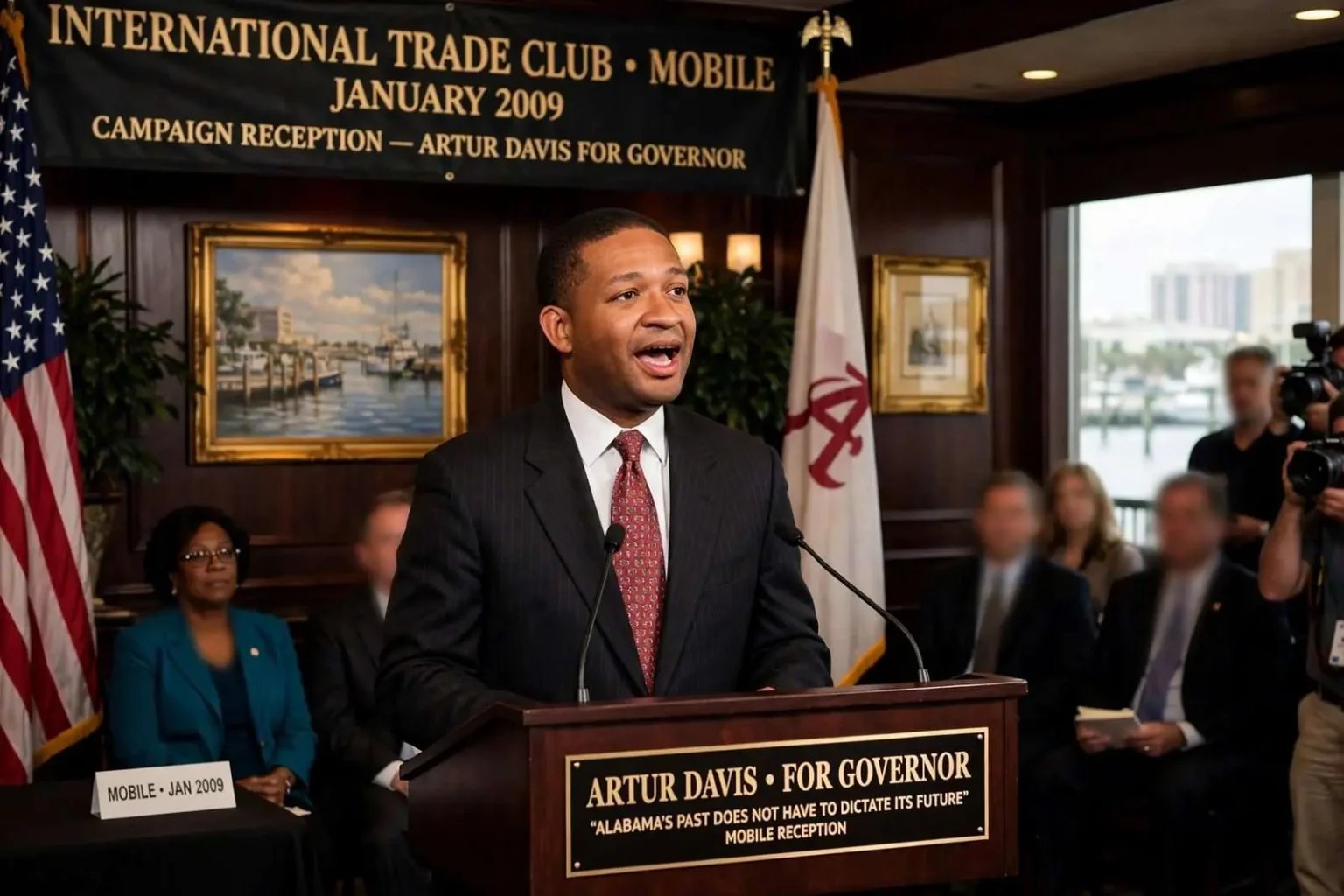
MOBILE — If Sam Jones’ election in 2005 as Mobile’s first black mayor offered a preview of Barack Obama’s national future, the question hanging over a reception at the International Trade Club was whether Obama’s victory had, in turn, opened a path for U.S. Rep. Artur Davis to become Alabama’s first black governor. Davis had made his plans public in Birmingham days earlier. He followed that appearance with the Mobile reception, where roughly 100 area Democrats and members of the news media gathered to hear his introductory campaign address. The crowd reflected the political base Davis would need to mobilize: African-American elected officials, party activists and a handful of white business leaders curious about the new congressman’s prospects.
‘Alabama’s past does not have to dictate its future’
A skilled and at times eloquent speaker, Davis delivered a talk of 20 to 25 minutes that could fairly be distilled into a single sentence: Alabama’s past does not have to dictate its future. His central theme was education. He called for a deeper commitment to the state’s schools, with corporations carrying a heavier share of the burden in exchange for a better-trained workforce. He returned repeatedly to a comparison that Alabamians feel in the bone. “Alabama’s children deserve the best public school system we can possibly provide,” Davis said. “We can’t if we’re 42nd in the nation and bragging because we’re not 48th. That’s not the standard we have for our football teams. What we ask of our football teams is more rigorous than what we ask of our schools.” If a parent chose a private school, he added, the reason should not be the failure of the public one. “It will be my job to see that the reason is not because the public school, the neighborhood school, is not good enough.”
The line that drew the warmest local applause was about the tanker: Mobile should and would get at least part of the $40 billion contract to build aerial refueling tankers for the U.S. military. The contract, awarded to a team led by EADS (now Airbus) and Northrop Grumman, became one of the most-watched industrial competitions in Mobile’s history and a centerpiece of the city’s economic development pitch. Davis’s vow to fight for the contract in Washington played directly to a Mobile audience that had watched the competition unfold in public hearings and political debates for months.
The Obama Parallel, Spoken and Unspoken
Davis did not draw the comparison explicitly, but it hung in the room. Many Alabama Democrats, including prominent African-American figures, had backed Hillary Clinton in the 2008 primary. Davis had been an early and visible Obama supporter, and his standing among black voters in the state gave him credibility that other potential candidates could not match. By the time he appeared at the International Trade Club, Obama had won the White House. The implicit question Davis’s reception was designed to answer: could a Democrat, and a black Democrat at that, win statewide in Alabama? Davis argued that the answer was yes, and that the same energy that had put Obama over the top in November could lift a credible Democratic candidate in a state like Alabama if the campaign was disciplined and the message was right.
A Pronunciation Lesson Worth Remembering
Davis, who grew up in Montgomery and was educated at Harvard Law School and Oxford, spoke with the polish of someone who had spent years preparing for exactly this moment. He did not stumble over Mobile’s geography or its political history. But the audience got its own brief lesson when, near the end of his remarks, Davis worked in the city’s name and pronounced it in a way that made clear he was a newcomer to the Gulf Coast. Several older attendees, who had heard generations of politicians misspeak in front of Mobile audiences, exchanged amused glances. The episode was a small reminder that even a polished statewide candidate can show his out-of-town roots on the wrong side of the map.
What the Reception Revealed
The reception itself, held at one of Mobile’s oldest private clubs, was a study in coalition politics. African-American party loyalists made up the bulk of the room, but there were also white trial lawyers, port executives, hospital administrators and the occasional academic, all of them curious about whether Davis could assemble the kind of multiracial coalition that Jones had assembled four years earlier. Jones’s 2005 victory over incumbent Mike Dow had been a watershed, the first time a black candidate had won a citywide race in Mobile. Whether the same kind of turnout could be replicated at the state level was the open question, and the reception did not resolve it.
Davis’s Path Forward
At the time of the reception, Davis had not formally declared his candidacy for governor, but his appearance made his intentions clear. He would go on to enter the 2010 Democratic primary for governor, facing state agriculture commissioner Ron Sparks and others. He would ultimately lose the primary to Sparks, who then lost the general election to Republican Robert Bentley. Davis’s career would later move in a more conservative direction, including a switch to the Republican Party after he left Congress. But in the weeks after Obama’s election, the Mobile reception was the clearest signal yet that Alabama Democrats saw a path forward that ran through the same kind of multiracial coalition that had just elected the country’s first black president.
Davis’s Mobile reception was more than a campaign stop. It was a marker of how the political landscape had shifted since Sam Jones’s 2005 victory and how those shifts were reverberating through Alabama politics. Jones himself had been talked about as a potential challenger to Davis in the Democratic primary, though he ultimately declined. Other African-American officeholders around the state were weighing their own statewide ambitions. The reception, by bringing so many of Mobile’s Democratic activists into one room, became a kind of early organizational meeting for a coalition that Davis hoped to build into a credible gubernatorial campaign.
The Tanker Question and Mobile’s Economy
For all his talk about education and coalition-building, Davis knew that the Mobile audience wanted to hear about the tanker contract. Mobile had spent the better part of two decades trying to position itself as a center for aerospace manufacturing, and the Air Force’s KC-X tanker competition had become a defining test of those ambitions. EADS, the parent company of Airbus, had chosen Mobile as the site for its final assembly facility, with the explicit hope that the tanker contract would follow. Davis’s promise to fight for the contract in Washington was a familiar refrain from Alabama Democrats, but it carried weight precisely because Obama’s victory meant a Democrat would now occupy the White House. Whether Davis could deliver would depend on a host of factors, including whether the contract was awarded on technical grounds and whether the Mobile workforce could meet the production schedule that came with it.
The Crowded 2010 Field
By the time Davis formally entered the race, the Democratic field had grown. Ron Sparks had already declared and was actively campaigning in north Alabama, framing himself as a populist who could win back white working-class voters who had drifted toward the Republican Party. Lt. Gov. Jim Folsom Jr. was also mentioned as a possible candidate, though he ultimately did not run. The result was a primary that would test whether Davis’s coalition of African-American voters, college-educated whites and urban professionals could outpoll Sparks’s broader but less reliable base. The Mobile event, by giving Davis a foothold on the Gulf Coast, was an early move in that contest.
Why the Reception Still Matters
More than a decade later, the reception at the International Trade Club is remembered mostly by political historians and by the small number of attendees who still talk about that night. But it captures a moment when Alabama Democrats believed the state was on the verge of a political realignment, when Obama’s election had created an opening that no statewide Democrat had been able to exploit since the 1990s. Whether that belief was ever realistic is a separate question. What the Mobile reception shows is that the belief was genuine, that Davis made a serious effort to capitalize on it, and that the Democratic infrastructure in Mobile was willing to show up and listen, even if the candidate who addressed them would not be the one to break through.
A Look Back at Mobile’s Democratic Tradition
Mobile has long been one of the more reliably Democratic cities in a reliably Republican state. African-American voters in the city have voted overwhelmingly Democratic for generations, and white voters in older neighborhoods and along the coast have often broken for Democrats when the candidate was the right fit. Sam Jones’s 2005 victory was the high-water mark of that tradition in the modern era, and his success was built on a multiracial coalition that few other Alabama Democrats have been able to replicate. Davis’s reception was, in a sense, an attempt to export that coalition statewide. It is a sign of how steep the challenge was that even with Obama’s victory fresh in everyone’s memory, the attempt failed. Alabama would remain a reliably red state, and the coalition Davis tried to build would prove difficult to sustain.