Federal Prosecutors Drop Remaining Tax Charges Against Mobile County’s Kim Hastie
Federal prosecutors moved to dismiss remaining tax charges against Mobile County License Commissioner Kim Hastie after a string of courtroom losses.
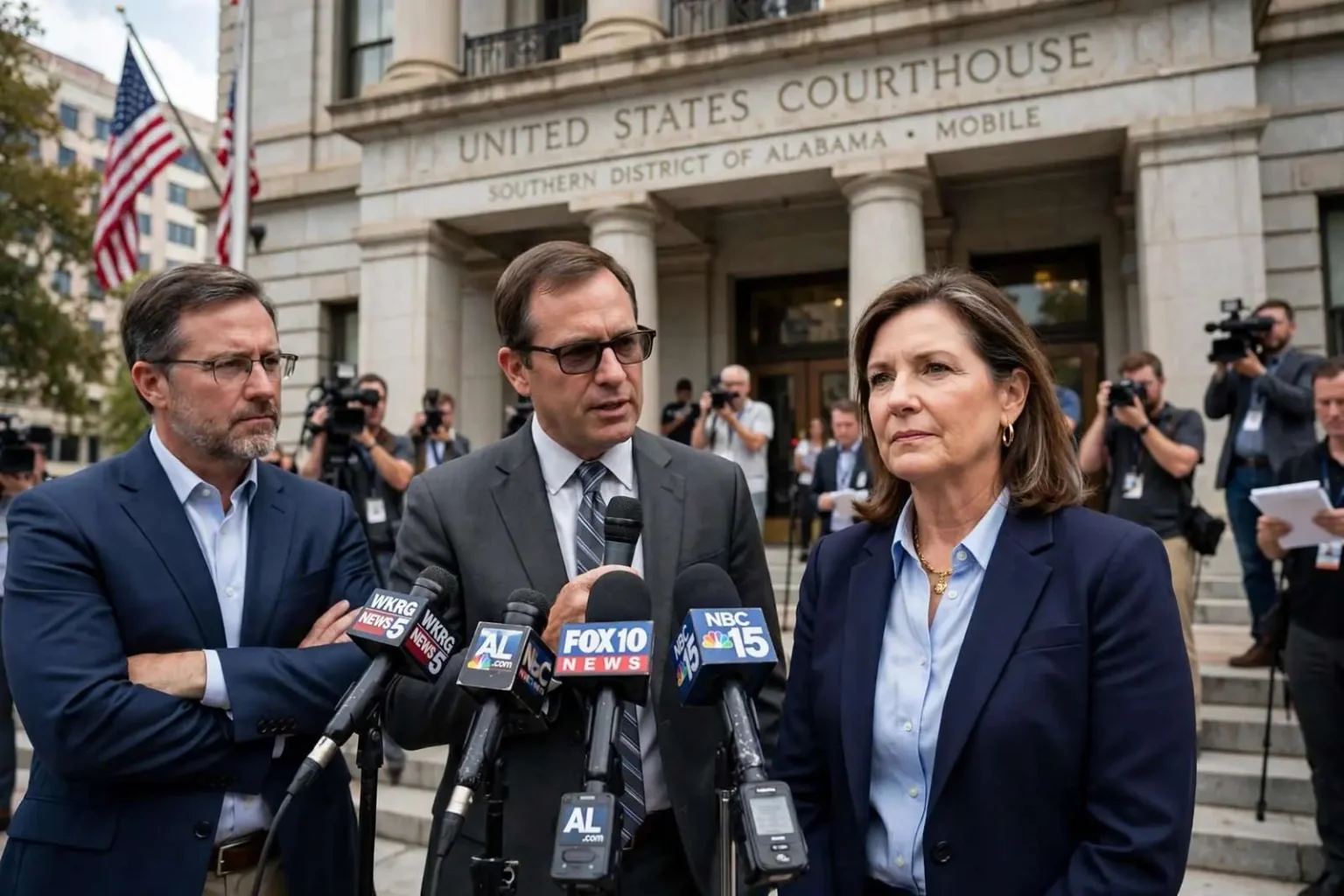
Federal prosecutors moved to drop the remaining tax charges against Mobile County License Commissioner Kim Hastie, a decision her defense team characterized as a clear signal that the government’s case had unraveled after a string of courtroom setbacks. The motion to dismiss marks the latest — and potentially final — turn in a prosecution that has stretched across multiple trials, a mistrial and a mixed verdict, and it leaves Hastie’s legal standing dramatically different from what it appeared to be when the case began. For an elected official whose office touches thousands of Mobile County residents every week, the government’s retreat represents a striking reversal of fortune.
“I think they got their butt whipped, and that’s part of it,” Hastie’s attorney, Neil Hanley, told reporters gathered for a Saturday morning press conference outside the federal courthouse. Hanley’s assessment was blunt, but it reflected the arithmetic of the case as it had unfolded in recent months: jury after jury declined to accept the government’s central claims, and prosecutors were left weighing whether any remaining count was worth the cost of another trial. The press conference drew local reporters and photographers to the steps of the downtown Mobile courthouse, a familiar stage for a case that has attracted sustained public attention.
Hastie and her husband, John, attended the announcement but declined to comment publicly until the dismissal is formally approved by the presiding judge. That caution is a practical necessity as much as a strategic one. A prosecutor’s motion to drop charges does not take effect on its own; under federal rules, the government must seek leave of the court, and a judge must sign off before the counts officially disappear from the docket. Until that order is entered, the case technically remains live, and defense lawyers routinely advise clients to say nothing that could complicate the final step.
The move brings to a close, or near-close, a lengthy public corruption case that had dogged the elected license commissioner for months. Hastie holds a countywide office that most residents encounter in mundane but unavoidable ways: registering vehicles, transferring titles, and obtaining the license plates and driver’s licenses that keep daily life moving. Because the office interacts with so many people, an extended criminal case against its elected head carried consequences well beyond the courtroom, casting a shadow over routine transactions and making every court date a matter of local interest.
The prior month, a jury had acquitted Hastie of all but one of the criminal charges she faced, clearing her of 16 of 17 public corruption counts. That verdict was a sweeping rejection of the prosecution’s core theory, and it came after weeks of testimony and deliberation. Jurors did convict her on a single, lesser count tied to the improper release of a list of individuals who had obtained driver’s licenses through her office. That count, the only one on which the government prevailed, alleged misuse of records rather than financial gain.
A Records Case With Political Consequences
The list at the center of the surviving conviction later surfaced in a local mayoral campaign, which used it in an effort to identify and target voters. The episode tapped into a concern that extends well beyond Mobile: state motor vehicle databases contain sensitive personal information, and the law restricts how that data can be shared and used. When license records migrate from a government office into a political operation, questions about privacy and public trust follow, regardless of how the information ultimately gets deployed.
Hastie was not the only official swept up in the case. Her deputy was tried alongside her on nine related corruption counts and was acquitted on all of them, a result that further undercut prosecutors’ broader theory of coordinated wrongdoing inside the license commissioner’s office. A clean sweep for the deputy made it harder for the government to argue that the office operated as a criminal enterprise, and it left the single conviction against Hastie standing as an outlier rather than the centerpiece of a wider conspiracy.
The Tax Case and Its Troubles
The tax charges targeted for dismissal stemmed from a separate allegation: that Hastie and her husband had conspired to avoid reporting roughly $58,600 in income to the IRS, tied to land transactions, timber cutting and land-clearing work. Cases of that kind typically turn on dense financial records and contested questions about how income from land sales, timber harvests and clearing contracts should be characterized and reported. They are often built over years, and they demand that jurors follow paper trails involving deeds, contracts, payments and tax forms.
That portion of the case had already hit a wall earlier in the year when the presiding federal judge declared a mistrial after jurors could not reach a verdict on the tax fraud counts. A hung jury is not an acquittal, but it is rarely an encouraging sign for prosecutors, who must convince twelve unanimous jurors beyond a reasonable doubt. When a first panel deadlocks, the government has to decide whether a retrial is likely to produce a different outcome or simply repeat the same fight at considerable public expense.
According to Jeff Deen, the attorney representing John Hastie, prosecutors continued weighing whether to retry the tax allegations before ultimately deciding to abandon them. The decision to walk away from a hung case is not unusual, but it is rarely made quickly. Prosecutors must weigh the strength of their evidence, the likelihood that a second jury would agree, the resources a retrial would consume, and whether a conviction on the remaining counts would meaningfully change the outcome. In this instance, the pattern of the case — one acquittal after another — appears to have answered that question for them.
Federal tax prosecutions occupy a distinctive corner of the criminal law. To convict, the government must prove beyond a reasonable doubt that a defendant willfully attempted to defeat or evade a tax that was due, and willfulness is famously difficult to establish. Income from land transactions, timber cutting and land-clearing work often flows through informal arrangements — handshake agreements, seasonal payments, proceeds split among family members — and disputes frequently center on whether an omission was a deliberate scheme or a bookkeeping failure. Juries asked to sort out those questions do not always reach the conclusion prosecutors intend.
The mistrial earlier in the year illustrated the point. After deliberating on the tax fraud counts, the jury reported that it could not agree, and the judge had no choice but to declare a mistrial and discharge the panel. From that moment, the clock was running on the government’s decision. Every additional month spent preparing a retrial would carry costs — witness availability, exhibit preparation, courtroom time — with no guarantee of a different result, while the defense gained the benefit of seeing exactly how the first presentation played out.
What Happens Next in the Case
The dismissal motion now heads to the presiding judge, who must approve it before the tax counts are formally removed. In the federal system, prosecutors invoke a rule that allows the government to drop an indictment with the court’s consent, and judges routinely grant such motions when the government explains its reasons. Once approved, the dismissal ends the tax case for good, and the only remaining piece of the entire prosecution will be the single conviction on the records count, with any sentencing to be scheduled by the court at a later date.
For the Hastie family, the sequence of events represents an almost complete vindication, even if the final paperwork is still pending. An acquittal on 16 of 17 counts, a full acquittal for the deputy, a hung jury on the tax counts, and now a motion to abandon those counts altogether compose a record that defense attorneys describe as rare in federal court. Public corruption cases are pursued carefully and often successfully by federal prosecutors, which is why a collapse of this scale draws attention from lawyers and observers well beyond Mobile.
The case also offers a procedural education for local residents who may not follow federal court practice closely. A mistrial is not an acquittal, but it is not a conviction either; it simply means the jury could not agree. A dismissal by prosecutors is different from either — it is a judgment by the government itself that continued pursuit of the case is not warranted. And a single conviction on a lesser count does not erase the acquittals that surround it; it stands only on the specific conduct the jury found proved.
Lessons for Public Records and Public Trust
Beyond the courtroom drama, the case leaves behind a set of practical lessons for Mobile County residents. The first concerns the security of personal data held by county offices. The driver’s license list at the heart of the surviving conviction contained the names of people who had done nothing wrong except obtain a license through the office, and its journey into a political campaign showed how quickly government records can travel once they leave a building. Residents who assume that information provided to a public agency stays with that agency now have a local example showing why oversight of records matters.
The second lesson concerns the weight of a jury verdict. Over the course of the case, Mobile County residents watched two separate juries decline to convict on the overwhelming majority of the charges, followed by prosecutors themselves concluding that the remaining counts should be dropped. Whatever one’s view of the original allegations, the outcome is a reminder that an indictment is an accusation, not a finding of guilt, and that the proof required at trial is a deliberately high bar — one the government failed to clear nearly everywhere it tried.
For the license commissioner’s office itself, the end of the case should bring a measure of normalcy. The office continues to handle the vehicle registrations, titles and licensing transactions that residents depend on, and its day-to-day work proceeds regardless of what happens in court. Employees who spent months working under the shadow of the investigation now have clarity about the legal landscape, and county residents can expect the office to function as it always has while any remaining proceedings play out.
The final chapter is not yet written. The judge must still approve the dismissal, and sentencing on the single conviction remains ahead. But the trajectory is unmistakable: a prosecution that once threatened to define an elected official’s career has been reduced to a single count, and the government has signaled that it intends to fight no more of it. When the judge signs the order, Mobile County’s longest-running local corruption saga in recent memory will effectively be over, and Kim Hastie will have survived it with her office — and most of the charges against her — intact.