Dauphin Islanders Rally to Save Their Little Red Schoolhouse
A group of Dauphin Island residents launched a fundraising drive to move and preserve the island's beloved little red schoolhouse, aiming to turn the 1930s building into a heritage and arts center.
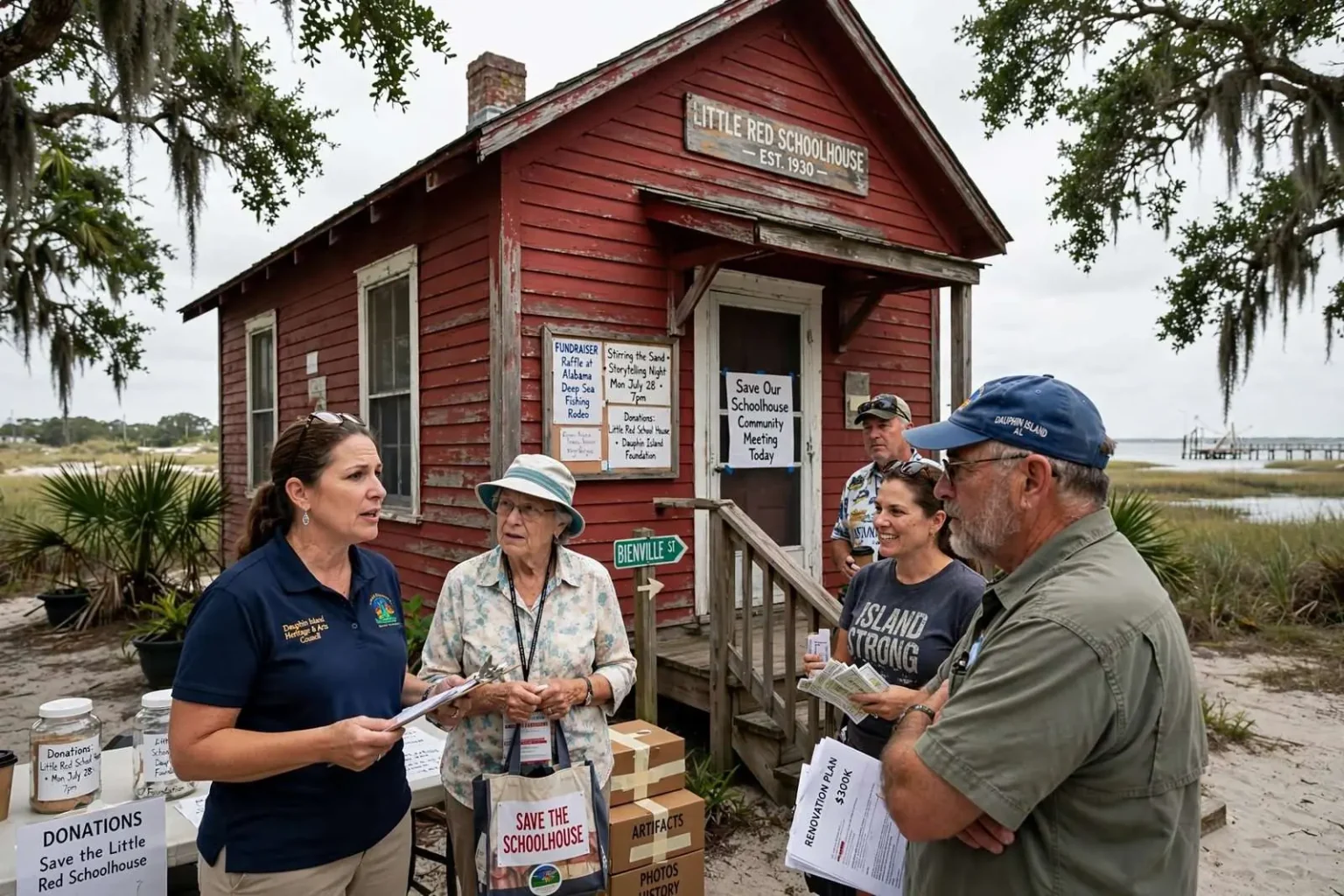
The little red schoolhouse on Dauphin Island has long held a special place for those who live on the barrier island, and a group of residents set out to make sure it endures. As plans advanced for a new school, islanders organized to preserve the old building rather than see it lost. The effort joins the island’s small year-round population to a building that taught several generations of their children, and it asks a question coastal communities across the Gulf face as they modernize: what is worth keeping when the new replaces the old. “It’s a big project, but we’re confident we can do it,” said Kathryn Carver, who was leading the fundraising effort.
Dauphin Island sits at the mouth of Mobile Bay, connected to the mainland by a single bridge and reachable by nothing else when storms close the causeway. An island of that geography holds its landmarks close. The schoolhouse has served generations of island children whose families fished, worked the water and weathered hurricanes together, and for many of them the little red building is as much a fixture of the island as the fort, the pier or the Shell Mounds. Saving it became a community project before anyone had drawn up a budget.
From the Shell Mounds to Bienville
The schoolhouse was built in 1930 near the Shell Mounds, a few blocks west of Cadillac Square and a street north of Bienville. The original building held two rooms, a hall and an auditorium. Islander Clinton Collier recalled that in the early 1960s the school was moved to its current location on Bienville, near the public beach and pier, and additional classrooms were added in the early 2000s. The building’s two moves — first from its original site near the mounds, then onto the town’s main street — trace the island’s own development across a century.
The Shell Mounds themselves give the original site its significance. The mounds are ancient deposits of shells and earth left by Native American peoples over centuries, and they rise as some of the only natural high ground on a low-lying barrier island. Today the area around them is preserved as a park and bird sanctuary, a stop for migratory birds and the birdwatchers who follow them, and one of the island’s most visited natural sites. A schoolhouse placed near the mounds in 1930 sat at what islanders considered the heart of their community.
Life on a barrier island has always shaped what the school meant to the families it served. Children attended classes within sight of the water that employed their parents, and storms that closed the bridge closed the school. When hurricanes swept the coast, the island rebuilt around its institutions — the church, the fire department, the school — and the little red building accumulated decades of memories on top of its function. By the time plans for a new school took shape, preserving the old one had become a matter of local identity rather than simple real estate.
Town Councilmember Shirley Robinson said the council had been working with architect William Phillips, an island resident, to determine what would be needed to move the school to a new location. The relocation was estimated to cost up to $300,000. Robinson said the plan was to renovate the schoolhouse rather than fully restore it. The distinction matters for both budget and use: a renovation keeps the building sound and serviceable without the expense and strictures of a full historical restoration, and it allows the interior to be adapted for the community purpose organizers have in mind.
A Fundraising Drive Takes Shape
Carver, of the Dauphin Island Heritage and Arts Council, said the moving fund was launched with a $20,000 grant from BP, and that a committee of volunteers was working to apply for additional grants. Alongside the grants, the group planned a series of fundraisers. The BP grant gave the project a foundation and a signal to other funders that the effort had institutional backing — often the hardest hurdle for a small town’s preservation campaign, where organizers must show momentum before larger grants follow. A committee formed specifically to chase those grants meant the paperwork would proceed even as volunteers handled the events.
The most recent had been a raffle held during the 81st Alabama Deep Sea Fishing Rodeo. The rodeo, held at Dauphin Island each summer, is a fixture of the Gulf Coast sporting calendar, drawing thousands of anglers and spectators to the island for three days of competition across dozens of categories. For a fundraising committee, the rodeo crowd represents the largest single audience the island assembles all year — which is why the raffle piggybacked on the event. Every ticket sold connected the schoolhouse project to visitors and anglers who may have known the island only as a fishing destination.
The next event, called “Stirring the Sand,” was scheduled for Monday, July 28, and would feature stories of Old Dauphin Island shared at the little red schoolhouse beginning at 7 p.m. The format made the building itself part of the program: longtime residents sharing memories of the island’s past inside the very structure they hope to save. Storytelling evenings of this kind have become a staple of small-town preservation campaigns, because they convert abstract fundraising appeals into evenings where the community’s own history is the entertainment — and where the check-writing feels like joining the story rather than funding a building.
Small communities run fundraisers on volition rather than budget, and Dauphin Island’s campaign followed the pattern. The town’s year-round population is modest, and its seasonal visitors come and go, so every event depends on volunteers, donated goods and word of mouth. What the island lacks in deep-pocketed donors it makes up in persistence — a quality residents often describe as necessary for anyone who chooses to live behind a single bridge on a barrier island. The schoolhouse effort tapped exactly that spirit.
A Future Home for History and Art
Once moved, Carver and Robinson said, the building would become the Dauphin Island Heritage & Arts Center. Half of the facility would be dedicated to the island’s history and operated by the Town of Dauphin Island, with organizers hoping residents would donate artifacts and photographs so visitors could learn more about the island’s past. An island that has survived hurricanes, hosted a French colonial fort, served as a Civil War bastion and sheltered generations of fishing families has no shortage of material; what it has lacked is a dedicated place to keep and show it.
“The more I learn, the more I want to learn. It’s a unique place in the state,” Carver said. Her words capture what organizers encountered as the project progressed — each interview with a longtime resident, each photograph pulled from a family album, turned up another strand of the island’s story. Dauphin Island’s history is unusually layered for a community its size, reaching from Native American shell mounds through French colonial exploration, Civil War fortifications, the growth of the fishing industry and the modern era of tourism and conservation. A history center on the island would give that record a permanent home.
The other half would serve as an art gallery operated by the Dauphin Island Heritage and Arts Council, showcasing and selling work primarily by island artists. The center would also host art classes and other arts-related programs. Combining the two uses under one roof is deliberate: the gallery’s sales would help sustain the center financially, the art classes would give it a steady stream of visitors beyond the tourist season, and the pairing reflects the council’s founding mission of connecting the island’s creative community with its history.
Preservation campaigns on islands also carry an argument unique to their geography. Buildings that survive on the coast have already proven something — that they were built well, sited carefully, or simply fortunate — and each storm that passes adds to the record. A structure that has stood on Dauphin Island since 1930 has outlasted some of the most destructive hurricanes in Gulf history, and its plain wooden frame embodies a building tradition that predates modern construction codes. Archivists and historians sometimes note that the ordinary buildings of a community, not just its monuments, tell its story; the little red schoolhouse, plain as it is, may be the most complete witness the island has.
The effort reflected a broader impulse common to small coastal communities, where aging landmarks often carry outsized meaning for longtime residents. On a barrier island shaped by storms and shifting sands, preserving a building that had stood since 1930 became a way of holding onto the island’s story even as a new school rose to serve its children. Islands lose buildings to storms regularly; losing one to progress, by choice, struck the volunteers as unnecessary.
Organizers invited supporters to contribute, asking that checks be made payable to “Little Red School House” and sent to the Dauphin Island Foundation. With grant applications pending and fundraisers on the calendar, the volunteers pressed ahead, confident, as Carver put it, that the project was within reach. The $300,000 estimate remains the mountain to climb, but the climb had begun — with a grant, a raffle, a storytelling night scheduled inside the old classrooms, and an island that has never had much use for giving up.