Statewide Runoff Candidates Make Their Pitch at Mobile GOP Dinner
Five of the six candidates in Alabama's Republican primary runoffs took five minutes each to court party loyalists at a Mobile GOP dinner, with hometown appeals and jabs over Washington shaping the night.
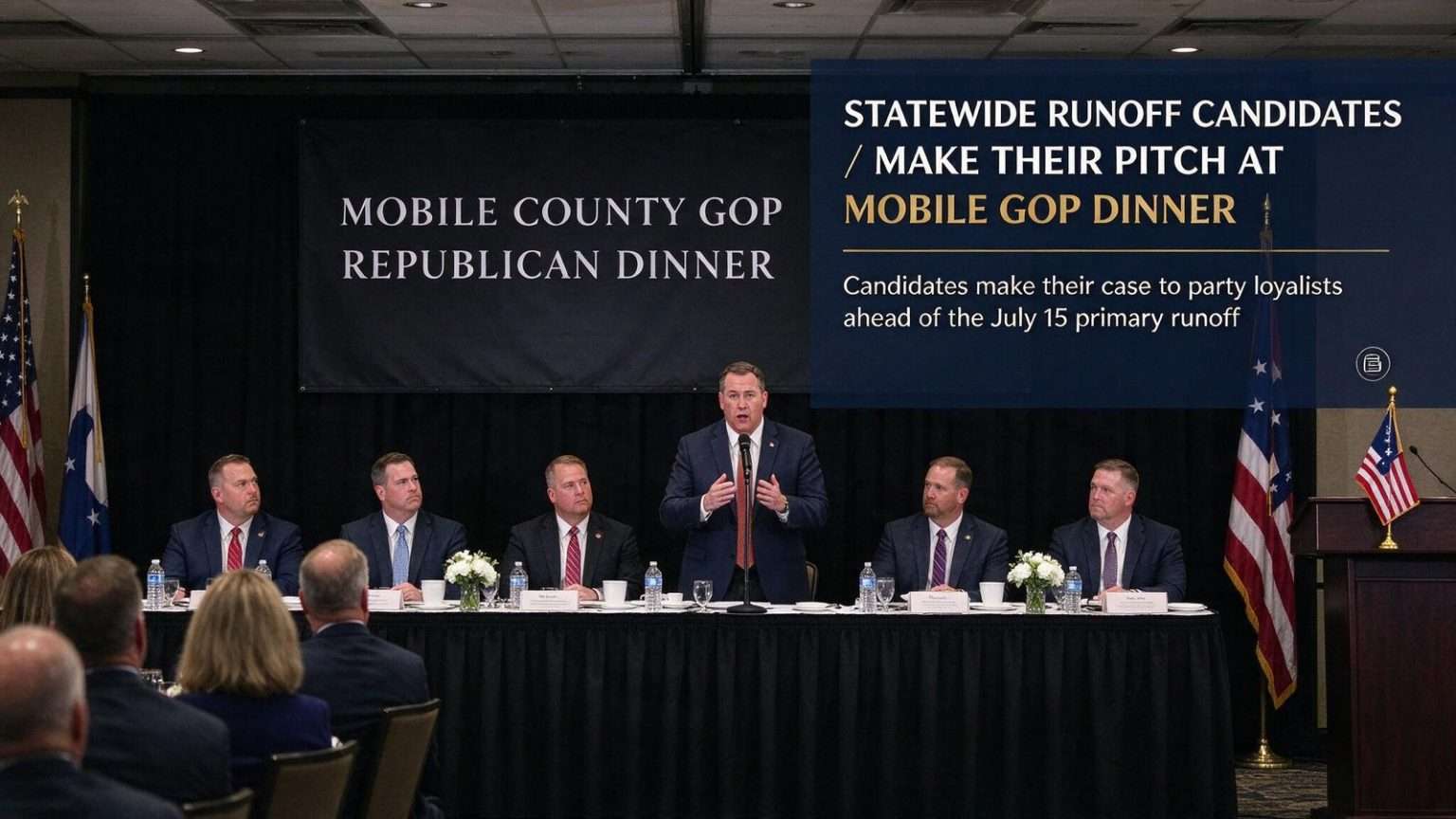
Five of the six candidates for statewide office who would appear on the following week’s Republican primary runoff ballot each got five minutes to make their case to party loyalists at a Mobile dinner hosted by the county GOP.
The gathering drew members of the Mobile County Republican Executive Committee and gave the candidates a chance to sharpen their messages before the July 15 runoff.
A Hometown Appeal in the Auditor’s Race
The only Mobile resident among the contenders, state auditor candidate Jim Zeigler, leaned on his local roots, telling the audience they would not have anyone in state government to call if he lost. He asked for their “unanimous support.”
His opponent, former Marine and retired farmer Dale Peterson, reminded the committee that he, too, had ties to the city. “Well, I was born here,” he said, closing his remarks with, “I’m Dale Peterson, and I’m from Mobile.”
The two offered competing visions for an office that is short on formal authority. “I have a plan to turn the state auditor’s office into something that it’s never been before, and that is a strong monitor of how your tax dollars are spent,” Zeigler said. Peterson called the position a “pretty useless job” and questioned how much either candidate could change it, noting the auditor’s main duty is to account for state property.
The disagreement went to the heart of what the office is for. The state auditor’s constitutional duty centers on the property ledger of Alabama government — the land, buildings, vehicles and equipment the state holds, tracked and disposed of under the auditor’s supervision. It is a custodial job, not a spending one, and generations of candidates for the post have run on little more than careful administration. Zeigler’s pitch proposed to stretch the office into a bully pulpit on government waste, using the platform of a statewide elected official to publicize how tax dollars are spent. Peterson’s answer was to say out loud what the job description says — and then propose the structural changes he thought might give it teeth.
Peterson said he would push to bring accountants from the Department of Examiners of Public Accounts under the elected auditor’s control and to raise pay for election registrars, one of whom the auditor appoints in most counties.
Both proposals ran into the same wall any auditor faces: the office’s powers are set by statute and the constitution, and the Department of Examiners of Public Accounts — the legislative audit arm that examines the books of counties, municipalities and state agencies — answers to the Legislature, not the auditor. Changing that arrangement would require the Legislature to reorganize its own oversight apparatus, a heavy lift for an office with no vote in the State House. The election registrar pay question, by contrast, sat closer to home: in most Alabama counties the auditor appoints the registrar of elections, a quiet patronage power that matters locally even if it never makes a headline.
The race carried its own history into the runoff. Peterson had already run statewide that cycle with a memorable online video that made his name known far beyond the auditor’s race, and Zeigler — a former legislator, court-of-criminal-appeals candidate and persistent government watchdog from Mobile — had spent years building the exact profile the office-as-watchdog pitch required. Between them they were arguing, in miniature, what kind of person Alabama’s low-profile constitutional offices ought to elect: a manager or an agitator.
Secretary of State and Public Service Commission
The secretary of state runoff pitted former Montgomery County Probate Judge Reese McKinney against state Rep. John Merrill of Tuscaloosa. McKinney argued the office’s election duties aligned closely with a probate judge’s work. “It’s important that we have someone who knows this office,” he said, pointing to training he instituted as probate judge.
The argument rested on a structural fact of Alabama election law: the state’s 67 probate judges double as the chief election officials of their counties, registering voters, qualifying candidates, hiring poll workers and certifying results, while the secretary of state in Montgomery writes the rules, trains the locals and certifies the statewide totals. A former probate judge has spent years on the receiving end of every directive the office issues — and, McKinney suggested, on the receiving end of every election-day crisis the directives failed to anticipate. His record included training programs he built for election officials as probate judge, experience he presented as the difference between administering the office and learning it on the job.
Merrill highlighted his sponsorship of a voter photo-ID law and his work to curb secret political donations funneled through multiple committees. “We’re going to identify the perpetrators and make sure they are investigated,” he said, adding that he would streamline business filings and make adoptions easier.
The legislative record was Merrill’s answer to McKinney’s administrative one. The photo-ID bill he carried was among the most contested measures of its session, and the dark-money issue — political spending laundered through layers of political action committees until its source disappeared — was a recurring scandal theme in Alabama campaigns. Both, he argued, belonged to the secretary of state’s portfolio: the office certifies election systems and regulates the PAC activity and corporate filings that state law routes through it. The business-filings and adoption promises pointed at the office’s quieter functions, which touch far more Alabamians in a year than any election does — the filing desk every new business and every adopting family must visit.
In the Public Service Commission race, former Greene County Commissioner Chris “Chip” Beeker sought to unseat Commissioner Terry Dunn, who did not attend the dinner. Beeker aimed his fire at federal regulators rather than his opponent. “One of the most important jobs this time is to fight federal regulations. The EPA has its targets on Alabama,” he said, vowing to oppose any effort to close coal-fired power plants or raise the cost of coal.
The framing fit the commission’s moment. The PSC regulates the rates Alabama Power and the state’s other utilities charge, and its two elected associate commissioners — the seat Dunn held — had little formal authority over the federal air-quality rules threatening the state’s coal fleet. But those rules, aimed at the coal-fired plants that anchor Alabama Power’s generation mix, threatened to reshape the rates the commission does oversee. Beeker, a Greene County commissioner and longtime party figure from western Alabama’s coal-country edge, argued the commission’s floor should be used to contest the EPA’s agenda; Dunn’s absence from the Mobile dinner left that argument unanswered in the room.
A Local Stage for Statewide Contests
The dinner offered a snapshot of a runoff season in which candidates for lower-profile offices worked to distinguish themselves before a small but committed slice of the electorate. Runoffs typically draw modest turnout, placing a premium on face-to-face appeals to the party faithful.
For Mobile Republicans, the evening carried a local dimension beyond the statewide stakes, with Zeigler pressing his claim as the area’s own candidate and Peterson countering with his birthplace. Their exchange over the auditor’s office captured a recurring theme of the night, as candidates debated not only who should hold each post but what the offices should become.
With the July 15 runoff approaching, the candidates left the Mobile dinner to continue campaigning across the state, their five-minute pitches offering party members a final in-person measure of the choices on the ballot.
Why the Runoff Stage Matters
The mathematics of an Alabama primary runoff explain why six candidates for offices most voters rarely think about were eating dinner with a county committee in July. A statewide primary in Alabama can be decided with a plurality, but a runoff requires a majority, and the second election draws only the most reliable voters in the party — precisely the men and women seated at a county executive committee dinner. A five-minute pitch to that room can outweigh weeks of television aimed at an electorate that will mostly stay home, and the party activists in the room talk to the neighbors, staff the polls and carry the absentee ballot operations that decide close runoffs.
Mobile County’s weight in a statewide runoff made the stop more than courtesy. The county reliably delivers one of the largest vote totals in the state, and its committee’s endorsement, spoken or unspoken, travels through a network of precinct workers who show up in July. For Zeigler, whose home base gave him a natural edge in the room, the evening was about converting familiarity into unanimity; for the others, it was about leaving Mobile with at least a memory that they showed up and stood for questions.
The auditor’s race in particular demonstrated how low-budget statewide campaigns actually operate. Neither candidate was running a television campaign for a office whose salary and profile make advertising an afterthought; the campaign lived in Republican club meetings, county committee dinners, church suppers and radio drive-time slots, retold from event to event. The five-minute format forced each candidate to compress a year’s argument into a single claim — Zeigler’s watchdog promise, Peterson’s plain-spoken reform agenda, the hometown claims of both — and the claims the men made in Mobile that night were the same ones they would make, room after room, until the votes were counted.
The PSC race showed the format’s limits as well. Dunn’s absence meant the committee heard one side of an incumbent-versus-challenger contest, a reminder that in a runoff season, showing up is itself part of the campaign. Incumbents down-ticket often win on the strength of ballot recognition alone; a challenger working the dinner circuit is trying to overcome exactly that, one committee at a time.
When the runoff votes were counted days later, the appeals made in Mobile would be tested against the only measure that matters in low-turnout elections: which campaign had done the slower, smaller work of reaching the voters who actually came out. The dinner was the last scheduled look for most of the committee before then, and every candidate in the room treated it accordingly — five minutes each, carefully spent.