Battle of Mobile Bay Stamp to Be Dedicated at the History Museum of Mobile
The History Museum of Mobile prepared to host a first-day-of-issue ceremony for a postage stamp marking the 150th anniversary of the Battle of Mobile Bay, with the postmaster general set to dedicate it.
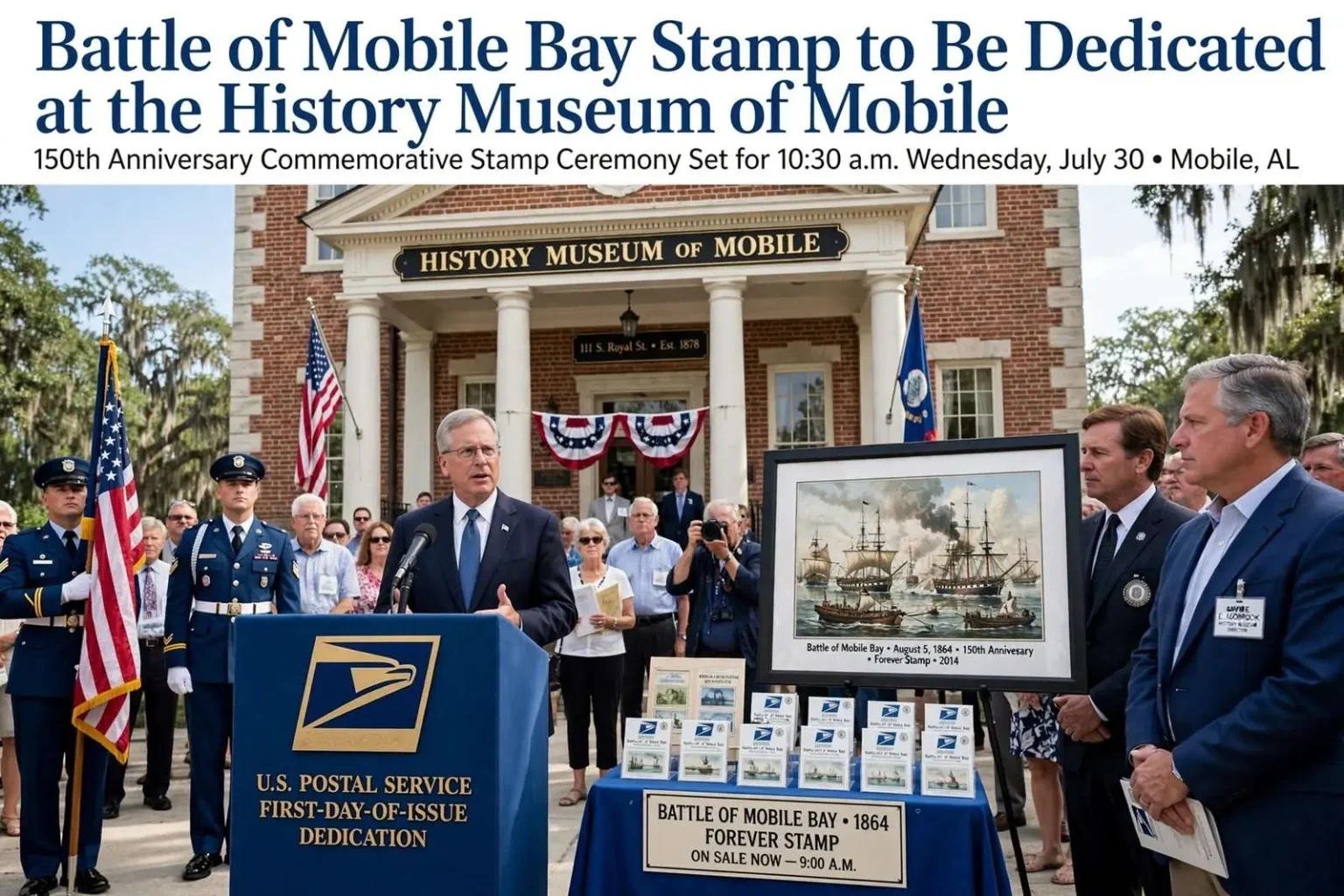
The History Museum of Mobile prepared to host a dedication ceremony for a postage stamp commemorating the 150th anniversary of the Battle of Mobile Bay, drawing the nation’s top postal official to the coast for the occasion. The ceremony was set for 10:30 a.m. on Wednesday, July 30, at the museum at 111 S. Royal St., the historic downtown building that has long served as the city’s repository of local history, and the public was invited to attend.
Patrick R. Donahoe, the postmaster general and chief executive of the U.S. Postal Service, was to serve as the dedicating official for the first-day-of-issue stamp. A postmaster general’s appearance at a first-day ceremony is a mark of the significance the Postal Service attaches to a subject, and the choice of Mobile as the dedicating city reflected the deep connection between the battle being honored and the port city where it was fought.
A wartime scene in miniature
The commemorative stamp depicts Admiral David G. Farragut’s fleet at the Battle of Mobile Bay on Aug. 5, 1864, the Union naval assault that effectively closed the bay to blockade runners and stands among the most famous naval engagements of the Civil War. The image is a reproduction of a painting by artist Julian Oliver Davidson, a marine artist of the late 19th century whose canvases of naval battles were widely admired, published around 1886 by Louis Prang & Co., the Boston lithography firm celebrated for bringing fine color printing to American homes.
Davidson’s painting captures the drama of the moment when Farragut’s wooden ships and monitors pushed past the forts and obstacles guarding the mouth of the bay. More than a century and a half after the engagement, the scene remains one of the most recognizable images associated with Mobile’s Civil War history, which is part of why the Postal Service chose it for a national commemorative issue.
The stamp was being issued as a Forever stamp, always equal in value to the current first-class one-ounce rate no matter how postage prices rise in the future. Forever stamps, introduced by the Postal Service in 2007, have become the standard format for commemorative issues, and they give collectors and casual buyers alike a practical reason to purchase and use them rather than simply tuck them away.
A program befitting the anniversary
Organizers planned a program befitting the anniversary. Mobile Mayor Sandy Stimpson, History Museum Director David E. Alsobrook and historian David Smithweck were among the scheduled speakers, and the U.S. Coast Guard ATC Mobile Color Guard was to post and retire the colors during the ceremony, giving the program a military pageantry appropriate to a naval commemoration. The Coast Guard’s Aviation Training Center at Mobile has been a fixture on the waterfront for decades, and its color guard units regularly appear at civic ceremonies across the area.
For the museum, the ceremony represented a chance to pair its permanent storytelling about Mobile’s past with a living national observance. First-day-of-issue events are staged in only one city per stamp, and hosting this one placed the History Museum of Mobile alongside a long line of institutions across the country that have served as the backdrop where new commemorative stamps formally entered circulation.
Stamps on sale at the museum
The stamps were to go on sale at the History Museum of Mobile beginning at 9 a.m., ahead of the formal dedication, allowing attendees to purchase sheets and first-day covers before the program began. After the ceremony, participants planned to hold an autograph session, and the event was to include music and refreshments — a combination that organizers hoped would turn the dedication into a community gathering as much as a philatelic occasion.
First-day ceremonies typically attract two overlapping crowds: stamp collectors who travel to dedicating cities to have new issues canceled with a special postmark on the first day of sale, and local residents who come out of civic pride or simple curiosity. In Mobile’s case, the subject matter guaranteed both. Civil War anniversary stamps have long been among the more popular commemorative themes with collectors, and the Battle of Mobile Bay occupies a singular place in local memory.
A companion stamp in Virginia
The Mobile stamp was one of two Civil War anniversary issues released by the Postal Service that summer. The second depicts the 22nd U.S. Colored Troops engaged in the June 15-18, 1864, assault on Petersburg, Va., honoring the Black Union regiments whose service proved decisive in the war’s final campaigns. That Petersburg Campaign stamp was to be dedicated in Virginia on the same day, July 30, and both were issued as Forever stamps.
The pairing gave collectors the chance to acquire both issues on the same day in two different cities, and it underlined the scope of the Postal Service’s Civil War sesquicentennial program, which spread commemorations across multiple years and multiple theaters of the war rather than concentrating them in a single release.
Part of a season of commemoration
The stamp dedication formed one thread in a broader season of remembrance along the coast. To mark the historic battle, the Alabama Historical Commission and the Coastal Alabama Business Chamber were sponsoring a re-enactment Aug. 1-3, extending the anniversary observances beyond the museum ceremony and drawing re-enactors and visitors to the sites where the battle unfolded. The state historic sites at Fort Morgan and Fort Gaines, the two brick fortresses that guarded the bay’s entrance in 1864, have long anchored the area’s Civil War tourism, and anniversary years bring out crowds that far exceed a typical summer weekend.
The Battle of Mobile Bay holds a singular place in the region’s history. Fought at the mouth of the bay in August 1864, it produced one of the Civil War’s most enduring lines, attributed to Farragut — “Damn the torpedoes, full speed ahead” — spoken, by tradition, as his flagship pressed forward through a field of naval mines that the era called torpedoes. The engagement pitted Farragut’s fleet against a smaller Confederate force anchored around the ironclad CSS Tennessee, and it ended with the bay in Union hands, tightening the blockade that slowly strangled the Confederacy’s ability to move goods through its remaining ports.
For Mobile itself, the battle’s aftermath was complicated. The city did not fall immediately; it remained in Confederate hands until the closing weeks of the war, even as the bay above it passed under Union control and its value as a blockade-running harbor evaporated. That distinction — between the battle for the bay and the later campaign for the city — is one that local historians have spent generations explaining, and the 150th anniversary offered an occasion to do so before a wider audience.
What the anniversary means for Mobile
A century and a half later, the commemorations gave residents and visitors alike a chance to reflect on the engagement and the sailors and soldiers who fought it. Anniversary observances of this kind serve several purposes at once: they honor participants on both sides, they preserve the sites and artifacts connected to the battle, and they introduce a new generation of students and families to a chapter of history that standard classroom treatment often compresses into a single paragraph. On the Gulf Coast, where the physical landscape of the battle — the bay, the barrier islands, the forts — remains visible and visitable, the connection between past and present is unusually direct.
For the History Museum of Mobile, hosting the first-day-of-issue ceremony placed the institution at the center of the anniversary, pairing a national postal milestone with the city’s own connection to the battle. The museum’s downtown location on Royal Street, steps from the historic commercial district that grew rich on the cotton trade Mobile was known for, made it a natural gathering point for an event that tied together naval history, civic pride and the rituals of American philately.
The presence of the postmaster general, along with local officials and a Coast Guard color guard, underscored the significance organizers attached to the occasion. A visit by the nation’s top postal officer is a rare occurrence in any city, and local organizers spent weeks coordinating logistics with Postal Service officials to ensure the ceremony met the formal requirements of a first-day dedication while still feeling like a Mobile event.
With the stamps set to go on sale that Wednesday morning and the re-enactment to follow days later, the dedication marked an early highlight in the coast’s observance of the battle’s 150th anniversary. For collectors, the Mobile Bay stamp joined a series of Civil War issues that will be studied and traded for decades. For the city, it was a reminder that the battle fought offshore in August 1864 remains one of the few episodes of local history with a claim on the nation’s attention — a claim renewed, a century and a half on, with a small square of paper bearing Farragut’s fleet under full sail.