Mobile Business Leaders to Host a Major Fundraiser for Tyson’s Attorney General Bid
An array of Mobile-area leaders lined up to host a major fundraiser for District Attorney John Tyson's Democratic campaign for attorney general, with contributions sought at $500, $1,000 and $2,500.
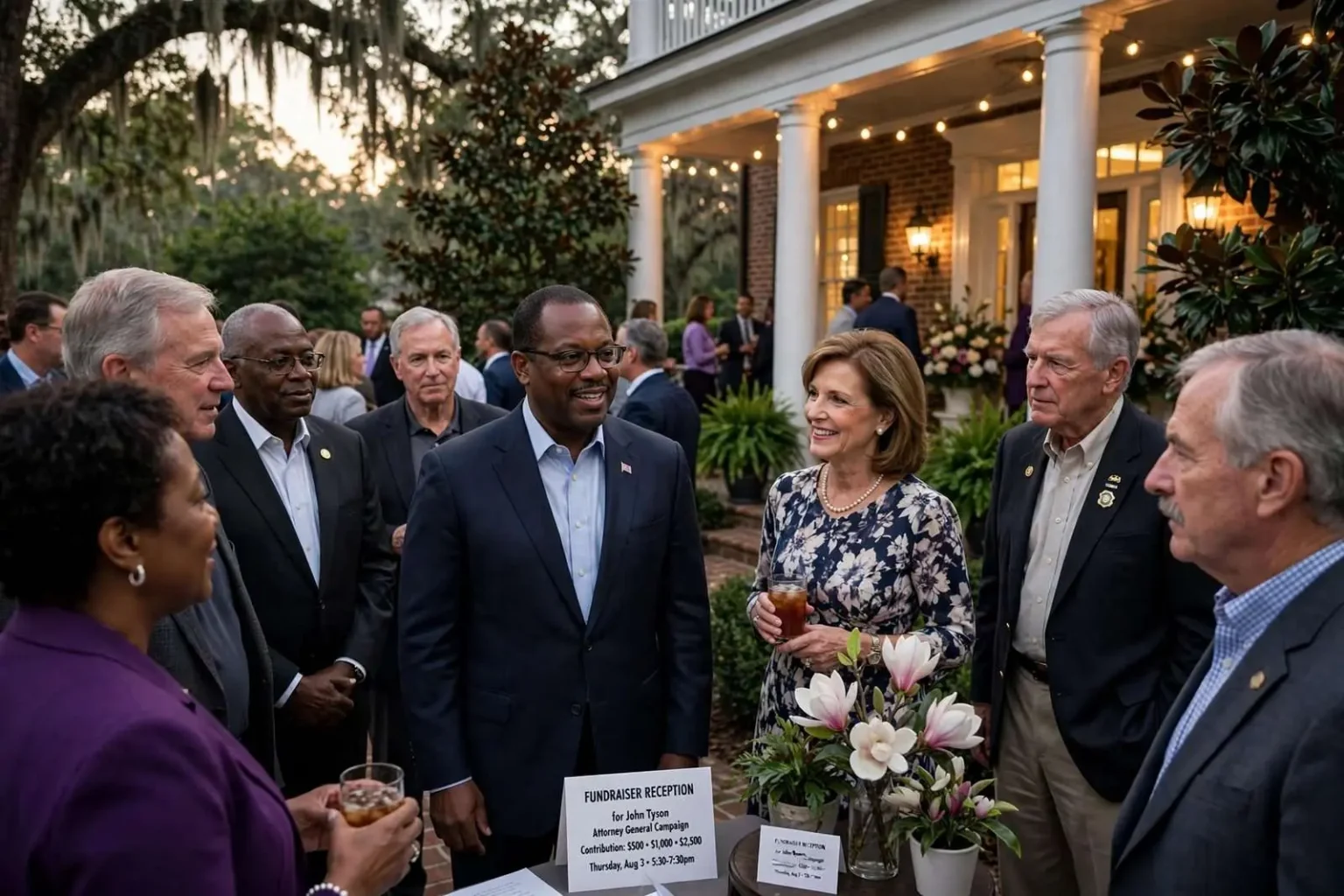
An array of Mobile-area leaders prepared to host a major fundraiser for Mobile County District Attorney John Tyson’s Democratic campaign for attorney general, set for Thursday, Aug. 3, from 5:30 to 7:30 p.m. Invitees to the reception at the home of Mobile businesswoman Celia A. Wallace were asked to contribute $500, $1,000 or $2,500 — the kind of contribution tiers that mark a serious, well-organized bid for statewide office.
Tyson had won the Democratic nomination to face Republican incumbent Attorney General Troy King in the November general election, and the reception underscored the district attorney’s deep roots in the Mobile business and legal community as he sought to translate a career as the county’s chief prosecutor into statewide office. For Tyson, the event was both a financial engine and a public demonstration of the establishment support his campaign hoped to carry across the state.
A Broad Host Committee
The list of hosts read like a directory of Mobile’s civic and professional establishment. Among those lending their names were Mayor Sam Jones, industrialist Angus R. Cooper II, retired Maj. Gen. J. Gary Cooper, state Sen. Vivian Davis Figures, state Reps. James Buskey and William Clark, City Council President Reggie Copeland Jr. and businessman Abraham Mitchell. The roster bridged the city’s political, industrial and legal elite — from the port interests represented by the Cooper name to the legislative delegation and the city’s elected leadership.
Physicians, attorneys, developers and longtime political figures rounded out a committee that numbered well over a hundred names, a scale of support that few local candidates for statewide office manage to assemble. Host committees serve double duty in campaigns of this kind: the names signal credibility to potential donors, while the hosts themselves typically open their own networks to raise money beyond what any single reception can collect.
The Race Against Troy King
The general election matchup pitted Tyson against the incumbent attorney general, giving Alabama voters a choice between a sitting statewide officeholder and a big-city district attorney with two decades of courtroom experience. Attorney general campaigns in Alabama traditionally turn on questions of crime, public corruption and the office’s independence, and Tyson’s record as Mobile County’s chief prosecutor — spanning everything from capital murder trials to public integrity cases — formed the core of his pitch to voters beyond the Gulf Coast.
For Mobile’s Democratic establishment, the race also represented an opportunity to put one of the city’s own in a constitutional office, something the region’s Democratic officeholders had pursued for years in a state where Republicans held most statewide seats. The host committee’s breadth reflected that ambition, uniting figures who did not always find themselves on the same side of local political questions.
A Notable Absence
Observers noted that Tyson’s host committee, while substantial, was somewhat smaller than the roster he had assembled two years earlier when he successfully sought re-election as district attorney. This time he was without a couple of Republican stalwarts, as well as state legislator and Bishop State Community College President Yvonne Kennedy — omissions that drew attention precisely because those names had anchored his previous bipartisan appeal. In a city where crossover support has long been a prerequisite for victory, the shrinking of a once-bipartisan committee was a measurable political shift.
The gap was widely read against the backdrop of recent events at Bishop State. Tyson’s office had prosecuted the college’s vice president, David Thomas, who was impeached from his seat on the Board of Commissioners of the Mobile County Public School System. The case placed the district attorney’s office in direct conflict with one of Mobile’s most prominent educational institutions and its circle of allied political figures, and Kennedy’s absence from the host committee was read as one visible consequence of that collision.
The episode illustrated the delicate crosscurrents a sitting prosecutor navigated while assembling support for a statewide campaign, drawing backers from across party lines while his office pursued cases that touched the very establishment figures whose names campaigns require. Prosecutors who run for office in their home counties face this tension in every race; Tyson’s campaign made it unusually visible, because the Bishop State proceedings were unfolding in the same window as his fundraising push.
The Bishop State Backdrop
The prosecution of David Thomas had grown out of a broader examination of dealings at Bishop State Community College, a two-year institution serving much of Mobile’s minority community, and the resulting impeachment from the school board seat underscored how far the fallout had spread beyond the criminal courtroom. Cases involving public institutions carry stakes that extend past individual defendants — they implicate boards, budgets and public trust — and they inevitably generate political friction when the officials affected hold influence over local government and party affairs.
For Tyson, the calculus was the one every prosecutor-politician confronts: the same willingness to charge prominent figures that built his law-and-order credentials also cost him support among the people connected to those figures. The Aug. 3 reception showed he retained enough of Mobile’s establishment to mount a credible statewide campaign, while the shorter host list showed exactly what that pursuit of accountability had cost him.
What the Fundraiser Signaled
Campaign receptions at private homes remain a staple of Alabama politics, and the Wallace residence event followed the familiar formula: contribution tiers that filter casual supporters from serious donors, a host list that doubles as an endorsement slate, and a candidate working the room among the people whose organizations will drive turnout in November. The $500 to $2,500 range put the event among the more ambitious local fundraisers of the cycle, appropriate for a race that would require name recognition far beyond Mobile County.
For the hosts, lending their names to a Democratic attorney general nominee also carried its own calculations. Figures such as Mayor Sam Jones and Council President Reggie Copeland led a city government that worked with the district attorney’s office daily; the Cooper family’s industrial enterprises and Abraham Mitchell’s business interests operated in a county where the DA’s priorities had tangible consequences; and the legislators on the committee — Figures, Buskey and Clark — represented districts where Tyson’s office was a familiar presence in community life.
The Road to November
From the Aug. 3 reception, Tyson’s campaign turned toward the task every Mobile Democrat faces in a statewide race: extending the home-county coalition to Birmingham, Huntsville, Montgomery and the Black Belt, while competing for attention in a general election dominated by the governor’s race at the top of the ticket. The host committee’s Mobile core gave the campaign a financial foundation and a story — a veteran prosecutor with bipartisan roots running on his record — but the gaps in that committee were equally part of the story, marking where the pursuit of cases like the Bishop State prosecution had redrawn the candidate’s political map.
However the November election unfolded, the reception itself captured a moment in Mobile politics: a district attorney at the peak of his local standing, a business and civic community opening its doors for his statewide bid, and the first visible fractures in the bipartisan coalition that had carried him through two decades of elected office in Mobile County.
Mobile’s Political Landscape in That Era
The fundraiser’s cast of characters captures Mobile’s civic structure at the time. Sam Jones served as the city’s mayor through a period of downtown revitalization and convention-center development; Reggie Copeland Jr., whose family name was synonymous with Mobile government across generations, presided over a city council that paired with the mayor’s office on the city’s biggest projects. The Cooper name — Angus R. Cooper II at the helm of the family’s maritime and industrial enterprises — represented the port economy that anchors Mobile’s business community, while retired Maj. Gen. J. Gary Cooper brought a distinguished military and business career to civic causes ranging from civil rights history to economic development.
State Sen. Vivian Davis Figures and Reps. James Buskey and William Clark anchored the county’s legislative delegation, and Abraham Mitchell’s name carried weight in both business and philanthropy. A host committee drawing from that mix — city hall, the Statehouse, the port, the professions — gave Tyson the kind of local coalition most statewide hopefuls can only build over years, and the Wallace reception put it on display in a single evening.
The District Attorney’s Record Behind the Campaign
Tyson’s standing in Mobile rested on a long tenure as the county’s chief prosecutor, during which his office handled the capital cases, drug conspiracies and public corruption prosecutions that shape a community’s sense of justice. District attorneys who seek higher office typically run on exactly that record, and Tyson’s team framed his candidacy as taking two decades of front-line prosecution experience to the state level, where the attorney general’s office directs statewide criminal appeals, public integrity units and multiagency investigations.
The same record, however, included the prosecutions that had strained his alliances — most visibly the Bishop State matter that shadowed this campaign. The tension between a prosecutor’s duty and a politician’s coalition is permanent, and the Aug. 3 guest list, for all its breadth, recorded how the balance had shifted since his last countywide race: fewer crossover Republicans, fewer figures tied to the institutions his office had investigated, and a committee that leaned more heavily on the Democratic establishment that had always formed his base.
Campaign Finance in a Statewide Race
Events like the Aug. 3 reception are the early engine of statewide fundraising in Alabama, where television markets in Birmingham, Huntsville and Montgomery make name recognition expensive for any candidate starting from a single county. Money raised in the late summer funds the fall’s advertising push, and contribution levels of $500 to $2,500 at a single reception are consistent with the pace a competitive general-election campaign requires. For Tyson, Mobile’s donor community was his strongest financial base, and the reception was designed to mine it fully before the campaign had to look elsewhere.
The reception at Celia Wallace’s home thus served as both a milestone and a measure: a milestone in the campaign’s organization, and a measure of exactly how much of Mobile’s establishment — and how much of the bipartisan coalition Tyson once assembled — remained willing to stand with him as the November election approached.