University of South Alabama Mobile
Alabama School of Math and Science Draws Record Turnout for Summer Camp
ASMS in Mobile hosted a record 790 students at its expanded three-week Adventures in Math and Science summer camp this June.
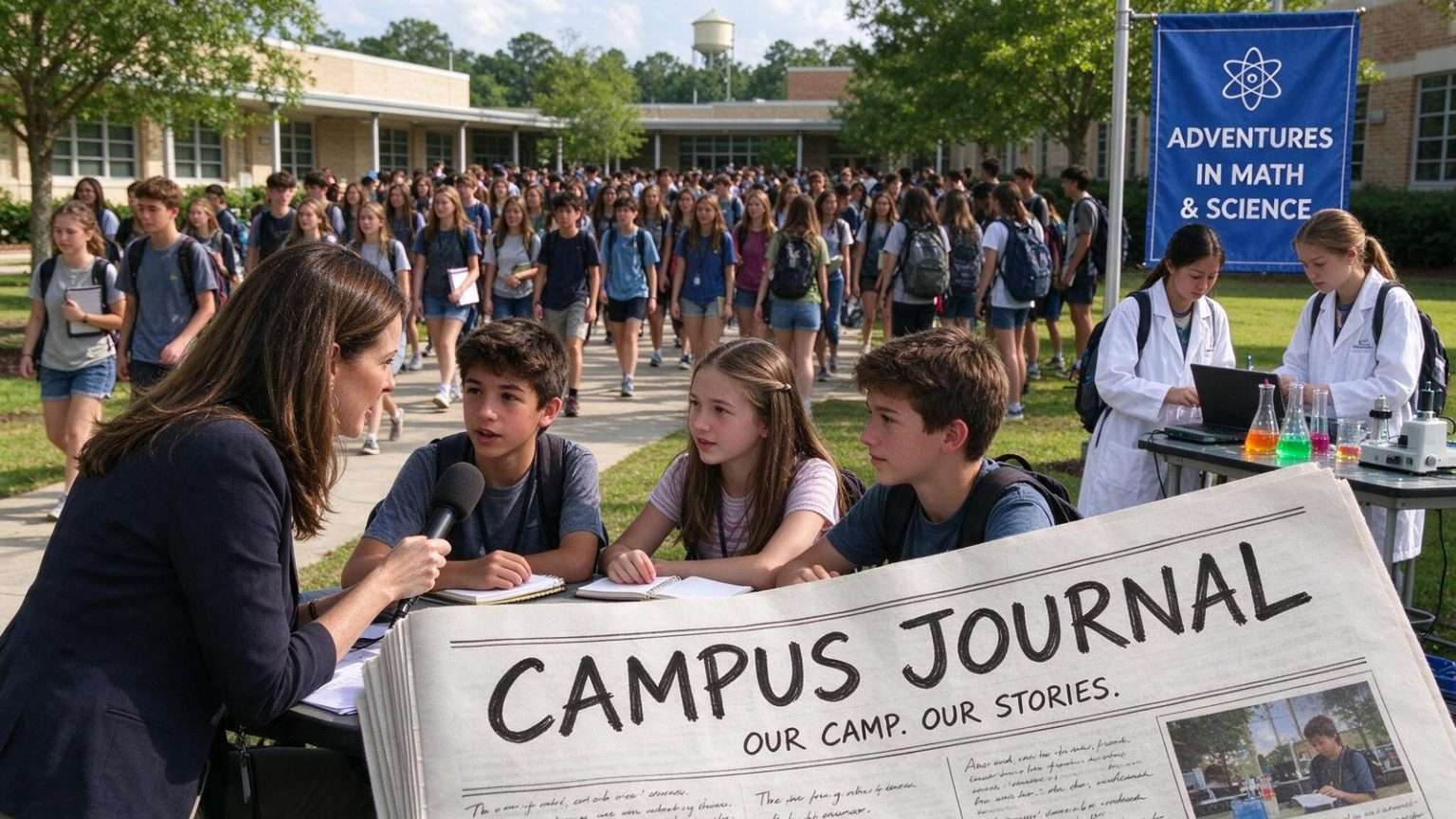
The Alabama School of Math and Science in Mobile welcomed its largest group of summer campers yet this June, as roughly 790 students from across the state took part in the school’s annual Adventures in Math and Science program. The enrollment figure set a record for the camp, which has grown into one of the state’s most visible summer academic programs for middle school students.
Organizers expanded the camp from two weeks to three this year to meet growing demand, giving participants more time to dive into hands-on coursework and residential life on the Mobile campus. The addition of a third week allowed the school to spread its course catalog across a longer calendar and to accommodate more campers in each session, a response to demand that had been straining the program’s capacity in recent years.
The camp is open to students as young as sixth grade through those entering their freshman year of high school. Depending on their preference, campers can stay in the dormitories for one to three weeks or commute in for day sessions. That flexibility lets families tailor the experience to the child — a sixth-grader’s first overnight stay might run a single week, while an eighth-grader eyeing ASMS for high school can settle in for the full three weeks of residential life.
Course offerings ranged from computer science and laboratory science to literature and creative writing, with instructors often building in unconventional, hands-on projects to keep students engaged. The range is deliberate: the camp functions as a sampler of the school’s approach, showing young students that mathematics and science pair naturally with writing, argument and imagination rather than replacing them.
A journalism class that reported the camp itself
One of this year’s most talked-about offerings was an introductory journalism course taught by Natalie Cochran-Murray, an ASMS teacher and University of South Alabama graduate. Students in the class spent the final week of camp interviewing fellow campers about their experiences, producing first-person reflections on what the program meant to them.
The assignment turned the class into working reporters covering their own community. Interviewing peers requires a different set of skills than solving equations — listening carefully, asking follow-up questions, capturing what someone actually said — and the campers’ published reflections gave the rest of the program a student-drawn portrait of itself at the end of the session.
First lessons in independence
For many younger participants, the camp offered a first taste of independence. Several students said simply waking up on their own and getting to class without a parent’s prompting felt like a meaningful milestone. The dormitory routine — managing a schedule, keeping a room, arriving on time — doubles as the camp’s quietest curriculum, and for eleven- and twelve-year-olds it is often the first sustained test of self-management they have faced.
Others described building fast friendships with peers from different corners of Alabama, from Huntsville to Birmingham, who shared similar academic interests but had never met before arriving on campus. For students who may be the only serious math enthusiast or science reader in their home school, finding a dorm full of kindred spirits is a formative experience — the discovery that there is a larger community of kids like them across the state.
Some campers said the experience reshaped how they think about themselves and their futures. One 15-year-old student from Birmingham described a moment when an older classmate stood up for her after another student was rude, saying the incident taught her to look past first impressions and challenge her own assumptions about people. A younger camper, just 11 years old, said the week marked the first time he had ever shared a dorm room or lived away from home, and that making friends there gave him confidence heading into the school year.
A preview of ASMS itself
ASMS, a public residential magnet school for gifted students, has long used its summer programming as an early introduction for prospective students who may later apply to attend full-time. The Mobile school draws students from every county in Alabama for its residential high school program, and the summer camp puts its classrooms, laboratories and dormitories on display for the exact age group that will be applying in the next few years.
For campers weighing their options, the week answers questions a brochure cannot: what it feels like to live on campus, how demanding the coursework is, whether residential school life suits them. Several campers who spoke about their week said they now hope to enroll at the Mobile school for high school, citing the mix of rigorous coursework and the sense of community they found during their short stay.
That pipeline works in both directions. The school gets an audience of motivated applicants who already know the campus, and the state gets a wider pool of students considering advanced coursework in the fields Alabama’s employers have the hardest time filling — computing, engineering, laboratory science. A summer camp that funnels even a fraction of 790 campers toward applications for admission strengthens that pipeline considerably.
Why the format works
With record attendance this year, camp organizers said the expanded three-week format allowed for a deeper range of electives while still giving families the flexibility of shorter, week-long stays. The structure stacks three one-week sessions rather than a single long block, so a family can choose one week without committing to three, while a camper who wants the full residential experience can stay across the entire program.
The week-long modules also let instructors design compact courses with clear beginnings and endings — a week of journalism interviews, a week of laboratory projects, a week of creative writing — rather than stretching a syllabus thin across a summer. Students can stack different subjects across consecutive weeks, engineering a summer schedule that matches their interests.
The residential piece carries the same design logic. Dormitory life under adult supervision, with roommates from across the state, is the aspect of ASMS that day schools cannot replicate, and the camp gives middle schoolers a supervised preview of it. For some families, that preview is the deciding factor in whether a student applies for the full-time program; the camp lets them make the decision with their own experience rather than someone else’s description.
What comes next for the program
The program remains one of the most visible ways ASMS connects with middle and high school students throughout Alabama each summer, well before they ever set foot in a fall classroom. With three weeks on the calendar and a record 790 campers served, the school has signaled that the camp’s growth is something it intends to accommodate rather than cap, provided the campus can absorb the numbers.
For the students who filled the dormitories this June — the 11-year-olds away from home for the first time and the eighth-graders already drafting their applications — the record summer served the same purpose it always has: a taste of the school’s blend of rigorous coursework, residential independence and a community of peers who share their interests, delivered early enough to shape what they do next.
The school behind the camp
The Alabama School of Math and Science occupies a campus in Mobile’s Midtown area and serves as the state’s only public residential high school focused exclusively on math and science. Admission is open to students from across Alabama, and those accepted leave their home districts to live and study on campus for their high school years, taking advanced coursework in laboratories and classrooms staffed by faculty with research and industry backgrounds.
The school’s mission ties directly to a long-running concern in Alabama economic development: keeping the state’s most academically talented students engaged in technical fields and, ideally, in the state itself. Alumni of the school have gone on to universities and careers across science, medicine, engineering and computing, and the institution counts its pipeline of graduates among its contributions to the state’s workforce.
Because the school is public, admission carries no tuition cost for Alabama families, with the state covering the educational program — an arrangement that makes the residential experience accessible to students from small towns and rural districts whose home high schools may not offer advanced laboratory science or computer science coursework at all.
What the campers actually did all week
The Adventures in Math and Science schedule blends classroom time with activities designed to keep a middle schooler’s attention. Laboratory sessions put campers at benches doing experiments rather than watching demonstrations; computer science offerings introduced programming and problem-solving; and the writing courses gave students who lean toward the humanities a reason to spend their summer on a math and science campus.
Instructors are drawn largely from the school’s own faculty, teaching subjects they know well in a format looser than the regular academic year. That is where the “unconventional, hands-on projects” come from — a journalism teacher sending her class out with interview assignments, science faculty designing experiments that end in a friendly competition, literature sessions built around discussion rather than worksheets.
Evenings and weekends in the dormitories are programmed too, since residential campers need supervision and structure beyond the classroom. The result is a schedule that feels closer to a preview of boarding school life than a day camp, which is precisely the point for a school whose full-time program is residential.
The value of a record summer
Reaching roughly 790 campers in a single summer means the program touched nearly eight hundred households across Alabama with a direct experience of the school. Each of those campers goes home with stories — the dorm, the experiments, the friends from Huntsville and Birmingham — that circulate through home schools, churches and neighborhoods, and that word-of-mouth network has been central to the camp’s growth from year to year.
The three-week expansion also gave the school a test of its own capacity: dining, dormitory staffing, laboratory scheduling and safety supervision all scaled up for the longer calendar. Running the expanded format successfully this June gives organizers a base of experience for planning future summers, whether that means holding the three-week format or continuing to grow it.
For now, the takeaway from the record summer is the one camp organizers and campers both emphasized: the program delivered its mix of academic challenge and first independence to more Alabama students than ever before, and a meaningful share of them left the Mobile campus already talking about coming back — this time as applicants.