Alabama School of Math and Science Builds Track Record of Sending Students to Top Colleges
The residential Mobile school for gifted students has sent thousands of graduates to top colleges, backed by scholarships and free tuition statewide.
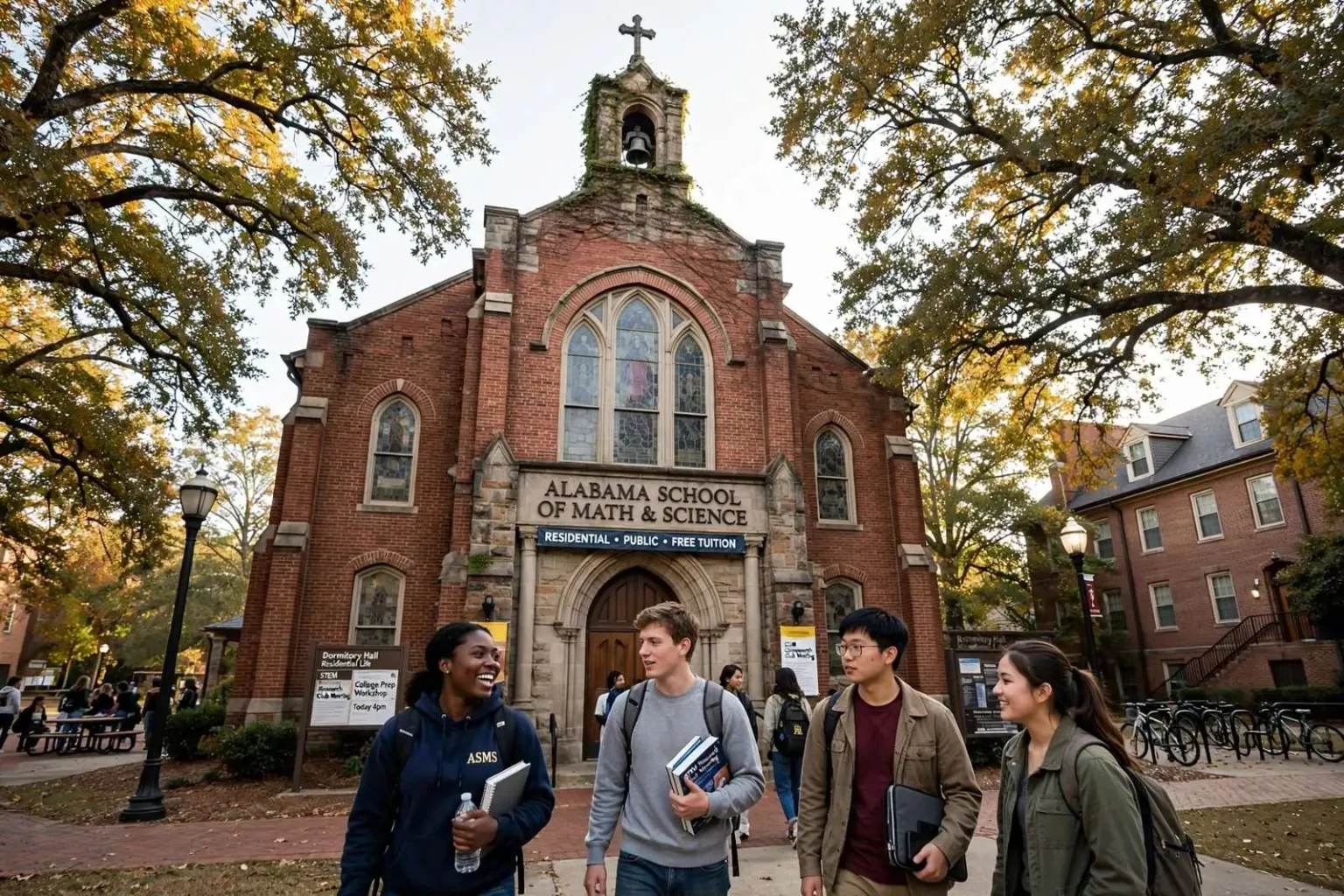
The Alabama School of Math and Science doesn’t operate like a typical high school, and it was never meant to. Established in the late 1980s as a residential public school serving students statewide, the Mobile institution has built a reputation as one of the top public high schools in the country, drawing sophomores, juniors and seniors from every corner of Alabama to its 15-acre campus.
The school occupies a historic building that once housed Dauphin Way Baptist Church, and today it welcomes close to 300 new students a year. Because students live in dormitories on campus, the learning experience extends well beyond the classroom, with teachers who take a close, mentor-like interest in a group of academically gifted teenagers living and studying together around the clock.
Residential schools of this kind occupy a particular niche in American education. Alabama created its school in the same era that saw similar magnet institutions open in other states — publicly funded academies designed to concentrate advanced math and science instruction that small high schools could not offer on their own. A rural school with two hundred students cannot staff multivariable calculus, research-level chemistry labs or computer science beyond the introductory level; the residential model solves that by bringing the students to the resources instead of scattering the resources across every district.
Applicants compete for admission as sophomores primarily, though the school enrolls juniors and seniors as well, and the review looks at grades, test scores, teacher recommendations and a student’s demonstrated interest in the sciences. What the admissions office is not screening for is wealth. A student whose family earns nothing and a student whose family is comfortably middle class submit the same application to the same pool, and the state’s appropriation plus the foundation’s private fundraising absorbs the full cost of their education while they are on campus.
The mid-city Mobile campus sits comfortably inside that logic. Its location puts students within reach of the city’s research and medical institutions, its historic main building houses classrooms where church pews once stood, and its 15 acres hold the dormitories that turn a school into a living community. Weekends include structured activities, and the calendar fills with competitions, clubs and study sessions that follow the dormitory model wherever it exists.
Access without a price tag
Admission and tuition are free for any Alabama student who qualifies, regardless of family income, thanks to funding from the state along with support from the school’s affiliated foundation. Alongside rigorous coursework, students take part in field trips, student-led organizations, athletics and a range of extracurricular activities designed to round out campus life.
The free-tuition guarantee is central to the school’s mission and its results. Elite secondary education in America is frequently a private good, accessible mainly to families able to pay. By removing tuition from the equation, the state’s residential school makes admission a function of motivation and ability rather than zip code or income, and the foundation’s fundraising — covering what state appropriations do not — helps keep the program whole. For families in rural counties, the residential piece is as important as the financial one: a student from the Tennessee Valley or the Wiregrass could not commute to Mobile daily, and boarding makes participation possible.
A record measured in scholarships
Since the school graduated its first class in 1991, more than 2,000 students have earned diplomas there, collectively bringing in millions of dollars in college scholarships. Close to half of all graduates go on to pursue advanced degrees after finishing their undergraduate studies, a testament to the academic foundation the school aims to provide.
That track record includes some standout individual achievements. Seven students in the school’s history have won the competitive Gates Millennium Scholarship, which covers tuition all the way through graduate school and is awarded to only 1,000 students nationally each year. Other graduates have gone on to earn National Merit Corporate Scholarships, with some pursuing careers in fields like environmental engineering after their time on campus.
The Gates Millennium count deserves a closer look, because the odds behind it are steep. A national award pool of 1,000 winners per year is spread across tens of thousands of American high schools, and a single school producing seven over its history — a school with graduating classes measured in the low hundreds — is a statistical outlier by any measure. The scholarship’s full funding through doctoral study compounds its value; for students who win it, the financial ceiling on graduate education simply disappears.
The advanced-degree rate tells a parallel story. Half of a school’s graduates going on to master’s degrees, doctorates or professional school is a figure most institutions — public or private — would envy, and it speaks to how thoroughly the school’s graduates arrive at college already trained in the habits that higher education rewards: research work, self-directed study and comfort with demanding coursework.
Out of small towns and into national universities
Part of what makes the school’s story compelling is how many students arrive from small, rural corners of the state that might not otherwise produce students bound for elite universities. One recent example involved a student from Mt. Vernon, a small town north of Mobile, who enrolled at the urging of a local teacher. During her time at the school, she raised her ACT score by eight points and went on to enroll at Emory University, a nationally recognized research university in Atlanta.
Mt. Vernon’s story is common enough across Alabama that it amounts to a pattern. The town of a few hundred people sits in the far northeast corner of Mobile County, well off the suburban corridors where advanced coursework is routine, and its students attend schools that cannot begin to match the offerings of a dedicated math and science academy. A single teacher’s suggestion, and the willingness of a student to leave home for a residential campus, changed a college trajectory entirely.
An eight-point ACT improvement is not the product of test preparation alone; it reflects two years of immersion in coursework at a level most high schools never reach, taken alongside classmates who expect to compete for the same universities. By the time such a student applies, the transformation shows up everywhere — course load, laboratory experience, teacher recommendations — and selective universities respond accordingly.
Stories like hers illustrate the broader mission behind the school: identifying academically motivated students across Alabama, regardless of where they grow up, and giving them access to a level of instruction and mentorship that can open doors to some of the country’s most competitive colleges and universities.
Alumni outcomes feed back into the school’s culture as well. Current students hear directly from graduates who are now in medical school, engineering firms and graduate research programs, and those examples give freshmen a concrete picture of where the school’s demanding schedule leads. The mentorship that begins with dormitory life continues informally through the alumni network, which has now spread across enough professions and institutions to serve as a professional resource in its own right for new graduates entering college and the job market.
The recruitment pipeline depends on exactly that kind of ground-level referral. With a student body drawn from all 67 counties in principle, the school relies on teachers, counselors and alumni to spot promising candidates in places its admissions staff might never think to look. Rural districts benefit most: the students who most need what the school offers are the ones least likely to have heard of it without someone telling them.
The economic logic for the state is straightforward as well. Alabama, like the rest of the country, needs engineers, researchers, physicians and computer scientists, and its brightest students have always had the option of leaving the state entirely for secondary school or college. A free residential academy in Mobile keeps talented teenagers inside Alabama’s public system, sends them to college with scholarships already won, and gives in-state universities a steady stream of prepared applicants. Every student who spends two or three years on the Mobile campus is a student the state educated rather than one it watched leave.
For a state school built on the idea that talent isn’t confined to any one zip code, the results speak for themselves in the number of students who leave Mobile each year prepared for rigorous higher education.
Three decades in, the experiment that began in the late 1980s has settled into a proven institution: a campus in a converted church, dormitories full of the state’s most ambitious teenagers, and an alumni list that stretches from Gates Scholars to environmental engineers. The formula — find them early, house them together, and demand a great deal — has now produced thousands of graduates, and the school shows every sign of continuing to send them out into Alabama and beyond.