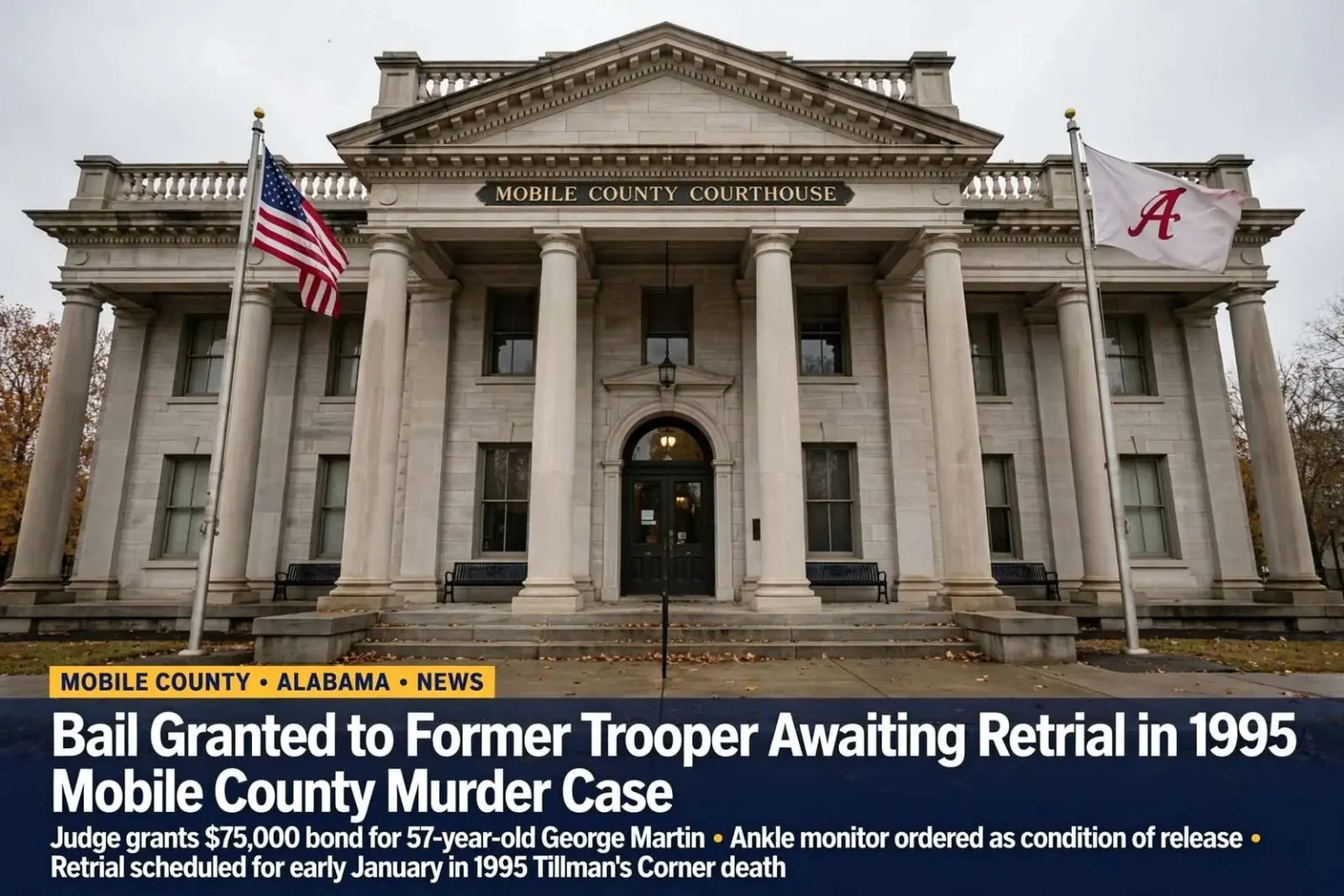
Bail Granted to Former Trooper Awaiting Retrial in 1995 Mobile County Murder Case
A Mobile County judge granted bail to a former state trooper awaiting retrial in a 1995 murder case overturned after evidence was withheld from the defense.
A former Alabama state trooper awaiting a retrial on a capital murder charge will spend the coming months out of jail rather than behind bars, after a Mobile County judge ruled this week that his defense team had overcome the steep legal presumption against bail in capital cases. The ruling capped a nearly two-hour hearing that revisited much of the evidence in a case that has already taken more than a dozen unusual turns.
Bail in a capital case is the exception rather than the rule in Alabama. State law presumes against release when the charge is capital murder, and a defendant can be granted bond only by rebutting the presumption, convincing the court that the proof against him is not evident and the presumption of guilt not great. Judges rarely find otherwise in cases involving death, which made the hearing itself an occasion: nearly two hours of argument and testimony aimed squarely at the strength of the state’s case, rather than at the usual questions of flight risk and danger alone.
The ruling does not end the case, and the judge was careful to frame it that way. What it changes is where the defendant waits: at home, under an ankle monitor and conditions, rather than in the Mobile County Metro Jail, while both sides prepare for a retrial that will relitigate everything the first trial decided.
A conviction overturned
A jury convicted George Martin in 2000 in connection with the 1995 death of his wife, and the trial judge at the time overrode the jury’s own sentencing recommendation to impose the death penalty. The override was the most controversial feature of the original proceedings. Alabama long stood alone in the frequency with which its judges substituted their own judgment for jury sentencing recommendations in capital cases, a practice that drew sustained criticism from defense lawyers, national commentators and, eventually, appellate courts, and that became a defining feature of the state’s death penalty system.
Years later, the presiding judge threw out that conviction after finding that prosecutors had withheld evidence favorable to the defense, a decision the Alabama Court of Criminal Appeals upheld the previous December. The ruling rested on one of the most serious violations known to American criminal procedure, the suppression of exculpatory material that the prosecution was constitutionally required to share. When a conviction is reversed on those grounds, the appellate courts do not merely note the error; they treat the trial’s fairness itself as compromised, and the case returns to the trial court for whatever comes next, from a second trial to a negotiated resolution.
This week’s judge set bail at $75,000 for the 57-year-old defendant, who sat quietly through the proceeding, along with conditions requiring electronic monitoring and no contact with prosecution witnesses. His attorney told the court his client would live with a sister and brother-in-law, himself a former state trooper post commander, while awaiting a trial date set for early January. The conditions amount to supervised release in practice: the monitoring bracelet fixes his location continuously, and the no-contact order places each of the state’s witnesses off limits, with any violation exposing him to immediate arrest and revocation of the bond he has just won.
The case against him
The case centers on the death of Hammoleketh Martin, whose badly burned body was discovered inside her car along a road in the Tillman’s Corner area in October 1995. The Tillman’s Corner community, south of the city of Mobile along U.S. Highway 90, was in the mid-1990s a sprawling stretch of stores, churches and neighborhoods that anchored the southern end of Mobile County, and the discovery of a burning car on a roadside there drew an immediate homicide investigation.
A forensic investigator determined she had been burned alive. That determination made the case capital from the start, because Alabama law treats murder by arson as a capital offense, and it shaped the prosecution’s theory throughout: the fire was not an accident or a consequence of another act but the method of killing itself. Investigators focused on her husband after learning he had been experiencing financial strain while steadily increasing his wife’s life insurance coverage, a policy that had grown to $380,000 by the time of her death. The insurance trail became the backbone of the state’s motive case, the argument that a man under mounting financial pressure stood to gain a six-figure payment from his wife’s death.
Central to the original prosecution was a witness who told jurors he saw a black man in a trooper’s uniform near the scene the night of the death. The defense argued, and the court ultimately agreed, that prosecutors never disclosed that the same witness had identified a different trooper entirely when shown photographic lineups during the original investigation. The withheld identification struck at the heart of the state’s case, because a witness who named someone other than the defendant as the uniformed figure near the scene was not merely impeached on a detail; he was pointing away from the man on trial, and the jury never heard it.
What the reversal means
The sequence of rulings, from the 2000 conviction to the judicial override, to the vacated conviction, to the appellate affirmation, to this week’s bail hearing, illustrates both the resilience and the cost of Alabama’s post-conviction process. It took years for the withheld evidence to surface and months more for the appellate courts to confirm the trial judge’s finding, and every step of that timeline was served by the defendant in custody. The bail ruling does not erase those years; it acknowledges that a man whose conviction was thrown out because the state did not play fair has a materially different claim to liberty than one whose conviction stands.
For prosecutors, the retrial presents hard practical questions. The case is now nearly a decade and a half old at trial and older at the events themselves, memories have faded, and the state’s most prominent witness carries the burden of the undisclosed identification, which the defense can now present to a jury in full. The suppression finding is also part of the record that a new jury will never hear, but it reshapes the legal landscape around the case: the same investigative files must now be disclosed in their entirety, and the defense enters the second trial knowing exactly what the first one hid.
For the defense, the months before January are for rebuilding a case with a restored piece at its center. Cross-examination of the eyewitness takes on a different character when the prior identification of another trooper can be put before the jury, and the financial motive evidence, which has never been disputed, must now carry a case that the uniformed-witness testimony no longer supports alone. The $75,000 bond and the electronic monitoring give the defense something else as well: a client who can sit at the defense table rested, in street clothes, able to assist in his own preparation in the weeks before trial.
The road to January
The conditions of release place the defendant back into the care of family with deep law enforcement roots. His brother-in-law’s career as a former state trooper post commander means the household supervising him knows exactly what troopers do, how the agency works and what the stakes of the January trial are. Courts often prefer such arrangements in high-profile releases, since a responsible household with standing in the community gives the judge confidence the conditions will hold, and the no-contact order is easier to honor when the defendant’s daily life is structured and observed.
Between now and the early January trial date, the courts will manage the usual machinery of a capital retrial: pretrial motions over what evidence carries over, rulings on the witness list, scheduling for jury selection, and the logistics of a case that will again attract public attention in Mobile County. Capital cases demand more of every participant, from specially qualified counsel to extended voir dire, and a retrial arriving nearly a decade after the original verdict will require the court to prune what has grown stale while preserving what the state still needs.
For the family of Hammoleketh Martin, the proceedings reopen grief that fourteen years of litigation had ground down but never closed. Every hearing in a cold case renewed, and every reversal, is lived by the victim’s family as well as the defendant, and the prospect of a second trial means another round of testimony about the October 1995 fire in Tillman’s Corner that took her life. The system’s answer to its own error, a fair second trial with the withheld evidence finally in the open, is the remedy the law offers, imperfect as it is. The judge’s bail ruling sends George Martin home to wait for it, monitored, conditioned and presumed innocent until a second Mobile County jury says otherwise.