Mobile County Magnet Schools Open Applications with January Open Houses
Mobile County opened applications for its seven magnet schools, with weekend open houses giving families a chance to tour campuses and apply.
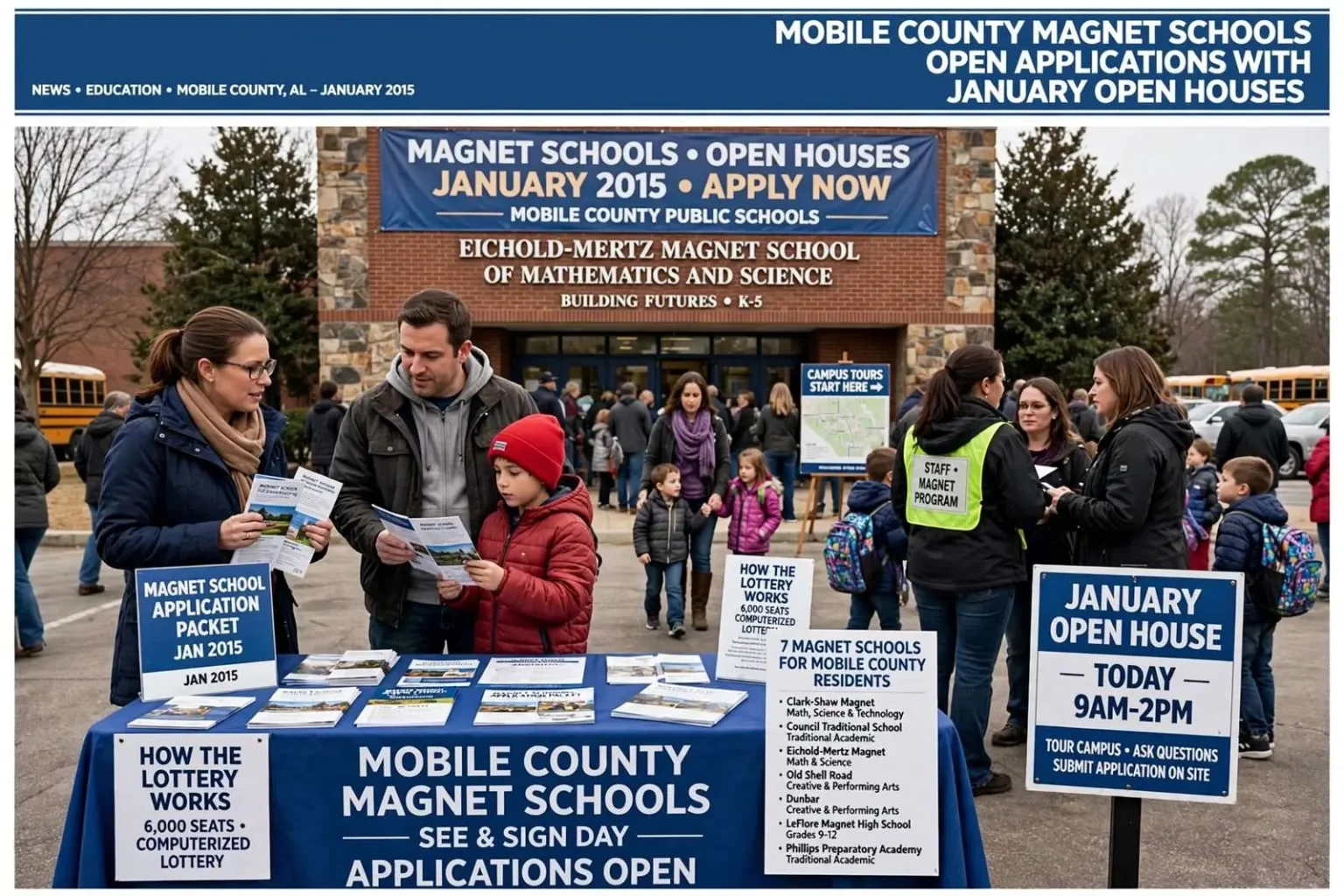
The Mobile County school system opened its application period for magnet schools in January 2015, kicking things off with weekend open houses that let families tour campuses and submit applications in person. For parents across Alabama’s largest school district, the start of the application window marked the beginning of a months-long process that could determine where their children spend the rest of their school years.
Only Mobile County residents are eligible to enroll in a magnet school, a restriction that keeps the programs reserved for local families and for the taxpayers who fund them. Roughly 6,000 students are selected each year through a computerized lottery system, a method designed to remove favoritism and guesswork from admissions and to give every eligible applicant an equal shot at a seat.
According to Marilyn Pace, supervisor of the magnet program, that number was expected to grow over the following few years. The growth is not incidental; it is the direct result of decisions the school board made about where magnet programs should live and how much space they should occupy, and it reflects the sustained demand that has made Mobile County’s magnet system one of the most developed in the state.
The expansion traces back to the school board’s decision to relocate the Chickasaw magnet program to the larger Eichold-Mertz Elementary, which added significant capacity to the system. The move consolidated a program that had been operating in smaller quarters onto a campus built to handle more students, immediately increasing the number of magnet seats available to elementary families without requiring new construction.
Eichold-Mertz enrolled about 500 students at the time but had room for as many as 800, and the district planned to add roughly 100 students a year until the school reached full capacity. The gradual approach was tied to how teacher funding is calculated from the prior year’s enrollment, meaning the school could not simply fill its hallways overnight even if applications poured in.
How the state’s largest magnet system works
Mobile County operates seven magnet schools, a roster that spans every grade level and a range of specialized focuses. The lineup includes Clark-Shaw Magnet School of Mathematics, Science and Technology; Council Traditional School; Eichold-Mertz Magnet School of Mathematics and Science; Old Shell Road School of Creative and Performing Arts; Dunbar School of Creative and Performing Arts; LeFlore Magnet High School; and Phillips Preparatory Academy.
That variety is deliberate. Families seeking a STEM-heavy curriculum can look to Clark-Shaw or Eichold-Mertz, while students drawn to the arts can pursue creative and performing arts programs at Old Shell Road or Dunbar. Council Traditional and Phillips Preparatory emphasize traditional academic instruction, and LeFlore extends the magnet concept through high school, giving students a pathway that can begin in kindergarten and continue through graduation.
Three of those schools, Clark-Shaw, Council and Phillips, have earned the National Blue Ribbon School designation from the U.S. Department of Education, a recognition reserved for schools with consistently high academic performance or significant gains in student achievement. The Blue Ribbon distinction is one of the highest honors an American school can receive, and having three of them within a single district’s magnet lineup is a marker of how competitive the programs are.
That track record feeds the demand that makes the lottery necessary. When schools consistently post strong results, word travels among parents, and application volumes rise accordingly. The district’s challenge is balancing that demand against the practical limits of campus space and staffing, which is exactly why the Eichold-Mertz relocation and its planned annual growth of about 100 students mattered to so many families.
For families new to the process, the magnet model can take some explaining. Unlike a neighborhood school, where enrollment follows address boundaries, a magnet school draws students from across the district based on application and, in Mobile County’s case, a computerized lottery. Families give up the guarantee of a nearby school in exchange for a specialized program, and transportation arrangements become part of the planning that parents must consider.
Open houses and “see and sign” days
Families interested in applying were invited to attend “see and sign” days, when volunteers, faculty and counselors were on hand to help with paperwork and answer questions about each school’s program. The events combined the two things a magnet application demands most: a genuine look at the campus and its culture, and hands-on help completing the materials correctly so that an application is not disqualified on a technicality.
Open houses serve a second purpose that is easy to overlook: they let children see the schools for themselves. A student deciding between a math and science magnet and a performing arts program is making a choice about daily life, not just curriculum, and walking the hallways, meeting teachers and watching current students at work gives families information no brochure can match.
The application period that opened in January gave families several weeks to attend events, gather documents and submit materials at whichever campus or session suited their schedules. Weekend timing mattered in a county as large as Mobile, where commuters and working parents may find weekday school visits difficult to arrange, and the open-house format turned what is often an intimidating bureaucratic process into something closer to a school fair.
The county’s geography makes that accessibility especially important. Mobile County stretches from the Mississippi line across the city of Mobile and down to the Gulf-facing communities of the southern part of the county, meaning magnet campuses can be a substantial drive from many students’ homes. Families weighing an application must factor in the daily commute alongside the academic fit, and visiting a campus in person is often the moment when that calculation becomes real.
The deadline to be included in the first lottery drawing was set for late February, though the district continued accepting applications afterward, since additional openings tend to surface as families move, change their minds or decline accepted seats. Missing the first deadline does not close the door entirely; it simply means an applicant competes for seats that free up later in the process rather than for the full pool of openings.
That rolling structure rewards families who stay engaged. A student who does not win a seat in the initial drawing can still be placed as attrition opens space during the spring and summer, and schools sometimes see meaningful movement before the first day of class. District staff typically encourage applicants to remain on the list even after a disappointing first result.
For the district, the magnet system plays a broader strategic role beyond serving the students who enroll. Specialized programs give Mobile County Public Schools a way to retain families who might otherwise consider private schools, charter options or neighboring systems, and the schools’ record of academic recognition strengthens the district’s overall reputation in a competitive environment.
The growth at Eichold-Mertz also carries implications for the Chickasaw community from which the magnet program moved. Program relocations change long-standing patterns of enrollment and neighborhood identity, and families in the affected community had to adjust to a new geography of where the program operates. The board’s calculation, in approving the move, was that concentrating the program on a larger campus would ultimately serve more students across the county.
What families should know
Parents considering an application in the 2015 cycle faced a series of practical steps: confirming residency in Mobile County, deciding which of the seven schools best fit their child’s interests and aptitudes, attending an open house or “see and sign” event, and completing the application before the late February deadline for the first lottery. Counselors at each magnet school and district staff could walk families through questions about eligibility, grade-level openings and program expectations.
The stakes of the decision vary by age. Elementary magnet seats, like the ones being added gradually at Eichold-Mertz, offer the longest runway — a child who enters a magnet program young can carry the benefit through a coordinated pathway toward the district’s secondary magnets. Older students transferring into a program like LeFlore’s gain specialized coursework and peers with shared interests, though the adjustment demands more immediately.
Lottery systems, for all their fairness, can be hard on families emotionally. A computerized drawing offers no explanation and no appeal, which is why district officials put so much emphasis on the open houses and information sessions — helping applicants understand the odds and the alternatives before results arrive makes the outcome easier to absorb whichever way it falls.
As the lottery approached, the message from district officials was consistent: apply early, visit the schools, and keep the application active even if the first drawing does not go your way. With capacity growing by roughly a hundred students a year at Eichold-Mertz and demand remaining strong across the system, the 2015 application window represented one of the best opportunities in years for Mobile County families to claim a seat in one of the state’s most decorated public school programs.