University of South Alabama Mobile
Missing Mobile Dog’s Brief Disappearance Reunites Two Families Nine Years Later
A Mobile family's rescue dog went missing for a day this spring, and his safe return revealed a hidden past that reunited two families years apart.
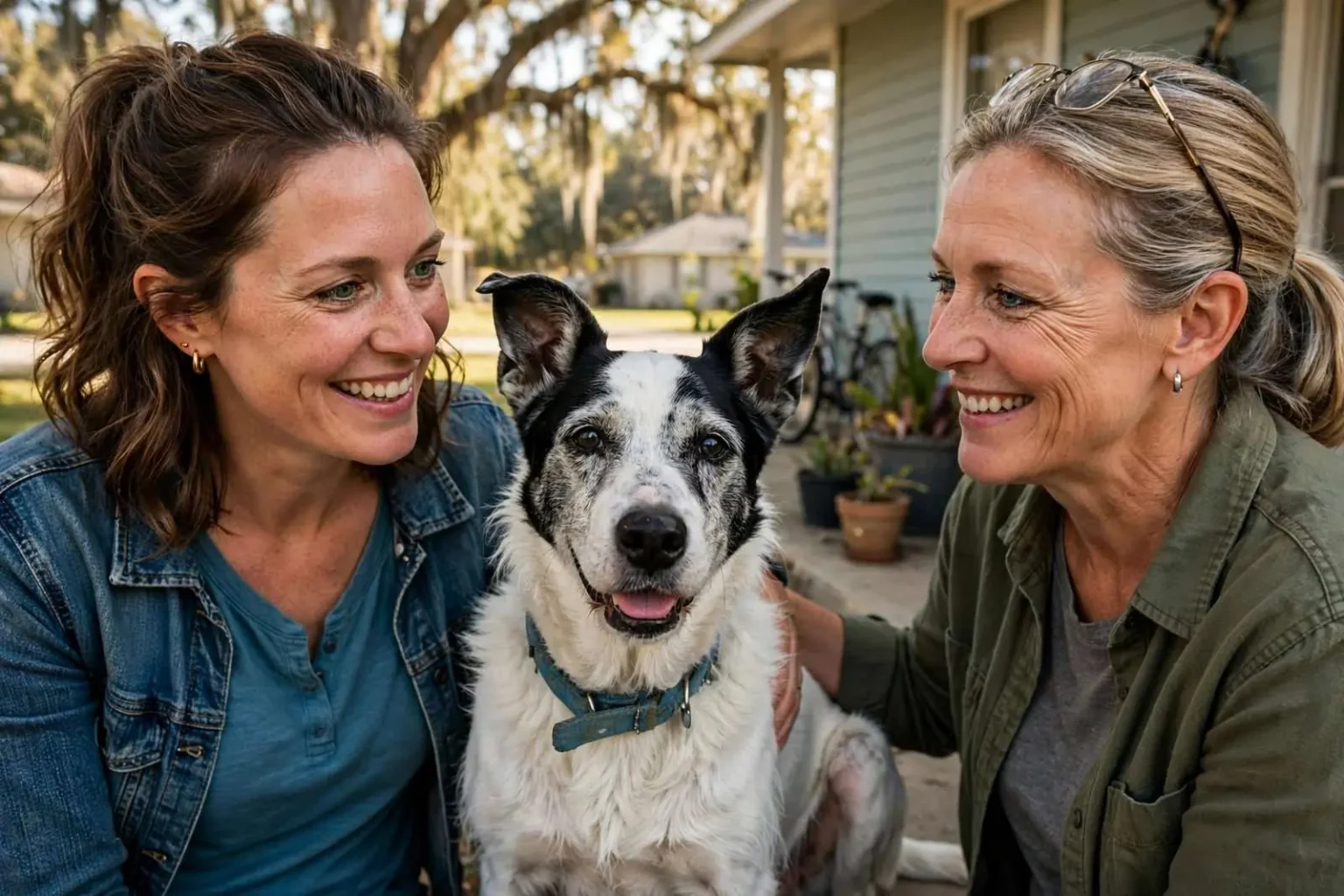
For nine years, a midtown Mobile family swapped stories about their beloved rescue dog, half-joking that the black-and-white mutt with the perked-up ears must have once been a champion sled dog in Alaska. A brief disappearance this spring proved the tale was closer to true than anyone imagined, and along the way reunited two families who had loved the same dog years apart.
Erin Rutherford adopted the dog from the City of Mobile Animal Shelter in 2006 as a birthday gift for her young daughter. He’d been at the shelter long enough that a staff member had grown attached to him and got misty-eyed watching him leave. His microchip traced back to Alaska, and tattooed identification numbers in his ears only deepened the family’s affection for what they nicknamed “Pedro the Wonder Dog.”
The stray details that come with a rescue dog are usually just that — stray details, filed away and revisited only when someone new asks about the ear tattoos. Rutherford’s family treated theirs like a mystery worth enjoying. The Alaska chip became part of household lore, retold alongside the perked-up ears and the dog’s obvious stamina, until “wonder dog” stopped being a joke and started being his name.
He settled easily into a household that would eventually include a pet pig, kittens and birds, and stuck with the family through a house fire in December that left them living in a small rental with no yard.
Recovering from a fire compresses a family’s life into temporary quarters, and pets feel the squeeze as much as anyone. Pedro had gone from whatever routine a midtown home allowed to a rental property without the outdoor space he had known, a change that mattered for an aging animal already slowed by the stiffness in his hindquarters.
That lack of yard space may have played a role this spring when Pedro, now around 14 and slowed by hip dysplasia, wandered off from the front yard of his midtown home and went missing for about a day.
An old dog with bad hips can still travel farther than an owner expects, and the first day of a missing pet is the worst kind of waiting. Rutherford’s family had nine years of attachment invested in Pedro, and the thought that a house fire had set the stage for his disappearance gave the search a bitter edge.
A good Samaritan on Dauphin Island Parkway
Not far away, a University of South Alabama employee driving to work spotted a dog struggling to cross Dauphin Island Parkway near the Loop, favoring one back leg. Thinking he might have been hit by a car, she coaxed him into her vehicle with a boiled egg from her lunch and took him straight to a veterinarian.
The stretch of Dauphin Island Parkway near the Loop carries steady traffic through south Mobile, and a lame dog picking his way along it had poor odds of surviving the morning. What happened next depended entirely on a stranger’s decision to stop — the kind of small intervention that goes unwitnessed and unrecorded in most stories of lost pets, and that in this one turned out to be the hinge.
A scan of his microchip revealed no injury at all, but it did turn up an old Clarksville, Tennessee, phone number and a different name entirely. When calls to that number went unanswered, the woman posted photos of the dog on her own Facebook page along with pages tied to the Tennessee community listed on his chip.
Microchips only work as well as the registration behind them, and Pedro’s chip carried a registration that had moved on without him — a Tennessee number, disconnected or abandoned, and a name no one in Mobile would have recognized. The good Samaritan’s instinct to post the photos online rather than stop at the dead-end phone number was what kept the trail alive.
Within a short time, the post reached a friend of a woman now living in Wyoming, who immediately recognized her long-lost dog, and separately reached a friend of Rutherford’s in Mobile, who recognized Pedro.
Social media has rewritten the odds for lost pets. A posting that once would have reached only a shelter’s bulletin board can now cross the country in hours, and in Pedro’s case it worked twice over — reaching both the family that had lost him years before and the family that had found him, in two different states, almost simultaneously.
The two threads that converged on the same black-and-white mutt solved a mystery two families had been carrying independently. One Mobile household had spent nine years joking about a wonder dog with a hidden past; one former Mobile household had spent those same years wondering what had become of a dog that escaped its yard and never came home.
The Alaska beginning
The Wyoming woman had adopted the dog in 2003 from a shelter in Fairbanks, Alaska, where her husband was stationed with the Army. She later learned from a local sled dog breeder that the mixed-breed pup actually did have sled dog lineage on his father’s side, with a champion show and agility dog as his mother.
The family’s old joke about a champion sled dog had thus been closer to the truth than they knew. Fairbanks sits in Alaska’s interior, where sled dog culture is part of everyday life and where mixed litters with working lineage are common, and the pup who ended up in a Mobile shelter had started life in a place where husky bloodlines are the neighborhood norm.
Military life explains the rest of the journey. After her husband deployed overseas, she moved to Mobile to be near family, settling into a rental home near Cottage Hill Road, a cross-town move that brought an Alaska-born dog to the Gulf Coast by way of an Army posting — the kind of relocation thousands of military families make every year, with the household pets along for it.
In the summer of 2006, neighborhood kids reportedly harassed the dog with water guns and rocks while he was tied out in the yard, and he escaped soon after.
She searched for him for months, calling the shelter regularly, but he had already been picked up under a different description and eventually adopted out to Rutherford’s family. The near-miss is the part of the story that stings: a family checking the same shelter that held their dog, defeated by a paperwork description that didn’t match the animal they remembered. Anyone who has lost a pet knows how a description can drift — the wrong color note, the wrong weight estimate — and how unforgiving that drift is when a holding period expires.
The two women have since connected online and discovered their paths may have crossed before, given family ties both share to Nashville and Wyoming.
Small worlds are a Mobile specialty, and the coincidence of shared family geography gave the reunion the feel of something arranged rather than accidental. Nine years of separate ownership, a house fire, a day-long disappearance, a boiled egg on a parkway — and underneath it all, two families one acquaintance apart.
A reunion nine years in the making
The Wyoming woman, whose landlord does not allow pets, does not plan to reclaim the dog, but is instead planning a visit to Mobile this summer for a reunion nine years in the making.
The arrangement reflects how these stories usually resolve: the dog stays with the family that raised him, and the family that lost him gets what closure and joy the visit can supply. A fourteen-year-old dog with hip dysplasia is not a candidate for a cross-country relocation anyway, and both women appear to have treated Pedro’s comfort as the fixed point around which the rest of the story would be organized.
For the visiting family, the summer reunion will close a loop that opened in 2006 with an escape from a Cottage Hill Road yard. For Pedro’s current household, it will supply the answer to a question their daughter has grown up with — where the wonder dog actually came from — told by the one person who could tell it firsthand.
For Rutherford, learning the real story behind her dog’s origins has been its own kind of gift, confirming that the family’s playful legend about a wonder dog with a hidden past wasn’t far from the truth after all.
The story has an afterlife beyond the two families. Shelters and rescue advocates make use of tales like Pedro’s to make two points they repeat endlessly: microchip your pets, and keep the registration current. Pedro’s chip did its job, but only after a decade of obsolescence — the number on file had been dead for years, and without the Facebook posting the scan would have ended in a dead end rather than a reunion.
The second lesson is about the everyday kindness the story depended on. A University of South Alabama employee on her morning commute stopped for a limping stray, spent her lunch egg on him, drove him to a veterinarian and then spent her own time posting his picture around the internet. None of it was her problem. All of it was the hinge.
Pedro, for his part, returned to his household none the worse for the adventure — a fourteen-year-old wonder dog with sled dog blood on his father’s side, a champion on his mother’s, an Alaska birth, a Tennessee listing, and two Mobile families who loved him nine years apart. The nickname, it turns out, was the accurate part all along.