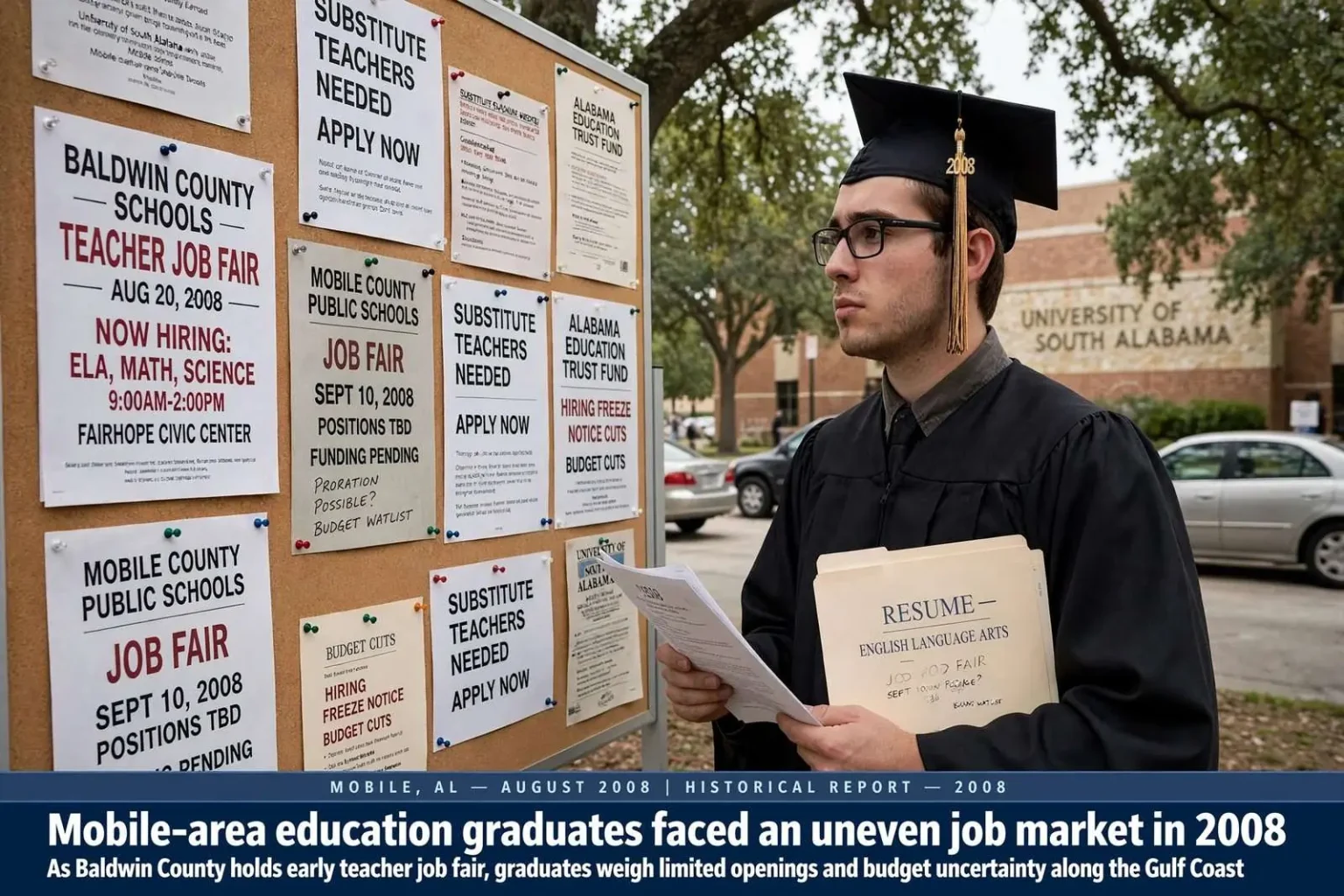
Historical report preserved from an archived 2008 local news story.
Mobile-area education graduates faced an uneven job market in 2008, according to an archived local news report that documented how new teachers were navigating the hiring season along the Gulf Coast. The report captured a class of graduates entering a profession whose openings rose and fell with school budgets, retirements and population growth — sometimes favoring new graduates, sometimes leaving them waiting.
One graduate specializing in English language arts said he was focusing his search on Baldwin County because its job fair was scheduled before Mobile County’s. The detail illustrates the practical strategy that shaped hiring season for new teachers: with positions limited and certification portable across Alabama districts, the timing of a district’s recruiting fair could determine where a graduate applied first, and where their name got in front of principals before slots filled.
A University of South Alabama adviser said the job market for teachers rose and fell over time and encouraged graduates to persist through the slow stretches. The adviser also said teaching in another state could be an option, pointing to the mobility that an Alabama teaching certificate and a shortage-area specialization could offer a graduate willing to look beyond the Gulf Coast.
The 2008 hiring landscape
The class of 2008 finished its preparation just as the national economy began to wobble. Alabama school budgets in that era rode on the Education Trust Fund, which drew its revenue from sales tax, income tax and use tax receipts — revenue streams that slowed almost immediately whenever the broader economy slowed. Districts approaching a budget crunch typically froze vacancies, cut supplementary positions and hired cautiously, even when classrooms still needed teachers.
At the same time, demand was never evenly spread. Alabama school systems consistently struggled to fill positions in special education, math, science and — as in the archived report’s example — English language arts at certain grade levels, while elementary openings drew stacks of applications for every seat. Rural and city systems with retention challenges hired steadily, while fast-growing suburban districts could afford to be selective. For a Mobile-area graduate, the practical map of the job market stretched from Mobile County Public Schools — one of the largest systems in the state — across the bay to Baldwin County’s rapidly expanding districts.
Baldwin County’s growth made it a particularly attractive target. The county’s population boom of the 2000s, driven by coastal development and the eastward expansion of the Mobile metro area, kept opening new schools and new classrooms, and district leaders regularly added teaching positions even in years when other systems retrenched. That growth also explains the job-fair calendar the graduate in the report cited: districts with positions to fill moved early, holding recruiting fairs in the spring before budgets were final, to identify strong candidates before competitors did.
The University of South Alabama’s pipeline
The University of South Alabama has long been one of the region’s principal sources of new teachers. Its College of Education prepares graduates for certification across the full range of Alabama’s grade levels and subject areas, and its graduates staff classrooms throughout Mobile and Baldwin counties and beyond. The adviser’s comments in the 2008 report reflected the office’s standard counsel in a down year: keep applying, keep credentials current, substitute teach or work in after-school programs to build experience, and be ready when a district’s budget picture improved.
The adviser’s suggestion that teaching in another state could be an option pointed to a reality Alabama graduates have used for decades. Gulf Coast graduates often looked west to Mississippi and Louisiana — particularly New Orleans during its massive post-Katrina rebuilding of public education — and to Florida and Texas, whose growing enrollments created steady demand. Certification transfers require some paperwork, typically transcript review and reciprocal licensing through each state’s department of education, but shortage-area teachers have historically found doors open across state lines.
How teacher hiring works in Alabama
Alabama’s public-school hiring runs on a calendar that can seem opaque to new graduates. Districts post vacancies as retirement and transfer paperwork arrives, often late in the spring; job fairs concentrate interviews in a few days; and offers can arrive days before pre-planning week begins in August. State certification, administered by the Alabama State Department of Education, requires a bachelor’s degree with an approved teacher-preparation program, passing scores on the relevant certification exams and a background check, with certificates issued by subject area and grade band.
For English language arts graduates specifically, the path ran through middle and high school classrooms, where reading and writing instruction anchor the curriculum. The state’s graduation requirements, its standardized assessment program and its professional standards for English teachers all shaped what districts looked for, but the decisive factors in hiring were usually local: the principal’s judgment, the timing of the vacancy and how early a candidate’s file reached the district’s personnel office.
The 2008 report’s snapshot of one graduate — watching the calendar, targeting Baldwin County’s earlier fair — shows the informal strategy those mechanics produced. Graduates compared fair dates, drove from district to district, and weighed any offer against the possibility of a better one that might never come. The adviser’s persistence message acknowledged that reality: the market rose and fell, and a graduate’s first year might involve substitute work or an out-of-state position rather than the hometown classroom they prepared for.
What happened after 2008
The years that followed tested the advice. The national recession that took hold in the fall of 2008 hit Alabama’s Education Trust Fund hard, and school systems across the state spent several years trimming staff through attrition and unit reductions. Hiring slowed statewide, and many districts received applications from experienced teachers displaced by cuts elsewhere, further squeezing new graduates. The Mobile and Baldwin County systems, buffered somewhat by regional growth, continued adding teachers in select areas, but the late-2000s stretch was among the most difficult hiring environments for new Alabama educators in a generation.
This article reflects an employment outlook reported in 2008 and is not current career guidance. Teacher supply and demand have shifted repeatedly in the years since, and today’s market conditions differ sharply from those the archived report described. What the report preserves is a moment: Mobile-area graduates in spring 2008, certificates in hand, reading job-fair calendars the way commodities traders read markets — timing their moves, watching neighboring districts, and hearing from a University of South Alabama adviser that persistence, and perhaps a state line crossed, would carry them through.
The districts around Mobile Bay
Mobile County Public Schools, the system the 2008 graduates knew best, enrolled roughly 60,000 students across some 90 schools in that era, making it the largest employer of teachers in the region and one of the largest in the state. Its size meant the county’s job fairs drew hundreds of candidates and its vacancies ranged across dozens of subject areas, but it also meant hiring decisions moved through layers of personnel administration that could stretch the process from first interview to contract offer across most of a summer.
Baldwin County Public Schools, by contrast, ran a system spread across one of the largest geographic counties in the eastern United States — from Spanish Fort and Daphne on the Eastern Shore down through Fairhope, Foley, Gulf Shores and Bay Minette. The district had been splitting and building schools for years to keep pace with growth, and its campuses ranged from affluent suburban feeder patterns to smaller communities along the county’s rural northern tier. For a job-seeking teacher, Baldwin offered both opportunity and variety: new positions driven by enrollment, and schools whose needs differed dramatically from one end of the county to the other.
Between and around the two large systems sat a row of small city districts — Saraland, Satsuma, Chickasaw and others — some of which would move to break away from the county system in the years after 2008, creating new municipal systems with their own hiring. That reorganization, though it came later, traces back to the same growth pressures that shaped the 2008 job market: south Alabama’s schools were changing quickly, and every change eventually produced openings.
Advice that outlasted the moment
The counsel the archived report attributed to the University of South Alabama adviser — that the market rose and fell, that graduates should persist, that another state could be an option — reflects a longer truth about the teaching profession that transcends any single year. Teacher hiring follows demographic and budget cycles: enrollment growth creates demand, recessions suppress it, retirements release positions in waves, and policy changes alter class sizes and staffing formulas. A graduate who misses one year’s window has historically found the market changed within two or three.
The report’s snapshot of the Baldwin-first strategy also captures how deeply local teacher hiring is. A graduate’s career could turn on the date of a district’s job fair, the retirement of a single English teacher, or a principal’s preference for a particular certification. National projections of teacher shortage meant little at the level where the graduate in the report was operating — what mattered was which fair came first, and whose desk the file reached earliest.
What the archived story preserves, then, is the texture of a hiring season rather than a forecast: a Mobile-area English language arts graduate watching Baldwin County’s calendar, a University of South Alabama adviser counseling persistence and out-of-state options, and a Gulf Coast job market that, in 2008 as in most years, rewarded the graduates who treated the search itself as a job. This article reflects the employment outlook reported in 2008 and is not current career guidance.