A Midtown Mobile Wine Merchant Calls the End of the Pinot Noir Era
Four years after the film Sideways rewrote American wine buying, the general manager of a midtown Mobile wine shop argued the Pinot Noir craze was fading and pointed drinkers toward what comes next.
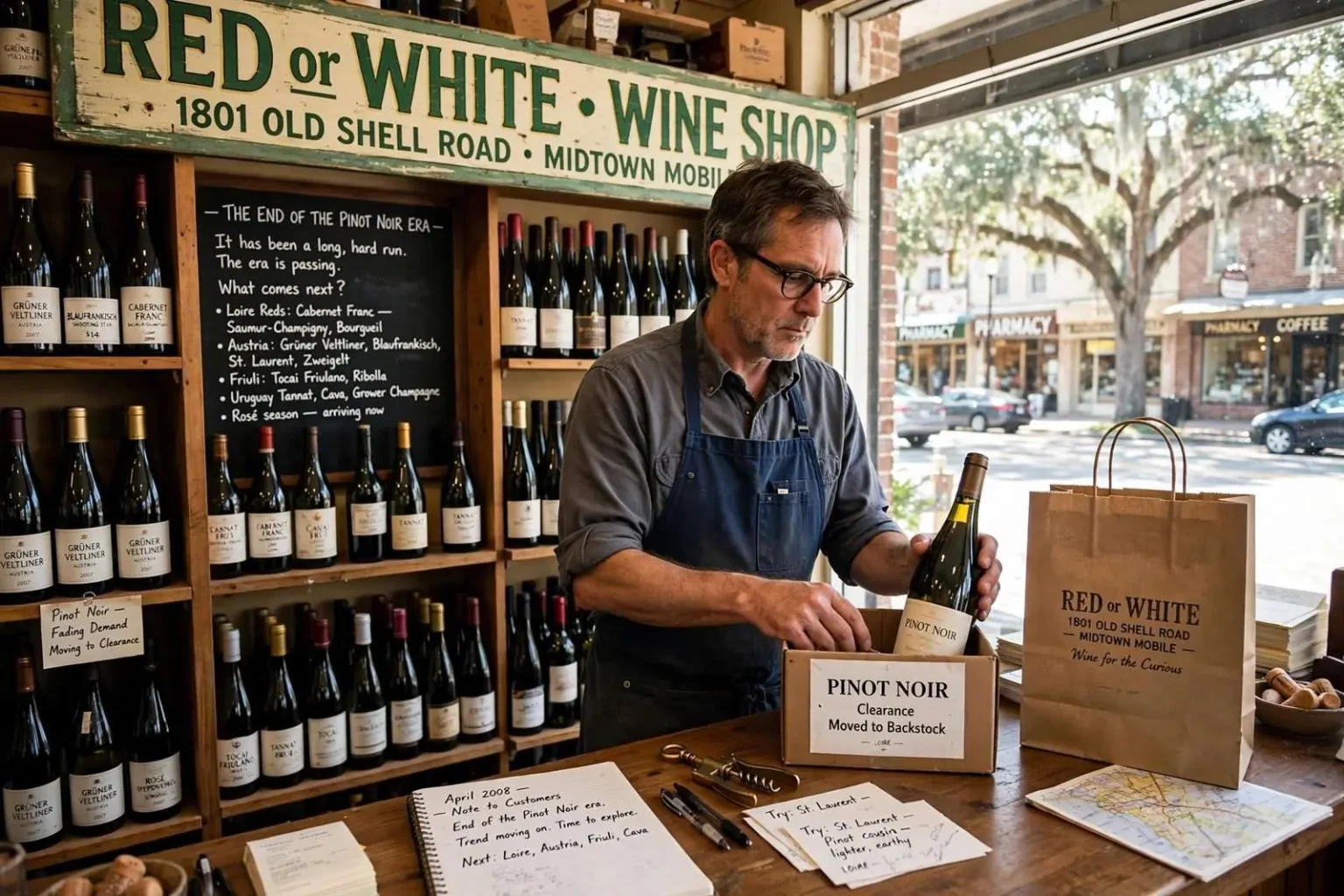
Every few years the American wine drinker changes hats. In April 2008, the general manager of Red or White, the wine shop at 1801 Old Shell Road in midtown Mobile, told his customers that the current hat was about to come off. The observation came from a vantage point few merchants have: a weekly column written directly to a neighborhood clientele, watched over years as fashions swept through the shelves. Old Shell Road in midtown Mobile has long been one of the city’s main retail corridors, and the shop’s customers ranged from longtime Mobilians with settled tastes to newcomers trying to make sense of an unfamiliar wine list at a downtown restaurant.
“It has been a long, hard run for our most recent pace-setter,” he wrote in his weekly column. “The end of the Pinot Noir era, however, is coming and will probably be as vague as the beginning.” No bell rings when a wine fashion dies. The pace-setter simply recedes, shelf by shelf, until one day a retailer looks up and realizes the phenomenon has passed its peak. The merchant was announcing that moment before the sales figures confirmed it.
The beginning, everyone agrees, was a movie. Sideways, released in 2004, crowned Pinot Noir and dethroned Merlot in a single memorable scene, and American retail shelves rearranged themselves accordingly. In one scene, a character delivers a monologue dismissing Merlot while praising Pinot Noir’s fragility and nuance, and the film’s enormous success translated directly into case sales across the country. Merlot producers spent the following years watching orders dry up; Pinot Noir plantings expanded in California, Oregon and beyond. Sommeliers and columnists have studied the episode ever since as perhaps the clearest example of popular culture reordering a consumer market overnight.
The merchant was careful about what that did and did not mean. True Merlot lovers, he noted, went right on buying what they wanted. The real Pinot lovers would do the same when the fad faded. Trends move the mass, not the faithful. That distinction — between fashion-driven buyers and drinkers genuinely attached to a grape — is one retail veterans make constantly, and it was the heart of his forecast. The crowds who surged into Pinot Noir because a movie told them to would surge just as quickly into whatever came next; the people who loved the grape would still be there when the shelves quieted down.
What comes next
Asked to name the next hero, he declined to name one. What he saw instead was a broader appetite: a surge of drinkers seeking variations on their favorite pastime, whether by grape, by origin or by style. The only real demand, he observed, was that the bottle in front of them be clearly different from the last one. That appetite for difference — the exploration impulse — was, in his view, the durable legacy of the Sideways wave. Once drinkers learn that the wine world extends far beyond the half-dozen grapes that dominate American shelves, they rarely go back to drinking by rote.
He offered several places he expected that restlessness to land.
Austria and northern Italy
Vine cuttings from this corner of Europe, he wrote, had been slow to travel the wine globe, and the wines slower still. Austria’s Gruner Veltliner had made its rounds. Friuli’s Tocai Friulano surfaced now and then. Otherwise the region had been missing in action. Austria’s wine industry, rebuilt after the scandals of the 1980s into one of the most quality-obsessed in Europe, remained a specialty item on American shelves even as its white wines won medals at international competitions. Friuli, in northeastern Italy, had cultivated an equally distinctive roster of local varieties that rarely left the region’s borders.
He expected more of the pack to arrive, and urged drinkers not to be scared of the names: Welschriesling, which despite the spelling is no relation to Riesling but a close cousin of Pinot Grigio; Lagrein; Zweigelt; St. Laurent, a cousin of Pinot Noir; and Blaufrankisch. Each of those grapes offered a recognizable bridge from familiar territory — Welschriesling to Pinot Grigio drinkers, St. Laurent to the Pinot faithful, Blaufrankisch to anyone who liked structured reds with dark fruit — which was precisely why he expected them to catch on once shelves made room.
When buying northern Italian bottles, he advised, look for the darker, Germanic-sounding names, which improve the odds of getting the real thing rather than a mass-manufactured product. The Friulian border country has long been bilingual, and labels bearing Slovenian or Austrian-influenced names signaled producers working close to their traditions. He named Fiegl, Gravner and Hofstatter as producers worth the money, singled out Schiopetto’s Tocai Friulano as the grand cru understanding of the grape, and pointed budget hunters to Shooting Star’s Blue Franc, an American Blaufrankisch he called quite solid at 14 dollars. Gravner, in particular, would become one of the most discussed figures in Italian wine for his work with amber wines fermented on the skins in clay vessels, making the merchant’s early endorsement look prescient.
The overlooked French
He had spent the previous week’s column on the Counoise grape and still had a good bit of it on the shelf, though customers were catching on. Counoise, a minor variety of the southern Rhone permitted in Chateauneuf-du-Pape blends, had virtually no American following at the time — exactly the kind of bottle a shop like his could champion. He flagged Tannat as the grape on the horizon, noting that Uruguay had inherited it the way Argentina inherited Malbec, and that the import traffic simply had not matured enough for American consumers to notice. Uruguay’s Tannat-based wines would indeed build an American audience in the following decade, driven by the country’s beef-and-Malbec-adjacent image. Tannat wines were also coming from satellite regions of the southern Rhone and from Gascony, around Armagnac, where the grape had been the local workhorse for generations.
Most of all he wanted Mobile to drink red Loire. Those wines were already here and thoroughly overlooked: Saumur-Champigny, Bourgueil, Saint-Nicolas-de-Bourgueil, Touraine rouge. The Loire’s red wines, made largely from Cabernet Franc, had spent decades in the shadow of Bordeaux and Burgundy on American lists despite offering precisely the food-friendly, moderately priced profile that restaurant buyers said they wanted. He stocked a Cabernet Franc from Nerleux and another from Mabileau, a Gamay de Touraine from Merieau with more muscle than the usual Beaujolais grape, and a Pinot Noir from Brem, a coastal village south of Nantes in Muscadet country, which he described as driven by European earth but paced by vibrant acidity and minerality.
“Trust me,” he wrote, “this is not the Pinot Noir wines that the God sent film paid tribute to.”
Bubbles beyond Champagne
The most practical advice concerned sparkling wine. Champagne had recently added more than thirty villages to its permitted growing area, and the merchant was skeptical about the motive, suspecting bulk production aimed at booming export markets rather than better prices at home. The expansion was the first significant enlargement of the Champagne appellation in decades, and critics at the time argued exactly what the merchant argued: that the region’s governing bodies were chasing volume for international markets, particularly Asia and the United States, rather than protecting the density of the appellation.
His counsel was to follow the heart and the wallet, which he noted rarely point the same direction. Grower Champagnes, and even their reserve bottlings, could then be had for the same money as the heavily marketed big-house labels, or less. The grower movement — Champagnes made and bottled by the families who farmed the vineyards, rather than the large houses that bought grapes across the region — was just beginning to reach American shelves, and bottles from single villages were frequently priced below the mass-market cuvees of the famous brands.
Beyond Champagne he pointed to the Loire’s Chenin Blanc and Cabernet Franc sparklers, Spanish Cava made from Macabeo, Parellada and Xarel-lo, and bigger Prosecco from producers like Bisol and Col Vetoraz. Cava, produced mainly in Catalonia around the town of Sant Sadurni d’Anoia using the same traditional method as Champagne, offered genuine bottle-aged bubbles at a fraction of the price. Prosecco, then still largely unfamiliar to American drinkers, was on the cusp of the export boom that would eventually make it the best-selling sparkling wine in the country.
All of it, he noted, was tempting drinkers at under twenty dollars, something Champagne had not done since he was in diapers, an era he dated by mentioning that his 48th birthday was a month away.
And then, pink
He closed with a promise. The rose wines were beginning their annual journey to the shelves, the misconception that anything of that color belongs in a convenience store was finally wearing off, and he would make his yearly case in their defense the following week. The annual rosé column was by then a fixture of his spring calendar at the shop, tied to the arrival of the new vintage each April.
The forecast held up better than most. Malbec, Loire reds, grower Champagne, Cava and dry rose all found American audiences in the years that followed, and the Sideways effect became a business school case study. Merlot sales eventually recovered, Austria’s and Friuli’s grapes appeared on wine lists across the Southeast, and the grower Champagne category grew from a sommelier’s secret into a shelf staple. What the column really captured was a moment when a neighborhood wine shop, on a street corner in midtown Mobile, was doing the patient work of talking a city into trying something it had not heard of — a task that falls to merchants in every mid-sized American city, and one that decides long before the national magazines do what a local market will be drinking five years on.