Gulf Shores Officials Press FEMA on Storm-Driven Oil Debris Plan
Gulf Shores officials are pushing federal agencies for updated guidance on handling oil debris that could wash ashore during a storm, five years after Deepwater Horizon.
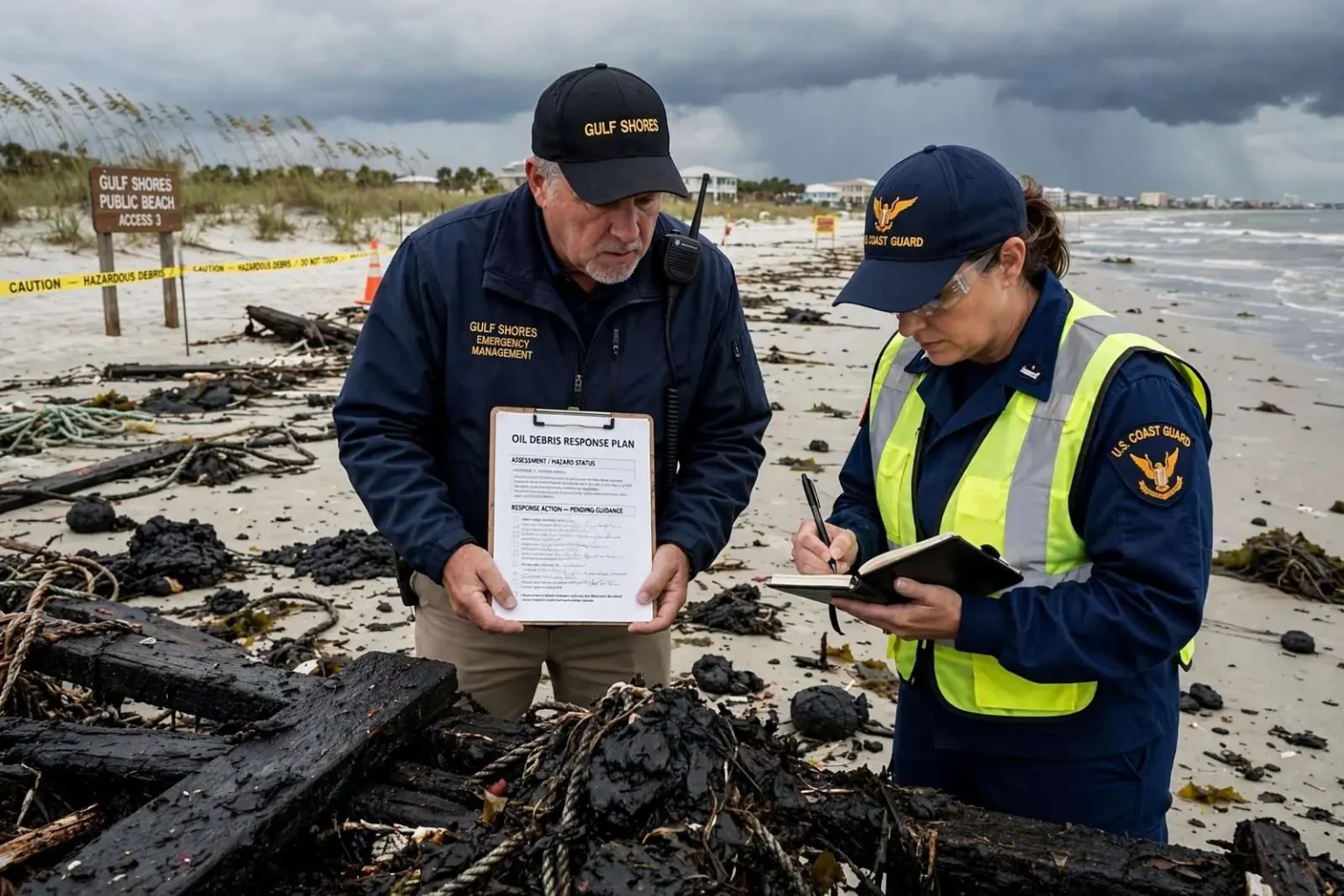
Five years after the Deepwater Horizon disaster spewed more than 200 million gallons of crude oil into the Gulf of Mexico, officials in Gulf Shores are pressing federal agencies for clearer guidance on how to handle oil-laden debris that could wash ashore if a storm disturbs oil still resting on the Gulf floor. The question sounds simple — who cleans it up, and who decides if it is hazardous — but five years of formal requests have yet to produce an answer city officials consider usable, and hurricane season raises the stakes every June.
Since the 2010 spill, more than 55 million pounds of oily material have been cleaned up along Alabama’s coast, according to U.S. Coast Guard statistics. The volume collected has dropped sharply since the disaster, falling from roughly 4.6 million pounds in 2011 to 320,215 pounds in 2012, 9,100 pounds in 2013 and just 530 pounds last year. The declining totals tell two stories at once: the intensive shoreline cleanup that followed the spill has wound down, but weathered oil keeps trickling ashore in small amounts, a reminder that the material in the Gulf has not simply disappeared.
Officials remain concerned about oil that settled to the bottom of the Gulf in the form of tar mats, which could be stirred up and pushed ashore during a hurricane. Unlike the weathered tarballs that beach walkers occasionally spot and that crews can bag and haul away in routine patrols, a storm-driven release from an offshore tar mat could blanket stretches of coastline with oil-soaked debris in a matter of hours — material that may require testing, special handling and disposal well beyond the capacity of a municipal public works department.
Gulf Shores Mayor Robert Craft said the city is “deeply engaged” in seeking a definitive answer from the Federal Emergency Management Agency and the U.S. Coast Guard about how to respond if storm-churned oil debris covers local beaches, timing that carries added urgency with hurricane season arriving. “If a tar mat turns loose in a storm and the debris on our beaches are covered with oil, which will potentially happen … what do we do with the debris?” Craft said. “Who makes the call as to whether it’s hazardous or not?”
An Outdated Playbook
While BP, the owner of the Macondo Prospect well that blew out in 2010, cleaned up oil that washed ashore between Florida and Louisiana in the disaster’s immediate aftermath, other crude settled on the Gulf floor and has remained there since. City officials say the existing BP-issued oil response plan is outdated and no longer reflects how federal response efforts are actually structured. Gulf Shores Emergency Management Coordinator Brandan Franklin said the city has spent three years trying to get updated guidance incorporated into the plan.
“It’s really outdated,” Franklin said. “The verbiage doesn’t really apply to today’s situation.” The problem, as city officials describe it, is practical rather than rhetorical: the plan was written while the spill response was still active, when BP contractors and Unified Command structures were in place along the coast. If a storm scatters oil debris tomorrow, the entities named in that old plan are no longer the ones a city would call, and the funding and decision-making channels it describes may no longer exist in that form.
Why the Question Has No Easy Answer
The confusion stems from the overlapping jurisdictions that govern disaster response on the Gulf Coast. When a hurricane strikes, FEMA administers federal disaster assistance under the Stafford Act, reimbursing states and local governments for debris removal and emergency protective measures. When oil is involved, however, the Coast Guard typically leads the response under the Oil Pollution Act, as it did throughout the Deepwater Horizon cleanup. Mixed debris — storm wreckage coated in oil — falls into the gap between those frameworks, and it is exactly that gap Gulf Shores is trying to close before a storm forces the question in real time.
The distinction matters financially as well as operationally. Ordinary hurricane debris removal can be reimbursed through FEMA’s public assistance programs once a disaster is declared, but material contaminated with oil may fall under a different cost-sharing structure, different testing requirements and different disposal standards, all of which affect who pays. A city of Gulf Shores’ size cannot absorb a multi-million-dollar specialized cleanup on its own while waiting for agencies to negotiate responsibility after the fact.
Gulf Shores has direct experience with both halves of the problem. The city’s beaches took a direct hit from spill-related oiling in 2010 and again from major hurricane impacts over the years, and its tourism-dependent economy rests on the white-sand shoreline that draws visitors to Baldwin County every summer. Beaches closed or tarred during peak season translate immediately into lost revenue for lodging, restaurants and entertainment businesses across the coastal strip, which is why city leaders treat the debris question as an economic issue and not merely an environmental housekeeping matter.
Five Years of Lingering Oil
The steady trickle of oily material documented by the Coast Guard — 320,215 pounds in 2012, 9,100 pounds in 2013 and 530 pounds last year — shows that residues from the spill continue to surface long after the formal cleanup stood down. Response crews have periodically found larger deposits in years past, including mats and concentrated pools of weathered oil uncovered by wave action, and scientists studying the Gulf floor have documented substantial accumulations of oil-containing sediment in deep water far offshore. A hurricane’s storm surge and wave energy represent the most likely mechanism for moving such material toward shore in quantity.
Alabama’s coastline makes the scenario particularly consequential. The state’s beaches are concentrated in a short stretch of Baldwin County — Gulf Shores, Orange Beach and the state park at Gulf State Park — so even a localized tar-mat release could affect a large share of Alabama’s tourist shoreline at once. State and local officials who lived through the 2010 cleanup remember the months of daily operations, contractor fleets and staging areas that even a modest oiling event required, and they are reluctant to face a repeat without a current playbook.
What Gulf Shores Wants From Washington
The city’s request boils down to a decision tree written before the storm, not after. Officials want to know which agency takes the lead when oil-coated debris comes ashore during a federally declared disaster, how material will be tested for hazardous characteristics, where it can legally be disposed of, and how the costs will be divided among federal, state and local government. Until those answers are written into a current response plan, Gulf Shores will keep pressing — three years of effort, by Franklin’s count, and counting.
For now, the city’s emergency management staff continue their routine storm preparations alongside the unresolved oil question: reviewing evacuation plans, coordinating with Baldwin County Emergency Management Agency, and monitoring the tropics as the season builds toward its climatological peak in late summer. The hope among city officials is that the answer arrives from FEMA and the Coast Guard on paper, before it has to be discovered on a debris-strewn beach with tourists watching and a cleanup clock already running.
Lessons Written Into Local Memory
The 2010 spill response also left Gulf Shores with institutional knowledge that shapes its current position. City staff who coordinated with spill responders remember the staging areas that occupied beach parking lots, the contractor crews patrolling the sand in daily shifts and the paperwork required to document every load of oily sand hauled away. That experience taught municipal officials how much organizational machinery a shoreline cleanup demands — machinery a small city cannot build overnight and cannot fund alone, which is precisely why the guidance gap worries them.
Regional coordination is already part of the picture. Baldwin County’s coastal communities coordinate through county emergency management, and the Alabama Emergency Management Agency serves as the state’s link to FEMA during declared disasters. What Gulf Shores is asking the federal agencies to supply is the missing layer: written, current procedures that connect a storm-driven oil release to the correct response authority, so that every level of government knows its role before the first tarred plank of debris washes up rather than litigating jurisdiction while an oil-slicked beach sits closed to the public.
The alternative — improvising those decisions in the middle of a hurricane recovery — is what Craft and Franklin are trying to prevent. With the fifth anniversary of the spill behind them and another hurricane season underway, Gulf Shores officials say they will continue to press FEMA and the Coast Guard until someone in Washington puts a usable answer in writing and updates the plan the city would actually follow.
In the meantime, residents and visitors who encounter tarballs or oily debris on Baldwin County beaches are urged to report the material rather than handle it, so that trained responders can document, sample and remove it under the procedures currently in place.