How Birmingham Money and Families Helped Build Gulf Shores in the 1950s
Long before condos lined the coast, Birmingham families and investment helped transform Gulf Shores from barren beach into a growing resort town.
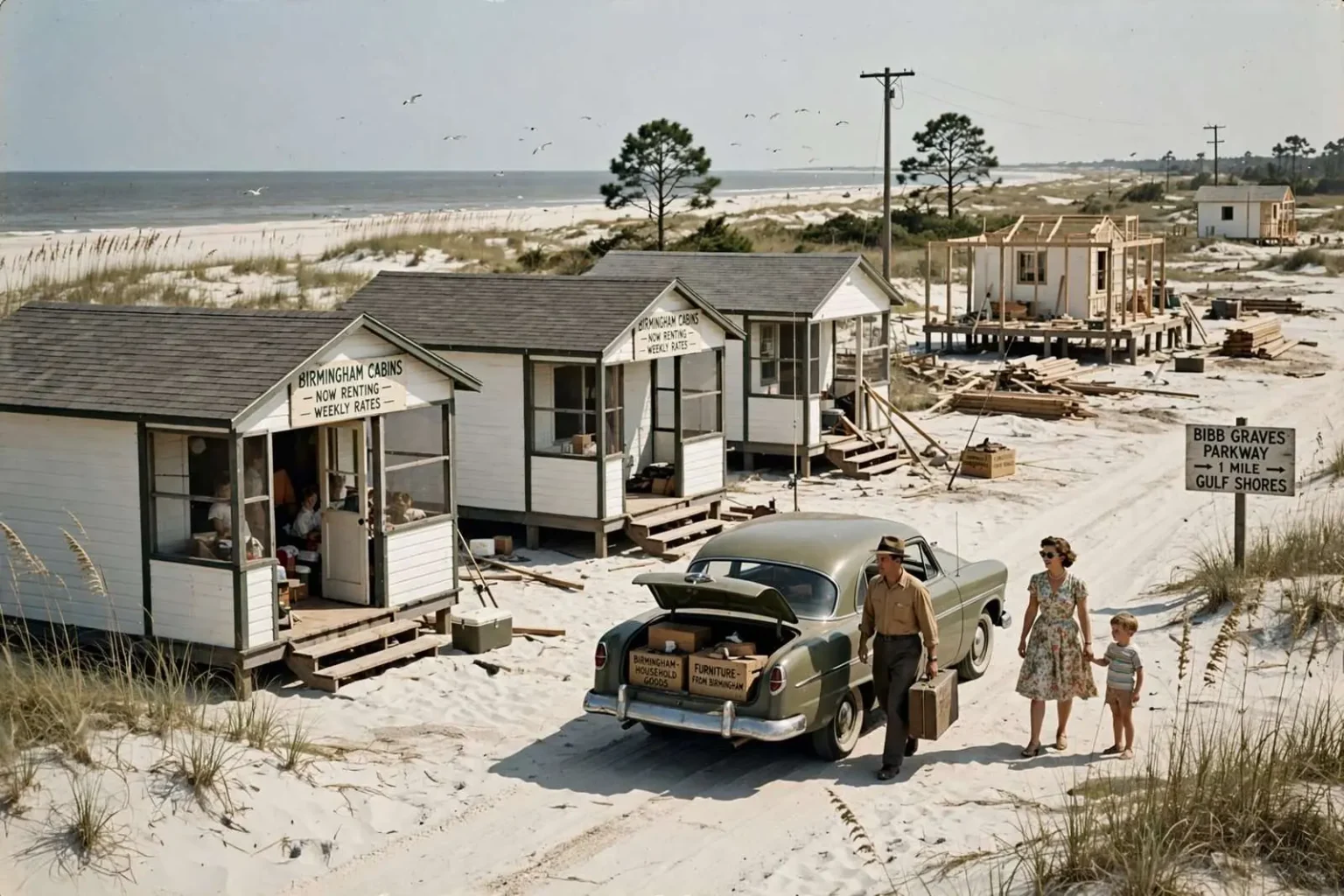
Decades before Gulf Shores became a booming Baldwin County beach destination lined with condominiums and souvenir shops, the small coastal community’s growth was fueled in large part by families and money from Birmingham, more than 300 miles to the north. The connection between Alabama’s biggest city and its most famous beach is older and deeper than many residents realize, and it helped shape the town long before the first high-rise changed its skyline.
Historical newspaper accounts from the early 1950s describe Gulf Shores as a stretch of largely undeveloped beach that was just beginning to attract attention from inland Alabama residents looking for a summer escape. In those years the town was a quiet fishing and farming community at the end of long two-lane roads, its white sand drawing only a trickle of the visitors who would someday crowd it by the millions.
According to those accounts, several Birmingham businessmen played an outsized role in developing the town’s earliest lodging and cottages, effectively laying the groundwork for the tourism economy that defines the area today. They bought land, built cabins and opened the first tourist accommodations at a time when a trip to the Gulf still required a full day’s drive down the state.
The first wave of Birmingham transplants
One of the earliest Birmingham transplants reportedly fell in love with the area after stumbling upon it while traveling toward the Florida Panhandle. He became one of the first Birmingham residents to settle permanently in Gulf Shores, trading the industrial bustle of the city for a life beside the dunes at a time when the idea of a beach town on Alabama’s coast struck many Alabamians as an oddity.
His story captures how the migration began — not through grand development schemes, but through individual discoveries. Roads improved after World War II, families gained automobiles and leisure time, and the Gulf of Mexico was suddenly within reach of Birmingham’s growing middle class. Those who made the trip told their neighbors, and the neighbors followed, some of them with money to invest.
Other investors used proceeds from selling a historic Birmingham theater to construct a dozen beachfront cabin units, while another built a string of cottages along what is now Bibb Graves Parkway, one of the main routes connecting Gulf Shores to the rest of Baldwin County. These were the town’s first tourist lodgings in any meaningful number, simple cabins within earshot of the surf that gave inland families a place to stay for a week or a summer.
The theater sale is a telling detail of the era. Birmingham’s entertainment and commercial landmarks were changing hands as the city modernized, and some of that capital flowed south to the coast, where beachfront land was cheap and demand was just beginning to build. A building that had entertained moviegoers in the Magic City became, in effect, a row of cabins by the sea.
A Birmingham suburb on the Gulf
The influx of Birmingham dollars and residents was significant enough that one contemporary newspaper account described Gulf Shores as functioning almost like a Birmingham suburb, despite the roughly 300-mile distance between the two. The comparison sounds absurd on a map — Birmingham sits in the foothills of the Appalachians at the state’s other end — but it captured a social truth: the people building, visiting and talking about Gulf Shores in those years came overwhelmingly from one city.
The writer predicted the town’s building boom could eventually put it in the same company as larger Gulf Coast resort destinations. That forecast, written when Gulf Shores could still be called a village, proved remarkably accurate. The Panama City Beaches and Florida’s Panhandle resorts were the established competition then; six decades later, Gulf Shores and neighboring Orange Beach stand among the most visited beach destinations on the northern Gulf Coast.
Mobile money and a landmark beach house
Mobile residents were part of the early building wave as well. Historical accounts describe a prominent Mobile family constructing one of the largest homes in the area at the time, a two-story, five-bedroom house spanning nearly 7,000 square feet and requiring more than 90 pilings driven into the sand to support the structure, an engineering feat for beachfront construction in that era.
The piling count remains the detail that stuns modern observers. Before modern foundation techniques and building codes, building anything large on Gulf-front sand was a gamble against wind, water and time, and driving more than 90 pilings represented both serious money and serious intent. The family was not building a fishing camp; they were planting a landmark, betting that Alabama’s coast had a future worth building for in earnest.
Homes of that scale on the beachfront also signaled a shift in the town’s self-image. A house meant for year-round or extended seasonal living, rather than a weekend cabin, suggested that Gulf Shores could support more than tourism — that it was becoming a place people belonged to, not merely visited.
Alabama families with names to know
The widow of a former Alabama governor also took up residence in Gulf Shores following her husband’s death, adding to the town’s growing profile among prominent Alabama families during the decade. Her arrival linked the young beach town to the state’s political aristocracy, the kind of association that turns a fishing village into a destination by reputation alone.
That pattern repeated across the 1950s. As Birmingham executives, Mobile professionals and politically connected families built cottages and homes along the shore, Gulf Shores accumulated a social standing that no advertising budget could buy. Summer residents returned each year with guests, guests became repeat visitors, and the town’s name traveled across the state through the networks that mattered — country clubs, churches, newspapers and dinner tables.
From isolated coast to resort economy
Today, Gulf Shores has grown into one of Alabama’s most visited tourist destinations, drawing millions of visitors annually to its beaches, fishing charters and family attractions. The city’s economy is built almost entirely on tourism and the industries that support it — lodging, restaurants, entertainment and the real estate that a million vacationers a year make valuable.
The scale of the modern town would be unrecognizable to those 1950s investors. High-rise condominiums line the beach, amusement attractions and championship golf courses fill the interior, and the seasonal population swells far beyond the year-round count of residents. Gulf State Park preserves a large slice of the original landscape, but the built environment around it reflects decisions made decade after decade as the town converted sand into an industry.
Local historians say the town’s mid-century transformation from an isolated stretch of coastline into a resort community offers a useful reminder of how much Baldwin County’s beach economy owes to visionary investment from across the state in those early postwar years. The cabins are gone and the pioneers’ names are attached mostly to street signs and faded newspaper clippings, but the model they established — Alabama families falling for the coast and investing in it — remains the engine of the place.
What the early boom left behind
The 1950s boom did more than build cabins; it built the argument for the infrastructure that followed. Roads like Bibb Graves Parkway, bridges over the bays and eventual hurricane-driven rebuilding all trace back to the moment when enough people cared about reaching Gulf Shores to make the investments worthwhile. Tourism now anchors school tax bases, employment and the identity of all of southern Baldwin County.
Every resort town has a founding story, and Gulf Shores’ belongs to Birmingham as much as to the coast itself. The 300-mile connection that one 1950s writer likened to a suburb endures in the traffic that still streams south on summer Fridays from the city’s metropolitan area, in the families who have summered on the same stretch of sand for generations, and in the simple fact that Alabama’s most famous beach speaks with a touch of Magic City history in its story.
The lesson local historians draw is a practical one for today’s leaders: destinations are not accidents. They are built, deliberately and early, by people willing to invest in a place before the crowds arrive — as a handful of Birmingham businessmen and one prominent Mobile family demonstrated on an empty stretch of Gulf sand more than seventy years ago.
Life in Gulf Shores before the boom
Understanding how dramatic the 1950s transformation was requires a picture of what came before. Through the first half of the twentieth century, Gulf Shores was a remote community of fishermen, farmers and a few hardy families who stuck out the hurricanes and the mosquitoes. The Gulf of Mexico was a workplace rather than a playground, and the idea that inland Alabamians would drive hours to sit on the sand was, to many locals, a curiosity at best.
The town’s isolation ended incrementally. Better roads connected the coast to Foley and the rest of southern Baldwin County, bridges made the bays passable by automobile, and the postwar explosion in car ownership put a beach vacation within the reach of families who had never seen the Gulf. Each improvement shortened the distance between Birmingham’s suburbs and the surf, and each summer brought more license plates from the north.
The pattern other Gulf towns followed
Gulf Shores’ experience mirrors the birth of resort communities across the northern Gulf Coast. Panama City, Destin and the Florida beach towns followed similar arcs — a quiet fishing economy, an influx of inland investors, a lodging industry built from cabins, and eventually the high-rise era. What set Gulf Shores apart was that its founding wave of visitors and builders came almost entirely from one city, giving the town an unusually concentrated patronage in its formative decade.
That concentration mattered. A resort built on customers from a single metropolitan area is more fragile than one drawing from everywhere, but it also gets a dependable annual pulse of demand that sustains businesses through the early, lean years. Birmingham’s loyalty gave Gulf Shores’ first innkeepers and cottage owners the bookings they needed to survive, expand and hand the next generation a going concern.
Preserving the memory of the founding era
Much of the physical record of the 1950s boom has washed away with time, storms and redevelopment. The cabins gave way to condominiums, the beach house supported by more than 90 pilings disappeared from the postcard landscape, and the pioneers who drove the first tourist trade have passed on. What survives is the paper trail — the newspaper accounts that described a beach town being born and the recollections that local historians continue to gather.
Those accounts are more than nostalgia. They document the commercial logic of the coast: that Alabama’s beaches were an asset worth developing, that inland demand was real and growing, and that a community’s location on the Gulf could carry it from obscurity to an economic engine within a generation. The investors who acted on that logic in the 1950s made fortunes for those who followed and built the foundation of the modern Baldwin County economy.
For today’s residents and visitors, the story of Birmingham money and Mobile families on an empty beach is a reminder that the condominium skyline has roots — in a dozen beachfront cabins financed by a sold theater, in a parkway that connected a fishing village to the state, and in the simple, consequential act of Alabamians falling in love with their own coast.