Two Injured When Small Aircraft Crashes at Gulf Shores Airport
Two men suffered non-life-threatening injuries when a light aircraft crashed while landing at Gulf Shores' Jack Edwards National Airport.
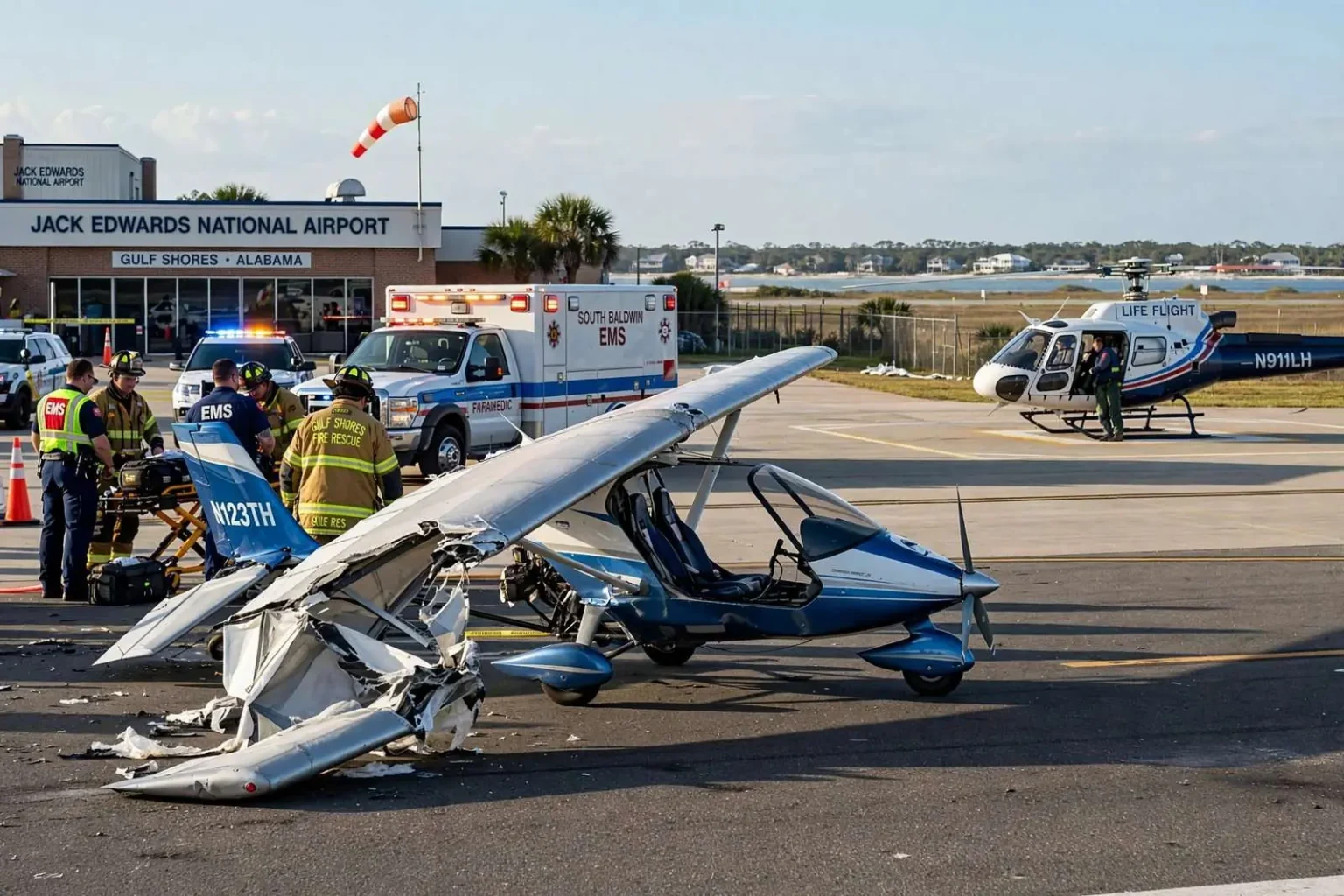
Two men were injured Wednesday afternoon when a light sport aircraft crashed while attempting to land at Jack Edwards National Airport in Gulf Shores, according to airport officials. The accident turned a routine approach into an emergency response at the coastal airport, which serves recreational and business aviation along Alabama’s beach communities.
The single-engine trike aircraft experienced a hard landing around noon that caused substantial damage to the plane’s left wing, said a spokesperson for the airport. Both men aboard suffered injuries that were not considered life-threatening. One of the men was flown by medical helicopter to Sacred Heart Hospital in Pensacola for treatment, while the other was taken by ambulance to South Baldwin Regional Medical Center in Foley.
The decision to fly one patient and drive the other reflected the differing assessments paramedics made at the scene. Medical helicopters are dispatched when injuries require a higher level of trauma care or when time matters most, while stable patients are often transported by ground to the nearest appropriate hospital — in this case, the regional medical center serving Foley and central Baldwin County.
Quick Response and a Fast Recovery
The Federal Aviation Administration was notified of the crash immediately following the incident. The accident scene was cleared shortly afterward, and Jack Edwards National Airport resumed normal flight operations the same day, minimizing disruption to the steady stream of general aviation traffic the airport handles during busy coastal seasons.
Airport officials have not released additional details about what led to the hard landing. Weather, mechanical trouble and pilot technique are the standard categories investigators consider in such accidents, but no determination was offered publicly in the immediate aftermath. No further information on the extent of the men’s injuries or their conditions was immediately available.
The FAA typically reviews incidents involving light sport aircraft, though the depth of any investigation depends on the circumstances and the extent of damage. For pilots and airport staff, the quick clearance of the scene and resumption of operations demonstrated the airport’s emergency procedures working as designed.
About Jack Edwards National Airport
Jack Edwards National Airport sits just north of the heart of Gulf Shores and serves as the primary general aviation facility for Alabama’s Gulf beaches. The airport handles private planes, charters and light sport aircraft, along with the occasional medical and law enforcement flight. For the beach communities of lower Baldwin County, it provides a convenient alternative to driving from larger airports in Pensacola or Mobile.
The facility is named for Jack Edwards, the longtime congressman who represented south Alabama in Washington and championed coastal development projects. Over the years the airport has grown into an economic asset for Gulf Shores, supporting tourism, real estate and the small businesses that serve visiting pilots and their passengers.
Like most general aviation fields, Jack Edwards operates without a control tower, meaning pilots coordinate their arrivals and departures through published procedures and radio calls on a shared frequency. That system works well for experienced pilots but places a premium on careful communication, particularly on busy days when multiple aircraft are in the pattern at once.
Light Sport Aircraft on the Gulf Coast
Light sport aircraft, including trike-style planes that pair a hang-glider-like wing with a powered undercarriage, are popular among recreational pilots along the Gulf Coast, where clear weather and coastal scenery draw significant small-aircraft traffic throughout the year. Trikes — formally known as weight-shift control aircraft — offer an open-air flying experience at a fraction of the cost of conventional small planes, and their visibility along the shoreline makes them a familiar sight for beachgoers.
The category was created by the FAA in the early 2000s to simplify certification for both aircraft and pilots, lowering the barriers to recreational flying. Sport pilot licenses require less training time than private pilot certificates, and the aircraft themselves are limited in weight and speed. That accessibility has expanded the ranks of recreational pilots, particularly in scenic coastal regions like the northern Gulf.
With more aircraft in the air, though, come more opportunities for mishaps. Light sport aircraft operate at slower speeds and lower altitudes than conventional planes, and their lightweight construction leaves them more vulnerable to wind gusts during landing — the most demanding phase of any flight.
Why Landing Is the Riskiest Phase
Aviation safety statistics consistently identify the approach and landing phases of flight as the most common settings for general aviation accidents. A hard landing — the term for a touchdown that transmits excessive force to the airframe — can occur when an aircraft flares too late, descends too fast or encounters a sudden wind shift just above the runway. In a trike-style aircraft, where the wing is controlled by shifting the pilot’s weight rather than moving conventional control surfaces, gusty conditions near the ground add another layer of difficulty.
The substantial damage to the left wing in Wednesday’s crash suggests the aircraft touched down asymmetrically or struck the runway surface hard enough to compromise the structure. Wings are designed to absorb significant stress in flight, but the loads of a bad touchdown can exceed those limits, particularly on a lightweight airframe.
First responders at the airport are trained for exactly these scenarios. General aviation fields keep emergency plans coordinated with local fire and rescue services, and Gulf Shores responders were able to reach the men, assess their injuries and get them moving toward hospitals quickly — a response that airport officials pointed to with some satisfaction in the hours after the crash.
The Hospitals That Received the Patients
The two injured men were sent to facilities on opposite sides of Mobile Bay’s eastern shore region. Sacred Heart Hospital in Pensacola serves as a major medical center for the central Gulf Coast, with trauma capabilities that make it the usual destination for helicopter transports from Baldwin County’s beaches. South Baldwin Regional Medical Center in Foley, meanwhile, is the closest full-service hospital to Gulf Shores, sitting along the Highway 98 corridor about twenty minutes north of the airport.
Splitting the patients between air and ground transport is standard practice when injuries vary in severity, and it also keeps a single emergency room from being overloaded. Both hospitals regularly receive patients from accidents along the coastal corridor, whether from the beach highway, the waterways or, as Wednesday demonstrated, the skies above them.
Officials said the men’s injuries were not considered life-threatening, though neither hospital released information about their conditions. Names of the men aboard were not made immediately available, and the FAA notification will likely produce the fullest public account of what happened once any review is complete.
General Aviation Along the Coastal Corridor
The crash is a reminder of how much small-aircraft traffic moves along the Gulf Coast. Between the airports at Gulf Shores, Foley, Fairhope, Mobile and Pensacola, recreational pilots share the skies with flight schools, charter operators and medical flights, and the coastal route along the beaches is one of the most scenic — and busiest — corridors for light aircraft in the region.
Weekends and holidays bring waves of arrivals for beach trips, fishing charters and real estate visits, and airport managers along the coast have invested in runway improvements, lighting and fuel services to handle the traffic. Jack Edwards in particular has benefited from the growth of Gulf Shores as a tourist destination, with visiting pilots drawn to a field just minutes from the sand.
That growth brings challenges as well. More operations mean more aircraft in airport traffic patterns, and pilots flying into unfamiliar fields for the first time each summer must absorb local procedures quickly. Aviation groups in the region hold safety seminars aimed at exactly this audience, emphasizing pattern discipline, radio communication and conservative decision-making in the busy months.
What Comes Next
In the days after an incident like Wednesday’s, the practical questions get answered quietly: the damaged aircraft is assessed by its insurer, the pilot files the necessary reports, and any FAA review proceeds at its own pace. If the agency determines the accident involved circumstances warranting deeper study, the National Transportation Safety Board may take a closer look; otherwise, the record stands as a statistical entry and a lesson for other pilots.
For the two men injured, recovery is now the priority. Injuries from hard landings in light aircraft most often include fractures, and outcomes in such crashes are generally good when patients reach care quickly — which Wednesday’s response ensured.
For the airport, the episode closed as a one-day story: an aircraft downed at midday, a scene cleared by afternoon and a field back to normal operations before sunset. The red marks on the runway will be repaired, the incident will be reviewed, and the trikes and Cessnas that fill the coastal skies will keep coming — with Wednesday serving as a reminder that even the most routine approach deserves full attention, especially on a sunny Gulf Coast afternoon.