Foley’s Retail Boom Continues With Moe’s BBQ Opening
Foley's retail growth along Highway 59 continues with a new Moe's Original BBQ location, part of a wave of openings in the Baldwin County city.
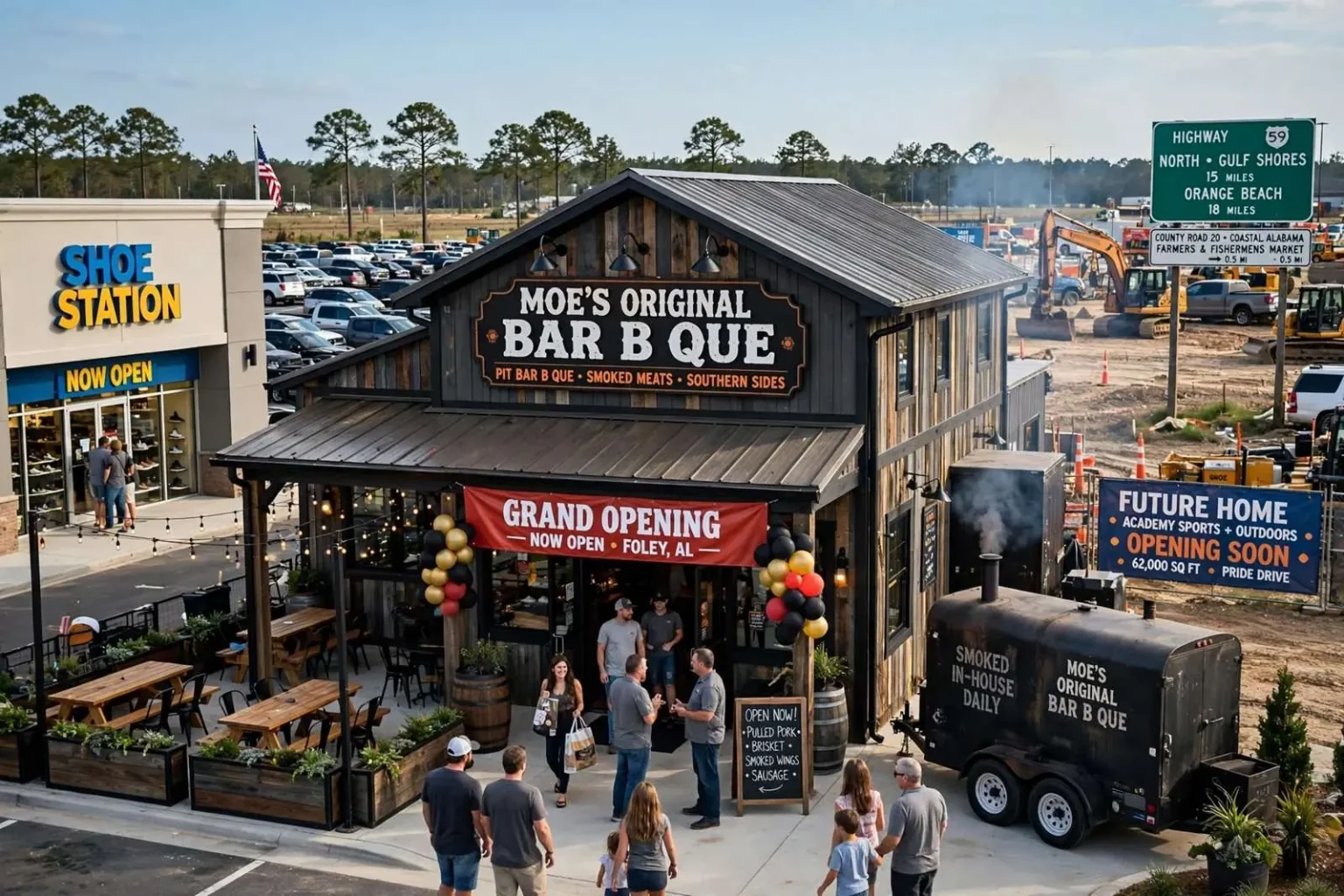
Foley’s ongoing retail expansion added another name to its list this weekend, as Moe’s Original Bar B Que celebrated its grand opening along the city’s booming Highway 59 corridor. The barbecue restaurant’s arrival follows closely behind a new Shoe Station location that opened last month, with an Academy Sports + Outdoors store expected to open in the coming weeks — a string of openings that has turned the highway corridor into one of the busiest retail construction zones in Baldwin County.
The succession of new doors opening within weeks of one another is no accident, city officials say. Retail follows rooftops and traffic counts, and Foley’s growth along Highway 59 has reached the point where national and regional chains are no longer weighing whether to enter the market but where in it.
Foley’s economic development director says the pace of new openings has been building steadily over the past several years as retailers and developers return to the area following the broader economic recovery. The years of recession and slow recovery hit retail development hard across the Gulf Coast, freezing new construction and leaving developers cautious about second locations. That caution has given way to renewed confidence in Foley, where population growth, beach-bound traffic on Highway 59, and available land have combined to make the city an easy pitch for national tenants.
The Academy Sports anchor project
The Academy Sports project, going up next to an existing Walmart, represents a roughly $15 million investment on 13 acres near Pride Drive, supported by a multimillion-dollar incentive package approved by the Foley City Council. The 62,000-square-foot store is expected to bring around 125 jobs to the area once it opens.
The council’s incentive package reflects the arithmetic that has become standard in retail recruitment: a store of Academy’s size brings not only its own payroll but the sales tax revenue that funds city services, and the competition among Gulf Coast cities for such anchors is real. Anchors of this kind also draw smaller tenants — the outparcels, restaurants, and service retailers that cluster around a major destination store — which multiplies the return on the city’s investment well beyond the store’s own footprint.
City officials say conversations are underway with additional grocery and retail chains interested in joining the surrounding shopping center, though no formal announcements have been made. Foley’s mayor said talks are also progressing with a mid-box clothing retailer, though details remain unofficial. In retail recruitment, “in conversations” is the standard state of play until leases are signed, and officials have learned to be careful about announcing tenants before ink meets paper — but the level of interest, they say, marks a clear change from the development climate of a few years ago.
The Highway 59 corridor’s advantage is its dual traffic: Foley’s own growing population on one side, and the river of beach-bound visitors on the other. The highway carries vacationers from I-65 down to Gulf Shores and Orange Beach through the heart of Foley, which means a retailer there captures both the year-round local market and the seasonal wave of tourists who pass through — and often stop — on the way to the coast.
That positioning helped make the city’s existing retail base — the outlet center and the established shopping centers — a fixture of Baldwin County commerce, and it explains why new development concentrates along the same corridor rather than spreading outward. Land near the highway’s interchanges and major crossroads is where the traffic counts are, and Pride Drive’s connection to the corridor puts the Academy project squarely in that flow.
Moe’s fifth Alabama coastal location
Moe’s new Foley location marks the barbecue chain’s fifth spot in coastal Alabama, joining existing restaurants in Mobile, west Mobile, Daphne and Orange Beach. The new restaurant sits near the Coastal Alabama Farmers and Fishermens Market on County Road 20, in a renovated warehouse building that will also soon house a custom outdoor kitchen and fire pit business.
Moe’s Original Bar B Que built its following on Southern-style pit barbecue — smoked meats, Southern sides, and a roadhouse atmosphere that grew from its founding location in Colorado into a chain spreading across the South. Its Alabama footprint has grown steadily, and the Baldwin County market — with its mix of year-round residents and tourist traffic — has proven fertile ground. The Foley store’s warehouse setting gives the brand the rustic, oversized character it favors, and the shared building with an outdoor kitchen and fire pit business creates a destination for the backyard-cooking crowd both retailers court.
The renovation of an existing warehouse rather than new construction reflects a pattern along the corridor’s side streets, where older industrial and agricultural buildings are finding second lives as retail and restaurant space. For a city that grew up as an agricultural crossroads — named for its founder’s family farm — the reuse of warehouse buildings for commerce is a fitting loop.
The Coastal Alabama Farmers and Fishermens Market nearby anchors the neighborhood in its own right, drawing shoppers from across southern Baldwin County for local produce, seafood, and specialty vendors. Retail development has long followed established destinations, and the market’s weekend crowds made the surrounding parcels logical ground for the next wave of commercial construction.
A commercial corridor with momentum
City leaders point to the string of recent openings, which also includes fast food and retail additions over the past year, as evidence that Foley’s commercial corridor continues to draw new investment even as national retail trends shift. The shift is real across the industry: national chains have consolidated, malls have emptied, and retail development has contracted in much of the country. Markets that keep attracting new stores in that climate are the exception, and Foley’s growth — population, tourism traffic, and household income moving in the right directions together — is what sets it apart.
Each opening also feeds the next. Retailers scout markets by watching what succeeds nearby; a Shoe Station that draws well, a Walmart that anchors traffic, and a restaurant chain willing to open its fifth coastal Alabama location together read as a market signal to every chain still on the fence. Development officials describe the dynamic as a snowball, and the past several years have given it plenty of downhill.
Officials say they expect the momentum to continue as more of the surrounding development is completed later this year. Construction along the corridor has been continuous, with new roofs and parking lots appearing alongside the established centers, and each completed project brings the next announcement closer.
For Foley residents, the practical effect is a widening set of options close to home — more reasons to shop, eat, and spend in the city rather than driving to Mobile or Pensacola. For the city treasury, every opening adds to the sales tax base that funds streets, parks, and public safety. And for the corridor itself, the string of openings — barbecue, athletic goods, shoes, and whatever comes next — is quickly building the critical mass of a genuine regional retail destination in the heart of Baldwin County.
Foley’s transformation from a small agricultural town into a Baldwin County retail center is one of the quieter success stories on the Alabama coast. The city of roughly twenty thousand residents sits a few miles north of the beach communities, close enough to capture the coastal economy’s traffic and far enough inland to keep the land costs and room for growth that beach towns ran out of years ago. That position has let Foley grow its commercial base while Gulf Shores and Orange Beach built theirs on tourism alone.
The city’s retail story began in earnest with the outlet center that put Foley on shopping maps across the region, drawing bargain-hunting day trippers from Mobile and Pensacola for decades. Around that anchor grew the shopping centers, restaurants, and service businesses that line Highway 59 today, and the new wave of development — Shoe Station, Academy Sports, Moe’s Original Bar B Que, and the projects still under wraps — extends a pattern rather than starting one.
What incentives buy a city
The incentive package behind the Academy Sports project illustrates how competitive retail recruitment has become along the Gulf Coast. Cities negotiate incentives for stores of this scale because the numbers work over time: a 62,000-square-foot destination retailer generates sales tax revenue year after year, most of it from shoppers who would otherwise spend in another city or another state. The council’s calculation, as with most such packages, is that a portion of future revenue is a fair price for a development that would not otherwise happen on that timeline.
The 125 jobs a store of this size brings are only the visible layer. Construction employment, the service jobs that follow retail growth, and the additional tenants that cluster near an anchor all compound the initial investment — which is why economic development directors speak of anchors like Academy as catalytic rather than simply additive.
The grocery-chain conversations the city is holding matter for a different reason. Grocery anchors shape daily traffic patterns more than any other retail category, and a new grocery in the shopping center surrounding Academy would consolidate the corridor’s pull on local households’ weekly routines — the trips that make the other stores along the way part of every resident’s regular circuit.
Moe’s opening weekend gave the city another small marker of the corridor’s momentum: a full parking lot, a renovated warehouse back in service, and a restaurant chain betting for the fifth time that coastal Alabama’s appetite for barbecue keeps growing. For a city whose leaders talk about momentum, the evidence is easy to see from Highway 59 — and, they expect, it is still building.