Bystanders Attempt Daring Rescue After Fiery Crash on Baldwin Beach Express
Three passing motorists tried to free a Texas man from a burning, overturned SUV after a high-speed crash on the Baldwin Beach Express near Robertsdale.
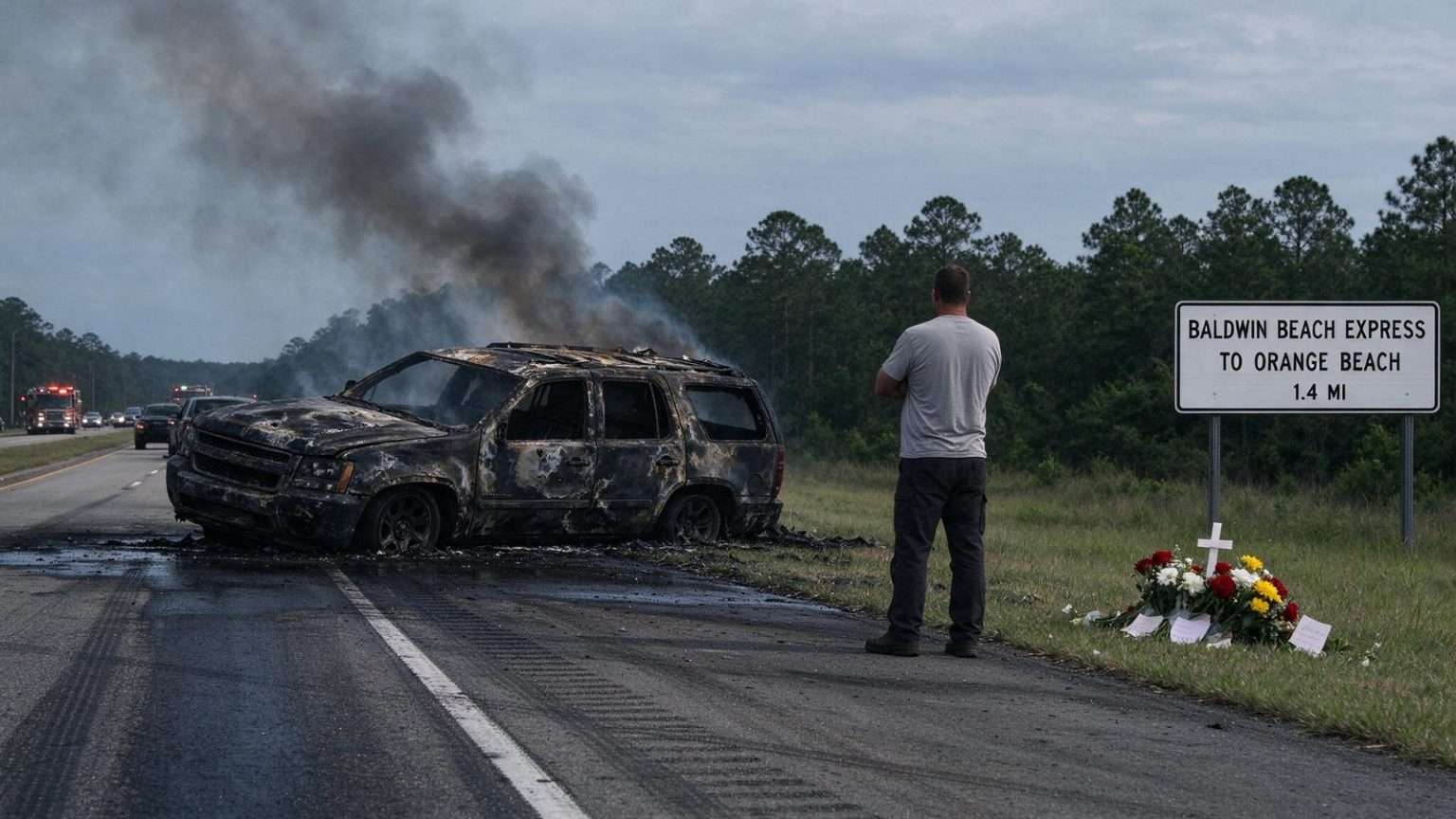
Three strangers who happened to be driving through Robertsdale on a Saturday morning found themselves in a desperate rescue attempt after coming upon a burning, overturned SUV on the Baldwin Beach Express.
One driver, headed south toward Orange Beach with his young son in the car, spotted smoke rising from the shoulder of the roadway. A second motorist, on his way home to Gulf Shores after visiting friends, saw the same plume of smoke moments later. A third man, from Orange Beach, arrived around the same time.
None of the three knew one another. Each stopped, as the others did, because a plume of smoke on the roadside shoulder left no room for hesitation. Within moments they had converged on the wreck as a group, strangers acting in unison on instinct and the shared assumption that someone inside might still be alive.
All three converged on the wrecked SUV, which had flipped onto the shoulder of the northbound lane and caught fire after being struck by a car that police say had been traveling at an excessively high speed before rear-ending it.
Inside the SUV, the men found the driver, a 42-year-old visitor from Texas, lodged in the backseat and unconscious. With smoke intensifying and fears the vehicle could be fully engulfed at any moment, the group searched for a knife to help free him, working quickly while aware they were putting themselves at risk.
The details of the attempt — an unconscious man pinned in a flipped, burning vehicle, rescuers cutting at seatbelts and wedging themselves into a closing window of seconds — describe the kind of rescue that training prepares firefighters for and ordinary drivers attempt out of nothing more than the refusal to watch. Overturned vehicles leave occupants disoriented and often trapped by their own restraints; fire changes the arithmetic of every passing moment.
The men worked while the driver’s car — the one that had struck the SUV — sat nearby and other motorists began to slow and pull over behind them. Freeing an occupant from a flipped vehicle typically means breaking or cutting through restraints, clearing glass and maneuvering a heavy, possibly injured body through a narrow opening, all without knowing the full extent of spinal or internal injuries. The knife the group sought was for the seatbelts and webbing that bind a crash victim in place; time and fire dictated everything else.
Safety experts consistently note that bystander rescues from burning vehicles carry real dangers — fuel lines, undeployed airbags and structural collapse among them — and that the people who attempt them accept risks they cannot fully measure in the moment. The three men here weighed those risks against a life visibly in danger and chose the life. The Robertsdale police lieutenant who later used the word “heroes” was, by every account of the morning, simply describing what he had been told happened on the shoulder of the northbound lane.
A Robertsdale police lieutenant later credited the men as “heroes” for their efforts.
Emergency crews arrived and requested a medevac helicopter to fly the injured man to a trauma center, and the bystanders stepped back to let first responders take over. Despite the rescue effort, the man later died en route to South Baldwin Regional Medical Center in Foley.
The decision to call for a helicopter reflected the severity of his injuries. Medevac transport is reserved for patients whose chances depend on reaching a higher level of trauma care faster than ground transport allows, cutting across the county’s distances directly rather than winding through the roads that feed the Beach Express. For the rescuers who had pulled the man from the wreckage, the sight of the helicopter lifting off without a survivor aboard closed the morning on a note of grief that none of them had time to prepare for.
The driver of the car that struck the SUV, a 44-year-old Foley man, remained at the scene afterward.
Robertsdale police said the crash remained under investigation and was expected to go before a Baldwin County grand jury for consideration of possible charges.
The grand jury referral signaled that investigators were treating speed as a central question in the crash. The Baldwin Beach Express — the limited-access toll route that carries traffic between Interstate 10 and the Gulf Shores-Orange Beach area — is designed for highway speeds, but collisions there at excessive speed leave little margin: a rear-end impact violent enough to flip a full-size SUV speaks to a closing speed far beyond ordinary following-distance errors. Grand juries in Alabama weigh evidence presented by the district attorney to decide whether charges, up to and including homicide counts in fatal crashes, are warranted.
Robertsdale authorities closed the northbound lane of the Baldwin Beach Express for much of the following day while investigators processed the crash scene.
Crash reconstruction teams work a scene like that one methodically — photographing and measuring the vehicles’ final positions, mapping skid and gouge marks across the pavement, documenting the fire damage, and recovering components that will later be read for speed, braking and impact angle. Closing the roadway for a full day inconvenienced weekend travelers headed to the beaches, but the evidence gathered in those hours forms the backbone of whatever case reaches the grand jury.
A makeshift roadside memorial was later placed near where the SUV came to rest.
Roadside memorials — flowers, crosses, notes left where a life ended — have become a familiar feature of the Gulf Coast’s highways, and they serve the living as much as the dead. For the families of crash victims, the site is often the last place their loved one was, and the marker gives grief a physical place to go. For passing drivers, it is a quiet admonition that the roadway’s speed carries consequences measured in more than traffic citations.
The men who attempted the rescue said afterward that they were still processing the loss, and that they wished the morning had ended any other way for the man they pulled from the burning vehicle.
Their account of the morning traced a simple sequence: smoke on the shoulder, the decision to stop, and the discovery that the wreck involved a person rather than debris. Each of the three had somewhere to be — a beach trip with a child in the car, a drive home from seeing friends, an ordinary weekend errand from Orange Beach — and all of it was set aside the moment the smoke came into view. In the days that followed, they spoke about the man from Texas as a person they came to know only in the worst moments of his life, and about the frustration of having done everything they could and still losing him.
Acts like theirs carry a weight that is easy to overlook once the emergency passes. Bystanders who attempt rescues routinely describe the experience in the same terms — no decision to be brave, only a moment when stopping felt like the only option — followed by weeks of replaying what they saw and wondered about afterward. Police agencies involved in such cases often encourage rescuers to talk with victim services or counseling resources, recognizing that the people who run toward a burning wreck are rarely prepared for what it leaves behind.
The Beach Express and the Cost of Speed
The Baldwin Beach Express has transformed travel in southern Baldwin County since it opened, giving drivers a direct route from I-10 to the coast and relieving the stretch of Highway 59 that once funneled every beachbound car through Foley’s intersections. But the road’s long sightlines and limited access also invite speed, and the crashes that occur there tend to be serious ones — high closing speeds, few intersections to slow traffic, and long, empty stretches between help.
Law enforcement agencies that patrol the route pair enforcement with a recurring message: the minutes saved by excessive speed on a highway run are never worth the outcome that one mistake at high speed can produce. The Saturday morning crash outside Robertsdale, with its overturned SUV, its fire and its three strangers searching for a knife in the smoke, became part of that argument in a way no public service announcement could.
What the Case Left Behind
The grand jury will decide in time whether the Foley driver faces charges for the crash. Whatever its conclusion, the record of that Saturday morning already contains the part the three rescuers played — documented by the Robertsdale police lieutenant who called them heroes, and remembered by the family of a 42-year-old Texan whose final minutes were spent in the hands of strangers who refused to let him be alone in the fire.
For the communities from which the three men came — the coastal towns strung along Alabama’s beaches and the mainland roads that feed them — the story stands as a reminder of both the fragility of a highway morning and the persistence of the instinct, in ordinary people, to stop the car and try.