Sprinkler System Flooded Mobile County Probate Court in 2009
A fire-sprinkler system flooded Mobile County Probate Court in January 2009, damaging documents at the Government Street building that holds records including marriage licenses and voting materials.
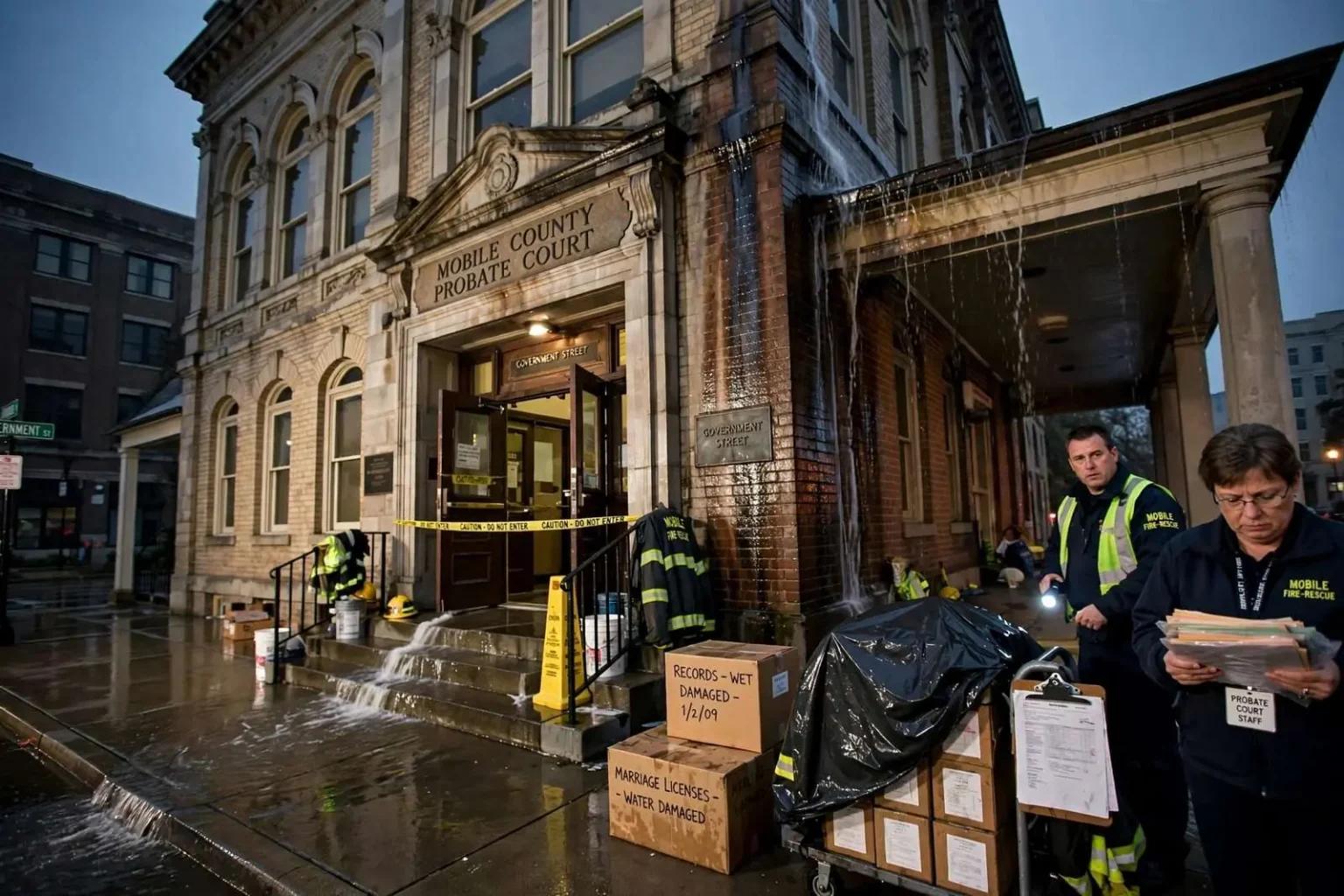
Mobile County Probate Court employees began 2009 dealing with water damage after a fire-sprinkler system flooded the Government Street building early on Jan. 2, soaking portions of a courthouse that serves as the record-keeper for Alabama’s second-most populous county. The timing could hardly have been less convenient — the damage arrived with the new year, just as courthouse operations resumed after the holidays — and it fell on a facility whose shelves hold some of the most irreplaceable paper in Mobile County.
Mobile Fire-Rescue reported that a roof sprinkler activated around 6 a.m., releasing water into the upper portion of the historic building. Water ran down the building and entered through an open second-floor window, reaching documents stored below. Crews responding in the early morning darkness found the aftermath of the activation: water streaking down interior walls, pooled flooring and wet record materials in the areas where the flow had traveled. No injuries were reported in connection with the incident.
A Building Built to Hold the County’s Past
The probate court facility on Government Street is far more than a courtroom annex. The Mobile County Probate Court is the county’s custodian of vital and historical records, and the building’s stacks hold documents including marriage licenses and voting materials, along with estate filings, wills, adoptions and other records that residents and genealogists rely on. Some of the county’s bound record books reach back more than a century, into the era when such volumes were recorded by hand — materials that are, by definition, impossible to reprint from a master copy.
That is precisely why an accidental sprinkler activation in the building is treated with such seriousness. Fire-suppression systems are required in public buildings precisely because a fire in a records facility would be catastrophic, and modern sprinkler heads are engineered to respond only to the heat of an actual blaze. But when a head does activate — whether from fire, heat, accidental damage or mechanical failure — the water follows gravity through a structure full of paper, and paper has little defense against it.
It Had Happened Before
For courthouse staff, the January 2009 scene was an unhappy rerun. The records building had been flooded by fire sprinklers once before, in September 2007, when a sprinkler activation sent water into storage areas and millions of documents were reported damaged. That earlier incident had already forced the county to grapple with the slow, specialized work of drying and restoring water-soaked records — work that typically involves separating wet pages, freezing materials to halt mold, and using controlled drying processes to salvage paper that would otherwise be lost.
The January 2009 account described the new incident as crews assessed the damage, but it did not answer the questions that inevitably follow such an event. The report did not state the final cause of the sprinkler activation, the total number of records affected or the later cost of cleanup. Those details — the origin of the activation, the count of damaged documents and the eventual restoration bill — remained unresolved in the immediate coverage of the flood.
Why Probate Records Matter So Much
The probate court’s holdings matter to far more people than the litigants who pass through its courtrooms on any given day. Marriage licenses issued by the court establish the legal record for families across the county and beyond. Election materials in the building’s custody underpin the administration of voting in Mobile County, one of the state’s largest jurisdictions. Estate and will filings determine how property passes between generations, and the older volumes in the collection serve historians and family researchers tracing lineage through the Gulf Coast’s long history.
Protecting Paper in the Digital Era
The 2009 flood also underscored the ongoing challenge records custodians face in transitioning from paper to digital access. Probate records in Alabama have increasingly been digitized and made available through online indexes, but the underlying original documents remain the legal source of record — and for older volumes, often the only complete version in existence. Water damage to those originals cannot simply be undone by pulling up a backup; it means conservation work, sometimes page by page, at considerable expense.
Institutions that protect historical records have developed a well-established playbook for these incidents, and Mobile County had the misfortune of learning it twice in sixteen months. Wet records are typically stabilized quickly to prevent mold, which can begin growing on damp paper within a day or two in the Gulf Coast’s humid climate. Documents may be blotted, air-dried on racks, or frozen while awaiting more careful treatment. Volumes with iron-gall ink, embossed seals or fragile bindings require particular care. The work is slow and specialized, which is why the cost of cleanup after a records flood can climb far beyond what the initial water damage might suggest.
Preventing the Next Activation
Every sprinkler accident prompts the same practical questions, and the January 2009 event was no exception: how the head that activated will be inspected, how records storage areas can be arranged to keep materials away from potential water paths, and whether devices such as monitored shutoff valves or protective enclosures make sense for the most valuable volumes. Facilities that house irreplaceable archives commonly respond to such incidents by relocating the most fragile materials, installing drainage improvements and reviewing maintenance of the suppression system itself. Insurers and risk managers, for their part, treat a repeat incident — two activations in sixteen months — as a signal to re-examine the building’s plumbing, pressure settings and storage layout in detail.
None of that diminishes the value of having sprinklers at all. A fire in a wooden-floored, paper-filled courthouse building would almost certainly have claimed far more of Mobile County’s heritage than any water incident did. The January 2009 flood — like its September 2007 predecessor — was an accident of protection rather than a failure of it: the system responded when it was not needed, and the county absorbed the cost of drying out. For the employees who arrived that morning to find water where records should be, the episode was a vivid reminder that the probate court’s most important work often happens not in its courtrooms, but in the quiet custody of the paper that holds the county’s memory.
The Probate Court’s Role in County Government
The scope of the water damage response also reflected how central the probate court is to the daily machinery of Mobile County government. The probate judge presides over estate matters, guardianships and adoptions, issues marriage licenses, processes recording fees for deeds and mortgages, and — through the county’s election apparatus — plays a direct role in administering elections, which explains the presence of voting materials among the records at risk in the Government Street building. When water threatens that building, it threatens not a single office’s files but the documentary backbone of several core government functions at once.
The court’s recording function connects it to nearly every significant property transaction in the county. Deeds, mortgages, liens and plats recorded in the probate court establish the legal chain of title for real estate across Mobile County, from downtown commercial towers to bayfront cottages. Damage to those records — even temporary damage that takes volumes out of circulation while they are dried and restored — has ripple effects for title searches, closings and legal proceedings that depend on the originals being available and legible.
A Reminder From January 2009
The timing of the incident, in the first days of a new year, gave the story an unceremonious start to 2009 for the employees who dealt with it. Rather than settling into the year’s routine of filings and hearings, courthouse staff spent the opening days of January pulling wet materials, coordinating with fire and building officials, and setting recovery plans in motion for whatever the assessment crews determined had been reached by the water that poured down from a roof sprinkler activation around 6 a.m. on Jan. 2.
The 2009 account of the flood preserved the essential outline: an early-morning activation, water traveling down the Government Street building and in through an open second-floor window, documents damaged, and a facility with a prior sprinkler flood still fresh in its institutional memory. What it did not preserve — because it had not yet been determined — was the cause of the activation, the full count of affected records, or the eventual cost of making the courthouse whole again. Those open questions were part of the record of the incident as it was reported, and they remain part of how the story is told: a January morning, a century-old habit of keeping the county’s paper safe, interrupted by the very system installed to protect it. In a records building, the difference between protection and damage can be measured in gallons of water.