Boat Fire at Mobile Yacht Basin Caused Major Damage and Pollution Response in 2009
A 2009 fire at Mobile’s Scenic Basin Yacht Club sank two boats, caused more than $1 million in damage and prompted a diesel and oil cleanup response.
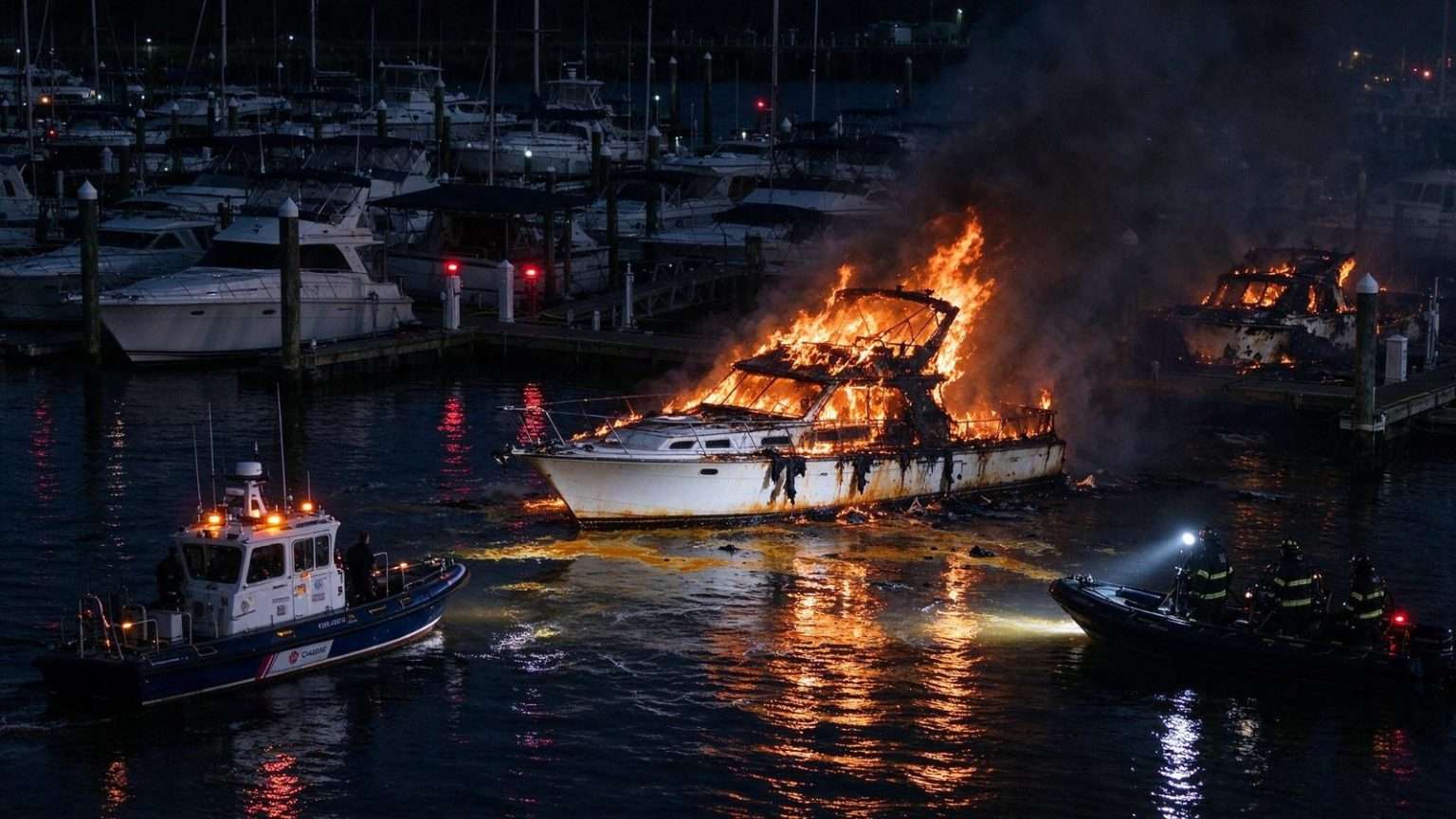
MOBILE, Ala. — A fire at Mobile’s Scenic Basin Yacht Club in September 2009 destroyed two boats, damaged slips and triggered a response to contain diesel fuel and oil released into the basin.
Mobile Fire-Rescue dispatchers received the report at 1:12 a.m. Firefighters arrived to find two 45-foot boats and part of the surrounding boat slips on fire.
A marina fire in the middle of the night is among the most difficult calls a waterfront fire department can draw. Boats are built of fiberglass, wood and foam — materials that burn hot and fast — and they sit within arm’s reach of full fuel tanks, shore-power connections and neighboring vessels. Firefighters arriving at Scenic Basin faced all of those hazards at once, in a narrow waterway off the Mobile Riverfront where access for apparatus is tight and every minute allows flames to jump from hull to hull.
Boats Sink After Fire Spreads
The mooring lines on one vessel burned through, allowing it to drift across the basin. The movement scorched the bows of two other boats as crews worked to control the fire.
Both burning boats later sank.
A burning vessel adrift in a confined basin multiplies the danger. Mooring lines are often the first casualties of a hull fire, and once a boat breaks free, wind and current carry it into whatever lies downstream — in this case, the bows of two moored boats that had not yet caught fire. Fire crews train for this scenario, but the tools available at 1 a.m. are limited: hose lines from the dock, sometimes fireboats or tugs if the waterway allows them, and the difficult calculus of whether to approach a burning, drifting hull.
Sinking adds a second emergency to the first. When a burned vessel goes down, it typically takes unburned fuel with it, and the tanks rupture as the hull fails. What was a fire call becomes a pollution call, and the priority shifts from extinguishing flames to containing a spreading slick.
Investigators believed the fire began on a vessel named Katie’s Dream, though the cause remained under review when the initial report was released.
Damage and Environmental Response
The incident was estimated to have caused more than $1 million in damage. In addition to the boats, the fire burned the roof over at least six slips and damaged portions of the slip walkways.
Mobile Fire-Rescue’s hazardous-materials team and the U.S. Coast Guard Strike Team responded to address diesel fuel and oil leaking from the vessels.
Their role was to help contain potential pollution in the basin after the boats sank.
The hazmat and Coast Guard response followed a well-established division of labor. The fire department’s hazardous-materials specialists handle assessment, containment and monitoring on shore and at the water’s edge. The Coast Guard, which holds federal authority over navigable waters, brings strike-team equipment — booms, skimmers and trained personnel — and coordinates with the responsible parties and contractors on cleanup. Diesel on a marina’s surface is more than an eyesore: it is toxic to fish and birds, and it spreads with every current and breeze until it is boomed and recovered.
Marina Fires Along the Gulf Coast
The Scenic Basin fire fit a pattern familiar to every Gulf Coast port city. Marina fires recur wherever boats are moored closely together, and the region’s long boating season, frequent use of onboard generators and shore power, and the sheer density of vessels in popular basins all raise the risk. Fire investigators typically focus on electrical systems, galley appliances, fuel-line failures and refueling mistakes, though determining a cause on a vessel that has burned and sunk is among the hardest jobs in the field — the evidence sits on the bottom until it can be raised.
The $1 million damage estimate was modest by the standards of worst-case marina fires, which can consume dozens of boats and entire dock structures. The difference usually comes down to detection and response time: a fire reported by a watchman or a neighbor in its first minutes can be held to one hull, while a fire that burns unnoticed for even a short time in a packed basin tends to involve everything within its reach. At Scenic Basin, the 1:12 a.m. dispatch put crews on scene while the fire was still contained to two vessels and their slips, and their work prevented the spread from becoming a basin-wide loss.
For the boat owners involved, the financial picture is complicated by insurance. Vessel policies, marina liability policies and pollution coverage each address a different piece of a fire like this one — the destroyed boats, the damaged docks and roof, the neighboring hulls scorched by the drifting vessel, and the cleanup itself. Sorting those claims can take longer than the cleanup, and disputes over which vessel’s owner bears responsibility for the drifting fire are common.
Mobile’s Waterfront and the Response Network
The basin sits in a working waterfront district where recreational and commercial vessels share water with an industrial port, and that mix shaped the response. Mobile Fire-Rescue operates fireboats and marine-capable units for exactly this kind of incident, and the Port City’s density of maritime professionals — tug crews, marine salvors, spill contractors — means help is unusually close at hand when something goes wrong on the water.
The U.S. Coast Guard’s presence in Mobile adds a federal layer that most inland cities lack. Sector Mobile oversees marine safety across a wide stretch of the central Gulf Coast, and its strike teams are standing resources for pollution response. When a burning boat sinks in a confined basin connected to navigable waters, the question of what is leaking, where it is drifting and who will pay for recovery falls under Coast Guard authority almost immediately, which is why its teams were on scene alongside the fire department’s hazmat specialists.
The 2009 fire illustrated the combined property and environmental risks of a marina incident. It required firefighting, marine investigation and pollution-control work in one of Mobile’s waterfront boating areas.
Lessons for Boat Owners and Marina Operators
Fires like the one at Scenic Basin drive the safety practices that marinas and boat owners are urged to follow. Fire officials recommend monthly inspection of shore-power cords and connections, since corroded or undersized wiring is a leading source of marina fires; keeping automatic extinguishing systems and smoke alarms maintained aboard; never leaving galley cooking or space heaters unattended; and following strict procedures during fueling, when vapors can find any ignition source. Owners are also encouraged to know their marina’s emergency plan — where the shutoffs are, how to report a fire from the water, and when to abandon the vessel rather than fight it.
Marina operators carry their own responsibilities. Dock electrical systems must meet marine standards, fire extinguishers must be staged at intervals along the piers, fuel docks need spill kits and emergency shutoffs, and the facility’s layout matters enormously in a fire: slip spacing, pier width and the orientation of the basin to the wind all determine whether a single-hull fire stays a single-hull fire. After incidents like the 2009 Scenic Basin fire, facilities across a region typically review their own layouts and inspection records, because the lessons travel quickly among boaters.
The drift scenario — mooring lines burning through and turning a burning boat into a floating projectile — is the detail boaters remember from cases like this one. Double and triple mooring lines, snubbers and regular line inspection are the standard defenses, and some marinas in hurricane-prone regions keep emergency line kits staged on the docks for exactly the moment when a vessel’s original lines give way.
When the Fire Is Out, the Work Continues
Long after the flames are extinguished at a marina fire, the incident enters a second phase that the public rarely sees. Salvage divers or crane barges raise the sunken vessels, a slow operation that requires sealing tanks, managing contaminated sediment and coordinating with environmental regulators. Investigators examine raised wreckage for the origin of the fire. Slips must be rebuilt, walkways replaced and the burned roof over six slips reconstructed — the less dramatic half of a million-dollar loss.
The environmental ledger also stays open after the booms come in. Diesel and oil that settle into bottom sediment can require monitoring, and affected dock pilings and seawalls may need cleaning or treatment. Cleanup contractors work under Coast Guard and state oversight, and the costs are pursued through the vessel owners’ insurers, an accounting exercise that can stretch on for many months.
This account records the initial information released by Mobile Fire-Rescue and responding agencies. It does not state a final cause of the fire or the ultimate scope of cleanup and repairs.
What the record does show is how a single 1 a.m. fire call unfolds into a full regional response: firefighters on the docks, hazmat specialists testing the water, Coast Guard teams booming the slick, investigators awaiting the raised hull, and a yacht club basin spending the following months putting itself back together.