Orange Beach Marked Its 25th Anniversary in 2009
Orange Beach marked its 25th anniversary in 2009, reflecting on its growth from a fishing and farming community into a major Gulf Coast destination.
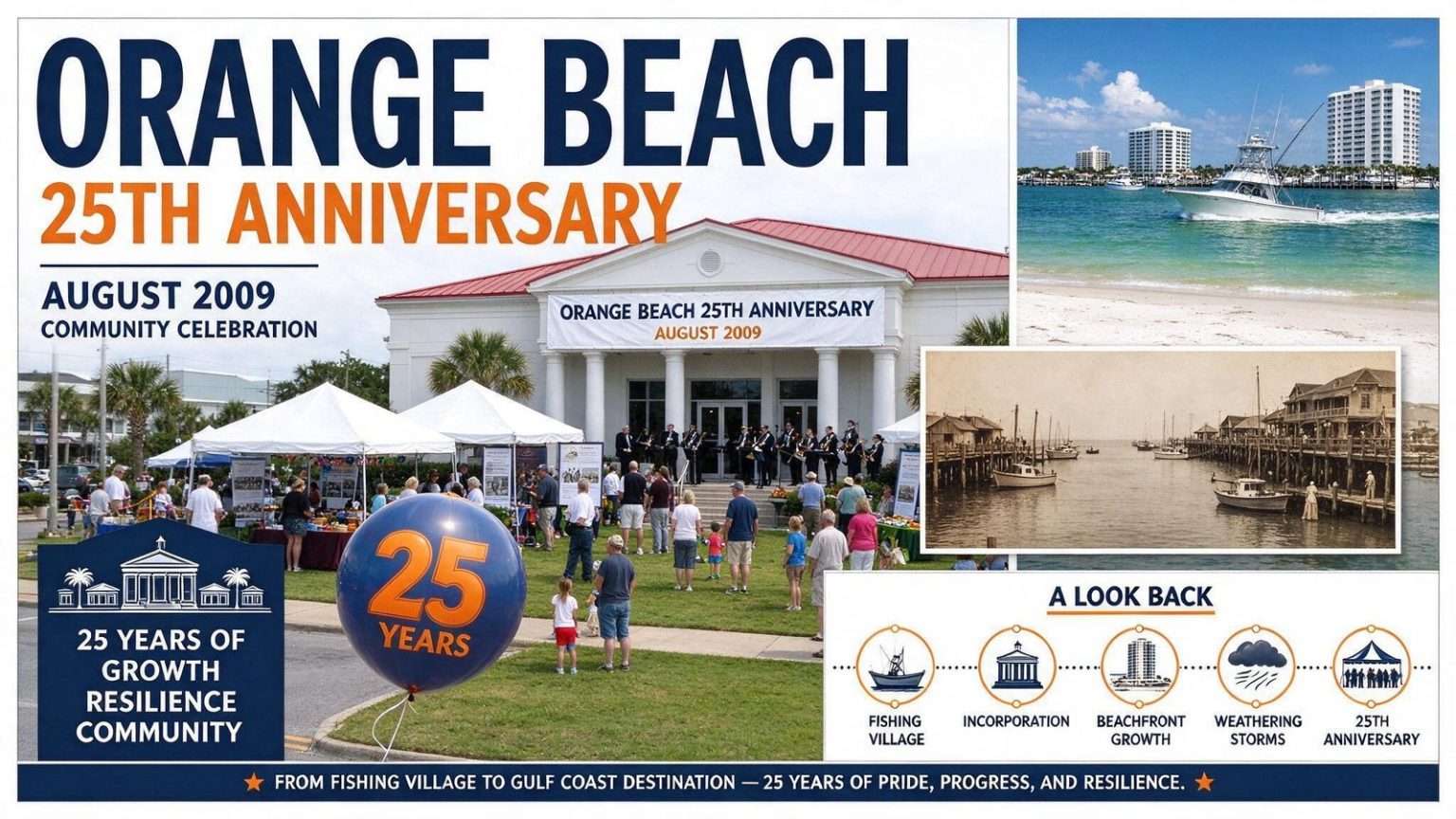
Orange Beach marked its 25th anniversary in August 2009 with a community celebration and a look back at the city’s transformation. City leaders reflected on the adversity the young municipality had weathered — hurricanes, recessions, financial challenges and political turmoil — and said the community had continued to rebuild and grow after those setbacks.
The milestone placed Orange Beach among the younger incorporated cities on the Alabama Gulf Coast. A quarter century of cityhood had carried the community from a modest resort-and-fishing town at the eastern end of Baldwin County to one of the region’s most recognizable destination names, with a skyline of condominium towers that would have been unrecognizable to the families who first settled the banks of the waterways there.
Anniversaries of this kind serve a double purpose in coastal communities. They are occasions for celebration — a birthday block party, historical displays, an evening of shared memory — and they are moments for taking stock. The leaders who spoke at the time of the 2009 observance did both, pairing the festivities with an acknowledgment that the city’s first 25 years had not been a smooth climb but a series of recoveries.
That framing was earned. In the span of a single decade before the anniversary, Orange Beach had absorbed direct hits from major hurricanes, a national economic downturn that chilled the tourism and real-estate markets at the heart of its economy, and internal political strife that played out in public view. Each blow cost the city something; none of them, by the account of its own leadership, stopped it.
From fishing and farming to a Gulf Coast destination
The historical record the city looked back on in 2009 described the area as a quiet fishing and farming community in the early 20th century. That origin story sets Orange Beach apart from the larger resort cities around it, and residents have long taken pride in it. Before the high-rises and the marinas, the settlement lived off the water and the land — fishing boats working the bays and the Gulf, family homesteads, and small-scale agriculture on the ground behind the dunes.
Water defined the place from the beginning. Orange Beach sits where the Gulf of Mexico meets a lattice of bays, bayous and passes, with Perdido Pass as the main connection between the back bays and the open Gulf, and the Intracoastal Waterway slicing east-west just inland of the beach. That geography made the community a natural home for commercial and charter fishing long before it made it a natural vacation destination.
The transformation from fishing village to resort economy unfolded over decades and accelerated sharply in the years before the anniversary. Condominium development along the beachfront, the growth of charter fishing and pleasure-boating out of the passes and marinas, and the expansion of the coastal tourism industry across Baldwin County turned a quiet stretch of the Alabama coast into a destination that draws visitors from across the Southeast.
Growth on that scale brought the markers of a modern resort city — restaurants, entertainment venues, shopping centers, a deepening inventory of places to stay — and it brought the strains that come with them: seasonal population surges, traffic on a two-lane beach highway, and an economy leveraged to the fortunes of tourism and coastal real estate. City government, incorporated in the mid-1980s, spent its first 25 years learning to manage both sides of that equation.
By 2009, the arc from the early-20th-century fishing and farming community described in the city’s historical displays to the destination city of the day was the central story the anniversary told about itself.
Weathering the storms
No part of the city’s first quarter-century loomed larger than the hurricanes. Coastal Alabama sits in one of the most hurricane-exposed corners of the country, and Orange Beach’s beachfront location at the mouth of Perdido Pass puts it squarely in the path of storms crossing the north-central Gulf. The city’s modern history is punctuated by evacuations, landfalls and recoveries.
The blows of the mid-2000s were the heaviest. A major hurricane struck the Alabama coast in 2004 and devastated Orange Beach, tearing apart condominiums, flattening businesses along the beach highway, and damaging hundreds of homes in the city and the surrounding communities. The following season brought another catastrophic Gulf hurricane that, while making its most famous landfall to the west, still hammered the coast with storm surge, wind and rain and stretched recovery resources that were already spent.
Recovery after those storms became the defining civic project of the decade. Condominium towers were repaired and rebuilt, businesses returned to the beach highway, and the city’s infrastructure was restored in stages over years. The storms also shaped how the city built: stronger construction standards, better evacuation planning and a heightened awareness of the coast’s exposure became part of the civic fabric, and leaders marking the anniversary pointed to the community’s demonstrated ability to rebuild as one of its defining traits — a resilience forged, in the most literal sense, by wind and water.
Recessions, finances and political turmoil
The storms were not the only adversity the city’s leaders cited. The late-2000s recession arrived just as the rebuilding years were winding down, and it struck Orange Beach in a particularly sensitive spot: tourism and real estate. A resort economy built on visitors, condominium sales and construction feels a national downturn quickly, and the financial crisis of 2008 and 2009 slowed the markets that powered the city’s growth just as the community was catching its breath from the hurricanes.
Financial challenges at the municipal level accompanied the broader downturn. Cities that lean on tourism-related revenues see their budgets rise and fall with the visitor economy, and the years leading up to the anniversary required difficult choices about spending, debt and priorities. Orange Beach’s leadership of the era managed those pressures while still operating a full calendar of city services and a growing list of capital projects.
Political turmoil rounded out the list. Like many small cities experiencing rapid growth and large budgets, Orange Beach saw its share of public disputes and leadership contention during its first decades, conflicts that played out in council chambers and in the local press. The anniversary reflections acknowledged those struggles alongside the storms and the recessions — difficulties that consumed energy and attention but did not derail the community’s trajectory.
The 2009 celebration
The anniversary observance was designed as a community event rather than an official ceremony. Historical displays were planned as part of the celebration, giving residents and visitors a chance to see the arc of the city’s history — photographs, artifacts and accounts from the fishing-and-farming decades through the boom years and the storm recoveries.
The centerpiece was a birthday block party scheduled at City Hall, with food, entertainment and children’s activities on the program. The setting carried its own symbolism: the building at the center of the city’s government would stand, for an evening, at the center of its social life, with families spread across the grounds to mark a milestone that belonged to everyone who had built the place.
Block parties and anniversary festivals fill a particular role in small Gulf Coast cities. They are inexpensive to mount, open to all, and distinctly local — the entertainment comes from the community, the food from local vendors and organizations, and the guest of honor is the city itself. For a municipality whose population swells and shrinks with the tourism seasons, an event aimed squarely at residents was a way of marking the birthday with the people who lived there year-round.
The children’s activities mattered more than a line item might suggest. A city celebrating 25 years was celebrating a place where many of its youngest residents had no memory of the fishing-village era and only secondhand memories of the storms. The anniversary gave the community a chance to pass its story down to the generation that would carry the city through its next quarter century. August was a fitting month — the heart of the summer season, when the beaches and passes show the destination the city had become, and also the deep of hurricane season, a quiet reminder of the exposure the city had spent 25 years learning to live with.
What 25 years meant for the city
A quarter century is short by the standards of American municipalities, and the speed of Orange Beach’s change was a recurring theme in the anniversary reflections. Cities on the Alabama coast that took shape over a century had, in Orange Beach’s case, compressed the fishing-village-to-resort transformation into a single generation, with all the disruption and opportunity that entails.
The growth produced tangible civic assets. A city government with the machinery to run a modern resort community — public safety, public works, planning — matured alongside the developments it regulated. Marinas, passes and waterways that once served a fishing fleet came to serve a mixed fleet of charter boats and pleasure craft, and the beach highway corridor filled with the businesses of a visitor economy spanning restaurants, entertainment, retail and recreation.
For residents, the anniversary was also an occasion to note what had been preserved alongside what had been built. The waterways, the fishing traditions and the small-city character persisted beneath the resort skyline, and the historical displays underscored the continuity: the same waters that carried fishing boats in the early 20th century carried the charter fleet in 2009.
The road to cityhood
Understanding what the 25th anniversary marked requires a look at the road to incorporation itself. Orange Beach’s path to cityhood came in the mid-1980s, when residents of the fast-growing coastal community chose to incorporate rather than remain an unincorporated stretch of Baldwin County. The decision reflected practical needs: development was accelerating along the beachfront, and local control over planning, zoning and services was becoming a necessity rather than an abstract question.
Early municipal government operated with the modest tools of a small Southern town — a council, a small staff, and a budget built on the revenues a growing but still modest community generated. The city that exists in the public imagination today, with its marina complexes and multimillion-dollar infrastructure, was assembled piece by piece over the 25 years the anniversary celebrated.
Incorporation also settled the community’s identity. Orange Beach has always lived in the shadow of its larger neighbor to the west, Gulf Shores, and part of the city’s first quarter-century was spent establishing itself as a distinct place — with its own city hall, its own harbor and pass, and its own sense of itself as the quieter, more boating-centered end of the Alabama beach strip. The anniversary was, in that sense, a coming-of-age: the point at which a young city has enough storms weathered and enough growth achieved for the reflection to mean something.
A historical record, kept in context
The account of the 2009 anniversary observance is a historical summary, and it should not be read as current event information. The celebration it describes belongs to August 2009 — a specific moment in the life of the city, situated between the hurricane recoveries of the mid-2000s and the changes the following decade would bring.
Reading it in context matters for anyone researching the city’s history. The 2009 observance captured a community at an inflection point: physically rebuilt from the storms, economically strained by the recession, politically seasoned by its internal struggles, and 25 years into an experiment in self-government that had transformed a fishing and farming settlement into a major Gulf Coast destination.
As historical record, the account preserves what was reported at the time: the 25th anniversary, the community celebration, the reflections on hurricanes, recessions, financial challenges and political turmoil, the description of the early-20th-century fishing and farming community, the planned historical displays, and the birthday block party at City Hall with food, entertainment and children’s activities. Together they document how one small Alabama coastal city chose to mark its first quarter century — and the resilience its own leaders cited as the through-line of the story.