Coast Guard Rescued Tugboat Crew After 2009 Mobile Bay Sinking
The Coast Guard rescued three crew members and confirmed a fourth reached shore after a tugboat partially sank in Mobile Bay in October 2009.
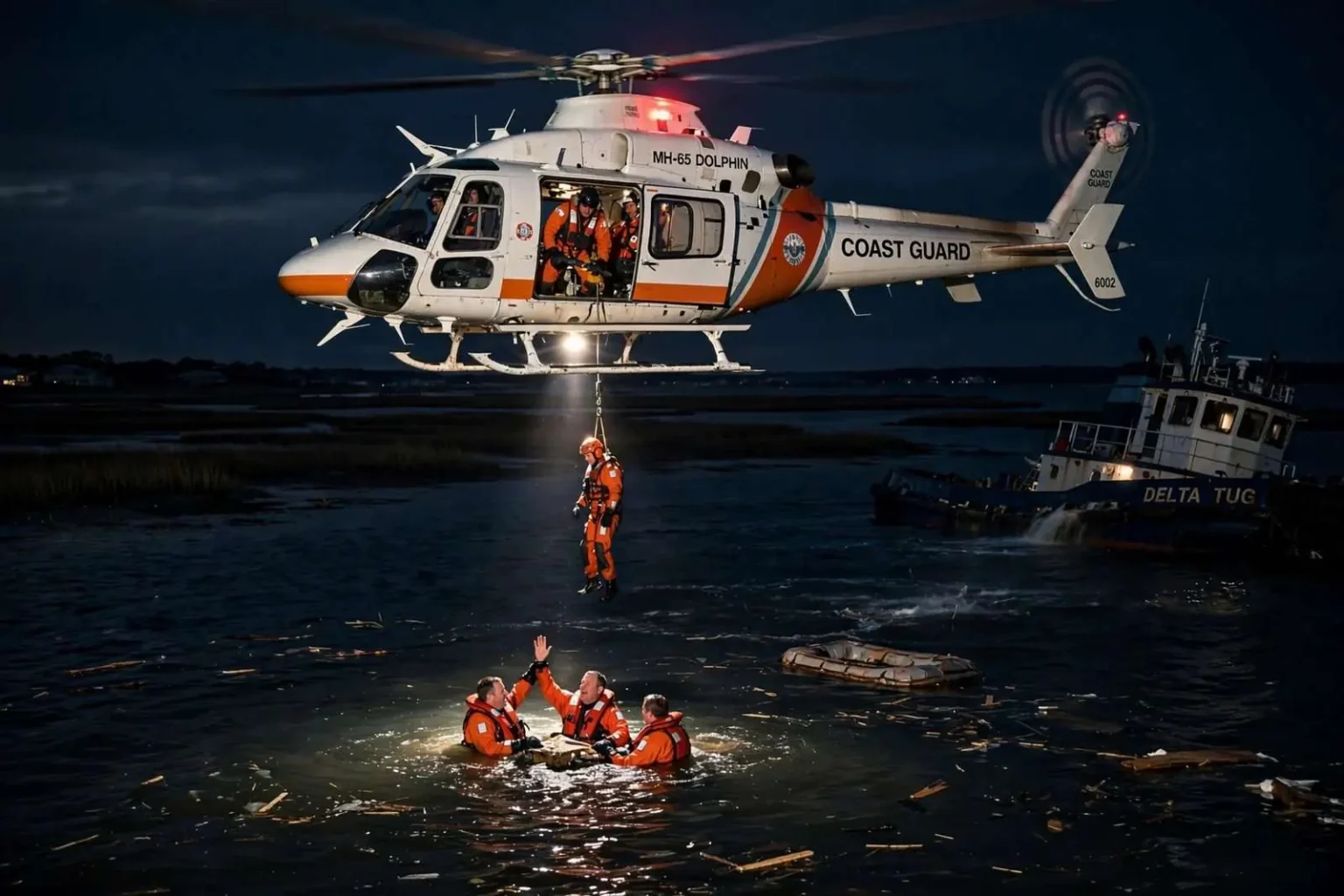
A late-night emergency on Mobile Bay in October 2009 ended with all four crew members of a tugboat safe, after the vessel partially sank in the early morning darkness and put its crew into the water. According to a Coast Guard report, the tugboat went down at about 3 a.m. on a Saturday, leaving its four-person crew in need of assistance in one of the Gulf Coast’s busiest bays. What followed was an overnight rescue operation that combined Coast Guard aviation, luck, and the resourcefulness of a crew member who reached shore on his own.
Overnight Rescue Operation
A Coast Guard helicopter and crew from Air Station New Orleans located and rescued three of the crew members at about 5 a.m., roughly two hours after the vessel went down. Air Station New Orleans, based at the New Orleans Lakefront Airport, maintains helicopter crews that stand watch around the clock to cover the central Gulf Coast, and its response area routinely extends across the Louisiana and Mississippi coasts and into Mobile Bay when local resources need reinforcement.
The rescue unfolded in the kind of conditions that make maritime search and rescue difficult. Overnight operations deprive responders of easy visual references on a dark bay, and anyone in the water in the pre-dawn hours faces the added danger of hypothermia even in Gulf Coast seasons. Locating three people in that environment in roughly two hours reflected the value of the helicopter’s search sensors and flares, as well as the crew’s familiarity with rescue swimmer deployment into open water.
The fourth crew member took a different route to safety. Rather than staying with the partially submerged vessel, he used a 14-foot skiff to reach shore and contacted the local fire department to report being safe. Fire departments along the bay’s shoreline are standard first points of contact for mariners who make it to land, and the notification gave responders an early head count that helped clarify how many people still needed extraction from the water.
All four people survived the incident. For a vessel casualty that put an entire crew into Mobile Bay at night, the outcome was the best possible result, and it underscored the layered safety net that surrounds commercial mariners on the bay: a mayday or distress signal, a Coast Guard air station two hundred miles away that can launch within minutes, and shoreline emergency services ready to receive survivors.
The Role of Tugboats on Mobile Bay
Tugboats are the workhorses of Mobile Bay’s maritime economy. The Port of Mobile, one of the largest deepwater ports on the Gulf of Mexico, depends on tugs to escort large oceangoing vessels through the ship channel, to dock and undock cargo ships at the port’s terminals, and to move barges carrying coal, aggregates, petroleum products, and other cargo between points on the bay and its tributary rivers.
That work exposes tug crews to risk around the clock. Tugs operate in confined waters with heavy traffic, often alongside vessels many times their size, and a collision, grounding, or structural failure can put a small vessel and its crew in immediate danger. The partial sinking reported in October 2009 — where the vessel went down but did not disappear entirely — is one of several casualty profiles that can follow from hull damage, flooding in an engine compartment, or a shift in cargo weight.
When a tug goes down, the people it normally protects are left exposed, and survival often depends on how quickly they can get clear of the vessel. Crews train for emergencies with drills covering abandonment, life rafts, and immersion suits, and the fact that this crew’s members were located alive — three by helicopter, one by his own navigation of a skiff to shore — suggested that at least some of that preparation paid off under real conditions.
Pollution Response and Investigation
A Coast Guard pollution team was sent toward the partially sunken tugboat to assess and contain possible fuel or oil leakage. That action reflected the additional environmental risks that can follow a vessel casualty in the bay’s busy maritime environment.
Any workboat of meaningful size carries diesel fuel, lubricating oils, and hydraulic fluids, and when a hull is compromised those products can escape into the surrounding water. Mobile Bay is an ecologically and commercially sensitive body of water: its brackish mixture of fresh river water and Gulf seawater supports extensive oyster reefs, seagrass beds, and marsh habitat, and it also carries the shipping traffic of the Port of Mobile. A sheen drifting from a sunken tug can close shellfish harvesting areas, foul shorelines, and complicate salvage work.
Pollution responders typically approach a partially submerged vessel by first securing the source — plugging vents, sealing tanks, or deploying containment boom around the wreck — and then arranging for the fuel and oil to be removed before any attempt to raise the vessel. The team dispatched in this case had the task of determining how much fuel the tug carried, whether tanks had been breached, and what equipment would be needed to prevent a spill from spreading. The partially sunken position of the vessel actually worked in responders’ favor in one respect: a vessel resting on or near the bottom in shallow bay water is easier to boom and dewater than one lost in deep open water.
The cause of the tugboat sinking was under investigation when the report was released. Coast Guard investigations of vessel casualties examine hull condition, loading, weather, crew rest and training, and mechanical systems, and their findings can lead to safety recommendations for the wider fleet. No further details about the vessel’s condition or the circumstances leading to the partial sinking were available in the initial account, leaving the operational questions — what failed, and why the crew could not stay with the vessel — to the investigation that followed.
Search and Rescue on the Central Gulf Coast
The response highlighted the role of air crews and local emergency responders in quickly locating people in distress on Mobile Bay during overnight conditions. The rescue also illustrated how the Coast Guard’s Gulf Coast infrastructure functions as an integrated system rather than a set of isolated stations.
Mobile Bay falls under the operational umbrella of Coast Guard Sector Mobile, but sector resources are not always the closest or fastest option for a given emergency. Air Station New Orleans’ helicopters carry rescue swimmers and medical equipment, can search large areas quickly at night with FLIR and other sensors, and routinely cross sector lines to cover a case. When a distress call goes out on the bay, dispatchers weigh the position, the number of people involved, the weather, and which assets are airborne or ready, and the aircraft that launched in this case covered the distance from the New Orleans area in time to make the rescues before dawn was fully gone.
Local fire departments play their own role in the system. A mariner who reaches shore — as the fourth crew member did with his skiff — will typically find the nearest fire or police department is the fastest way to alert authorities, and that notification provides searchers with critical information: how many people are accounted for, what the vessel was, and where the crew last saw it.
A Reminder of the Stakes
The event combined a successful crew rescue with an immediate effort to protect Mobile Bay from a potential spill. It remains a reminder of the operational and environmental stakes surrounding marine incidents in the waters serving the Port of Mobile and nearby coastal communities.
For the mariners who work the bay, the case reinforced the basics that safety advocates repeat after every incident: monitor the weather before getting underway, keep distress equipment accessible rather than stowed away, and know the abandonment procedures well enough to execute them in the dark. For the broader community, it was a look at the machinery that stands behind the port’s daily commerce — the rescue helicopters on standby, the pollution teams with their boom and skimmers, and the investigators who comb through what went wrong so the next crew has a better chance.
After the Rescue
Once all four crew members were accounted for, the standard sequence of post-rescue steps begins. Survivors pulled from the water are evaluated for exposure and hypothermia, since even a couple of hours of wet clothing and wind over the bay can lower body temperature enough to require medical attention. Coast Guard crews coordinate with local EMS to have ambulances ready at the dock or helipad, and family notifications are made as soon as head counts are confirmed.
The partially sunken vessel itself then becomes the focus of a separate operation. Salvors work with the Coast Guard to stabilize the tug, remove fuel and oil, and refloat or dismantle it depending on its condition and position. How quickly that can happen depends on weather, water depth at the sinking site, and the availability of dewatering pumps and marine equipment in the area.
Incidents like this one also feed directly into the culture of safety along the waterfront. Crews at towing companies and dockside operations pass along the details of what worked and what did not — how the skiff saved a life, how quickly the helicopter arrived — and those lessons shape the drills that the next crew runs before an emergency of its own ever arrives.