Baldwin County Schools Secured $35 Million Credit Line in 2009
The Baldwin County school system secured a $35 million line of credit in 2009 as leaders worked to manage a major budget deficit and maintain operations.
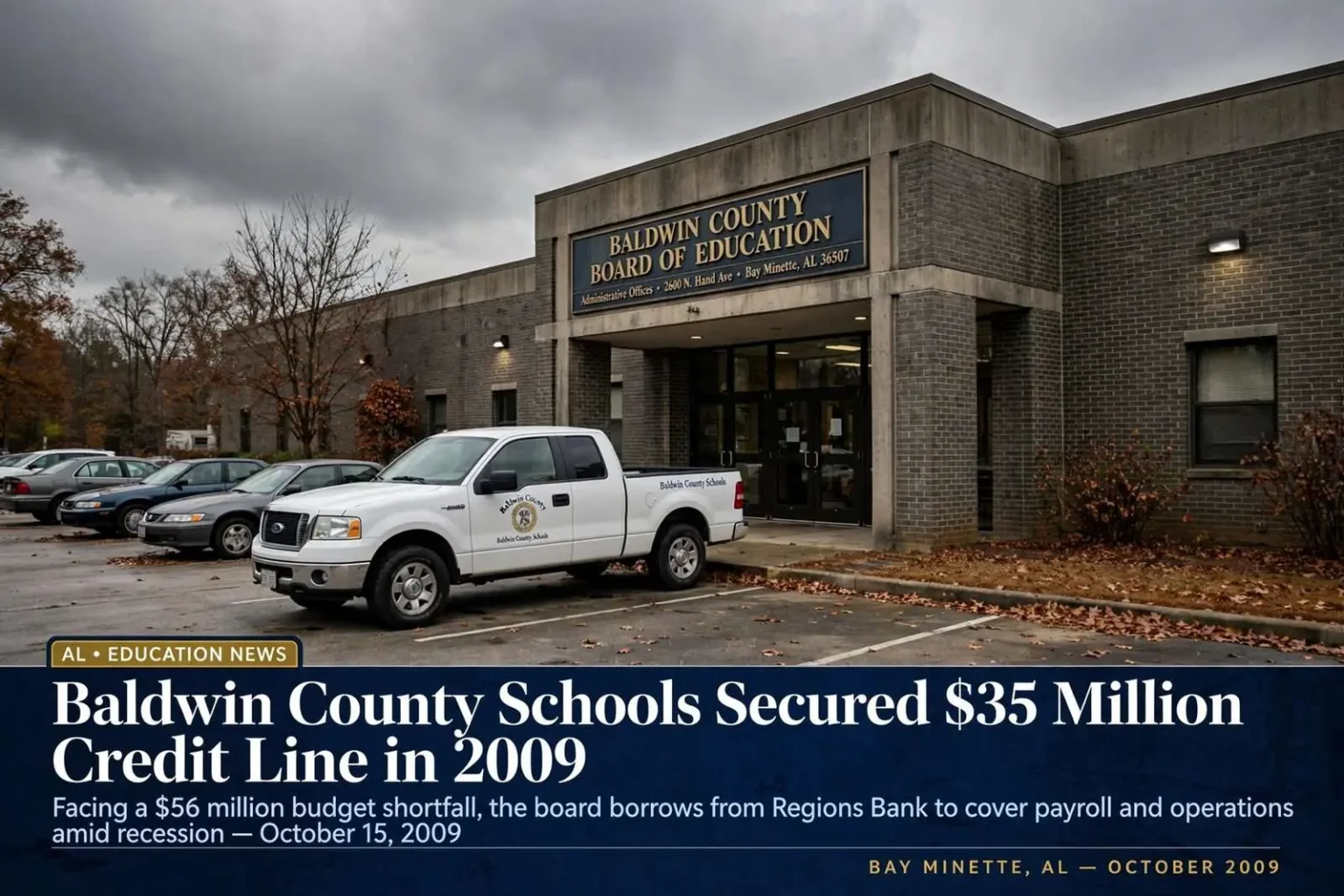
The Baldwin County Board of Education secured a $35 million line of credit in October 2009 as the school system worked to manage a severe budget shortfall brought on by the recession. Officials said the credit line from Regions Bank was needed to help pay bills and keep the district operating while revenue continued to fall short of obligations. The move came after months of cuts intended to address what leaders described as a $56 million budget deficit — a gap large enough that trimming alone could not close it.
The arrangement was extraordinary for a public school district, and it reflected how dire the arithmetic had become. A line of credit is a borrowing tool, not new revenue: it gave Baldwin County schools the cash to meet payroll and pay vendors on time while the system worked through a funding crisis that had been building for more than a year. School systems across Alabama were facing the same squeeze as state education revenues collapsed, but few were forced to borrow at the scale Baldwin County was.
Continuing financial strain shaped every decision the board made that fall. Superintendent Faron Hollinger said the system’s budget for the year was $75.5 million lower than it had been the previous year — a reduction that dwarfed most school districts’ entire annual budgets. He described the downturn as the most difficult financial climate he had seen during more than three decades in education, a striking assessment from an administrator whose career spanned multiple economic cycles and the funding troubles that came with them.
How the Shortfall Built Up
The deficit Baldwin County schools faced was not the product of local overspending; it tracked the broader collapse of the revenue streams that fund Alabama’s public schools. The state’s education budget is fueled largely by sales tax and income tax collections, and both fell sharply as the recession cut into employment and consumer spending. When state revenues miss projections, the state education budget is subjected to proration — across-the-board cuts that flow down to every city and county system — and Baldwin County, one of the largest and fastest-growing districts in the state, felt each round of proration more than most.
Local revenue provided no cushion. Baldwin County’s property taxes, which support the local share of school funding, remained comparatively modest for a district of its size, a long-standing feature of Alabama’s school finance structure. That left the system unusually dependent on state funding and therefore unusually exposed when the state’s economy contracted. A district that had been adding classrooms and hiring teachers to keep pace with growth for years suddenly found itself cutting in every direction at once.
The months leading up to the credit line had already produced painful reductions. Earlier cuts had included the elimination of extracurricular activities — a decision that touched students directly and drew community attention — along with staffing reductions across the system. District leaders expected more than 200 employees to be laid off in the week the credit line was announced, a wave of job losses that touched teachers, support staff and their families across the county. School leaders said those steps had not been enough to close the gap created by the sharp decline in revenue, which is why borrowing became necessary.
The Terms and the Deadline
The board was required to repay the Regions Bank credit line by Sept. 30 of the following year, a deadline that mattered because it aligned with the end of Alabama’s fiscal year — the point at which the district’s budget cycle turned over. The arrangement gave the system temporary capacity to meet immediate obligations while leaders continued to pursue longer-term solutions to the budget crisis. In effect, the loan bought time: bills got paid through the fall, winter and spring while the district searched for a way to right-size its spending to a revenue base that had contracted dramatically.
Borrowing to cover operating costs carries its own risks, and the repayment deadline put the board on a clock. Interest costs on a $35 million line add expense to a budget already short by tens of millions, and the district’s ability to repay depended on state funding levels that were themselves uncertain from year to year. The Sept. 30 deadline meant the district would need either recovered revenue, deeper spending cuts, or both by the start of the next fiscal year — with little room for the economy to disappoint again.
For the superintendent and board members who managed the process, the credit line was a bridge, not a fix. No borrowing arrangement could restore the $75.5 million that had disappeared from the system’s budget, and none of it eased the underlying decisions about programs, positions and priorities that the deficit demanded. What the loan could do was prevent the operational crisis — missed payrolls, unpaid vendors — that would have made an already painful restructuring unmanageable.
The Recession’s Reach Into Alabama Classrooms
The 2009 crisis in Baldwin County was part of a statewide and national picture. The Great Recession, which began in late 2008, hollowed out the tax collections that pay for public education across the South, and Alabama’s dependence on sales and income taxes made its education budget one of the most volatile in the country. Districts from the Tennessee Valley to the Gulf responded with a familiar playbook: hiring freezes, larger class sizes, program cuts, staffing reductions and, in the most severe cases, borrowing.
Baldwin County’s situation was distinctive for its scale and its growth. The county’s population had been expanding rapidly for years, drawn by the coast, the jobs and the quality of life along the eastern shore of Mobile Bay, and its schools had grown with it. Cutting a district that is still absorbing new students each year is harder than cutting one that is stable, because every reduction collides with rising demand for seats, teachers and services.
The events of October 2009 also illustrate how public education absorbed the shock of the recession in a way few other institutions could avoid. Schools could not close, enrollment could not be turned away, and the obligations to employees and students continued even as the money evaporated. The result was a stretch of years in which school leaders across Alabama spent as much time on budget arithmetic as on instruction, and Baldwin County’s line of credit became one of the most visible symbols of that era.
What the Cuts Meant on the Ground
Behind the budget figures were changes that residents of the county experienced directly. The elimination of extracurricular activities meant the end, at least temporarily, of programs that define school identity — the teams, bands and clubs that give students a stake in their schools beyond the classroom. Layoffs numbering in the hundreds removed experienced employees from classrooms and support roles, and each of those departures rippled through school communities where staff often serve for decades.
Employees who kept their jobs faced the other side of austerity: larger workloads, fewer resources and the uncertainty of watching colleagues leave. Parents watched class sizes grow and programs shrink, and local communities organized around efforts to protect what they could. The period tested the relationship between the school system and the county’s residents, who saw up close what a $56 million deficit meant in practical terms.
The layoffs expected that week in October 2009 represented the sharpest single step in the sequence, but they came on top of months of earlier reductions. Each round of cuts had been described by district leaders as unavoidable, and each had failed to fully close the gap — the reason the board ultimately turned to Regions Bank. The pattern was the defining experience of the era for Alabama school finance: repeated cuts, repeated shortfalls, and no easy end in sight while the national economy remained weak.
Why the Record Matters
The 2009 credit line illustrated the scale of the school system’s cash-flow challenge. It was not simply a matter of reducing future spending; the district also needed a way to maintain day-to-day operations while revenues remained under pressure. A payroll cannot wait for a tax base to recover, and vendors who supply cafeterias, maintenance departments and classrooms expect payment on schedule regardless of the state’s budget condition. The line of credit addressed that reality directly.
Preserving the account of what happened in October 2009 serves residents who want to understand how their schools weathered the period, and it provides context for later debates about school funding. The recession-era crisis showed how quickly a district’s fortunes can turn with the state economy, how little cushion Alabama’s funding structure leaves between a system and a shortfall, and what leaders resort to when the choices narrow to borrowing, layoffs and program cuts.
This account reflects the financial conditions and actions reported in October 2009, and it preserves the local record of a period when Baldwin County schools used credit, layoffs and program reductions to navigate the recession-era funding crisis. For the families, employees and taxpayers who lived through it, the episode remains a defining chapter in the history of one of Alabama’s largest school systems — and a reminder of how closely the health of local classrooms is tied to the broader economy.