Baldwin School Board Sought One-Cent Sales Tax During 2009 Budget Crisis
Facing a $38 million shortfall and projected revenue losses, the Baldwin County Board of Education voted in 2009 to seek a one-cent sales tax increase.
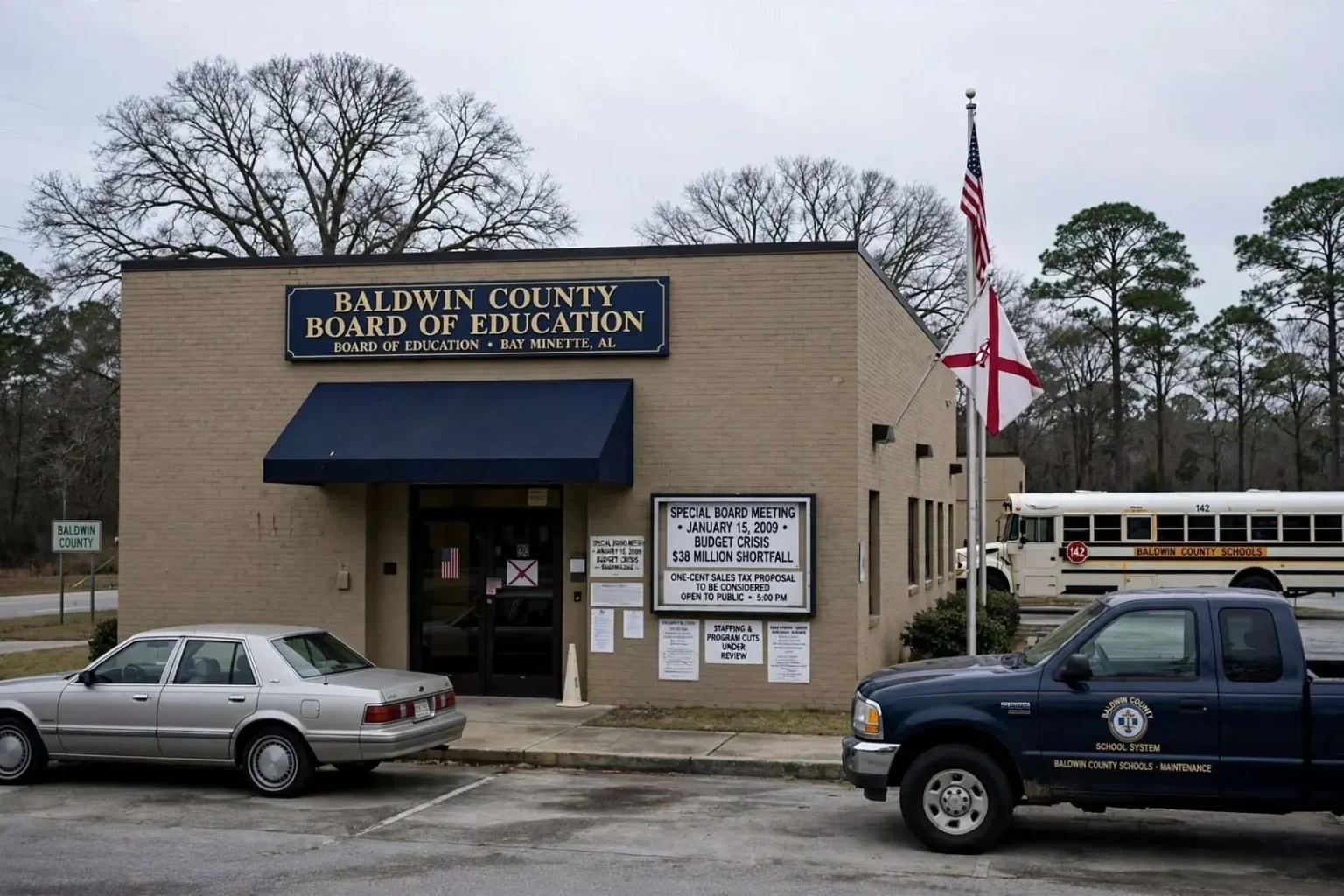
BALDWIN COUNTY, Ala. — The Baldwin County Board of Education voted in 2009 to ask county commissioners for a one-cent sales tax increase as the district faced a deep budget crisis.
School officials said the system had a $38 million shortfall and was preparing for another $13 million deficit because of declining local revenue. They warned that the financial pressure could change the school day for students and staff across the county.
The request landed at a moment when Baldwin County’s public schools — one of the largest systems in Alabama, serving tens of thousands of students across communities from Bay Minette to Gulf Shores — were confronting the same revenue collapse that was hammering school districts across the state. Alabama school budgets lean heavily on sales tax and income tax collections, and when the national recession of 2008 and 2009 cut consumer spending, districts felt the loss within a single budget cycle.
Programs and Staffing at Risk
Teacher layoffs, a hiring freeze, larger classes and the elimination of support positions were already among the actions under consideration. Officials also said extracurricular programs could be affected, including athletics, band, art and field trips — the parts of a school system that parents notice first when they disappear.
Terry Wilhite, a spokesman for the school system, said the district needed help as it confronted the financial crisis.
The proposed one-cent increase was estimated to generate about $29 million for the school system. In Baldwin County, a fast-growing county with heavy retail traffic along the U.S. 98 and Alabama 181 corridors and a tourism economy on the Gulf, even a single penny on the sales tax translates into significant money, which is why the board pinned its hopes on that option rather than a property tax increase, which would have required a vote of the people.
District officials had spent months trimming where they could, but payroll and classroom programs make up the overwhelming share of any school budget, and the scale of the shortfall meant that further cuts would inevitably reach teachers, aides and student activities.
Commissioners Faced Public Opposition
County Commissioner David Bishop said the commission would hear the school board’s request, while acknowledging that many residents had already contacted commissioners to oppose new taxes.
The political dynamics were difficult from the start. The Baldwin County Commission had its own budget pressures to manage, and a one-cent sales tax increase would have pushed the combined rate higher in communities that were already competing for shoppers and tourists against Mobile County to the west and the Florida panhandle to the east. Business owners worried aloud that a higher local rate would send customers across county or state lines, cutting into the very sales tax base the schools depended on.
The proposal therefore became both a school-finance question and a broader debate about how Baldwin County should respond to the recession. Residents who opposed the tax argued that families already strained by the downturn could not absorb higher costs at the register; supporters of the request countered that cutting classrooms would do lasting damage to a county whose rapid population growth was, in itself, driving enrollment up and costs higher.
How Alabama School Funding Works — and Why Sales Tax Matters
Understanding the board’s request requires understanding how Alabama pays for its schools. The state’s Education Trust Fund is funded almost entirely by sales taxes, income taxes and use taxes, not by property taxes, which instead flow mostly to county general funds and other purposes. That makes Alabama’s school budgets among the most volatile in the nation: when the economy slips, sales tax receipts and income tax withholdings fall almost immediately, and districts see the damage in their next allocations.
Local systems supplement state money with local sales and property taxes, and the size of that supplement varies enormously. Baldwin County, with its expanding retail base along Interstate 10 and its beach economy, historically generated strong local revenue — but strong is a relative term in a recession, and the 2009 shortfall of $38 million dwarfed what the system could absorb through attrition alone.
Because the county commission held the authority to raise the local sales tax without a referendum, the school board’s resolution was, in effect, a formal plea to the only elected body that could act quickly. Boards of education in Alabama cannot levy sales taxes themselves; they can only ask, which is why the 2009 vote marked the beginning of a negotiation rather than the end of one.
The Stakes for Students and Staff
The warnings issued in 2009 were not abstract. Larger classes mean less individual attention and more work for the teachers who remain. Eliminating support positions — aides, clerks, maintenance and transportation staff — shifts that work onto teachers and administrators. Cutting athletics, band and art programs removes the activities that keep many students engaged in school at all, and rural communities in northern Baldwin County, where the school is often the center of civic life, feel those cuts disproportionately.
Teacher layoffs carry their own long-term costs. Young educators who are let go during a crisis frequently leave the profession or the region entirely, and when enrollment rebounds, districts find themselves competing to hire in a market they emptied themselves. Administrators in Baldwin County and across Alabama cited exactly this dynamic as they weighed how deep to cut.
The board’s resolution marked a formal step in the effort to stabilize the system’s finances. It followed months of reductions and warnings that continued revenue losses could force more significant changes to staffing and student programs.
A Chapter in Baldwin County’s School-Finance History
The 2009 request fit into a longer pattern. Baldwin County’s schools have repeatedly collided with funding walls as the county’s population growth outran its revenue, and the district has returned to county and state leaders for help more than once in the decades since. Each episode has produced the same core debate — who should pay for growth, and through what tax — with parents, business owners and fiscal conservatives taking predictable positions.
This article records the school board’s 2009 request. It does not address whether the tax proposal was ultimately adopted or how the district’s finances developed afterward.
What the Shortfall Meant Across the County
A $38 million gap is not an even burden; it lands in specific places. In practice, districts facing shortfalls of that scale look first at vacancies left unfilled, then at supply and travel budgets, then at personnel — the only category big enough to close a gap that size. For Baldwin County, with campuses stretching from bayou communities along Mobile Bay to the beach towns at the county’s southern end, staffing decisions ripple through bus routes, cafeteria schedules and after-school programs in every corner of a county that runs some of the longest school bus routes in the state.
Parents organized quickly in communities across the county, as they typically do when class sizes and beloved programs are threatened. Booster clubs for athletic and band programs, parent-teacher organizations and civic groups all had a stake in the outcome, and many of the residents who contacted commissioners about the tax proposal were reacting to concrete warnings about what would disappear from their local schools if new revenue did not materialize.
Business leaders were caught in the middle. Retailers understood the argument that strong schools sustain property values and attract the families driving Baldwin County’s growth — the county has been one of the fastest-growing in Alabama for decades, and newcomers frequently cite schools among their top reasons for choosing it. At the same time, a higher sales tax during the worst recession in a generation threatened margins in an industry already operating on thin volumes, particularly in tourist districts where visitors, not just residents, pay the tax.
The recession context shaped everything. Across Alabama in 2009, school systems were announcing layoffs, shortened calendars and proration — the across-the-board cuts the state itself imposes when Education Trust Fund receipts come in below forecast. Baldwin County’s crisis was part of that statewide squeeze, but its resolution was local, because the levers that mattered most — the county sales tax rate and the district’s staffing levels — sat in Bay Minette with the commission and the school board, not in Montgomery.
That is the lasting significance of the board’s 2009 vote: it documented, in a single resolution, the moment a fast-growing suburban system acknowledged that its revenue structure could not keep pace with its obligations, and it forced a public conversation about taxes that county residents continued in one form or another in the years that followed.
The episode also illustrated the division of authority that shapes Alabama school finance: boards of education set policy, but the taxing power rests with county commissions and the Legislature, leaving superintendents and board members to advocate for revenue they cannot levy on their own.