Baldwin Leaders Revisited Sales Tax Option as School Cuts Mounted
Baldwin County leaders discussed renewed support for a temporary sales tax in 2009 as school budget cuts and potential personnel reductions continued.
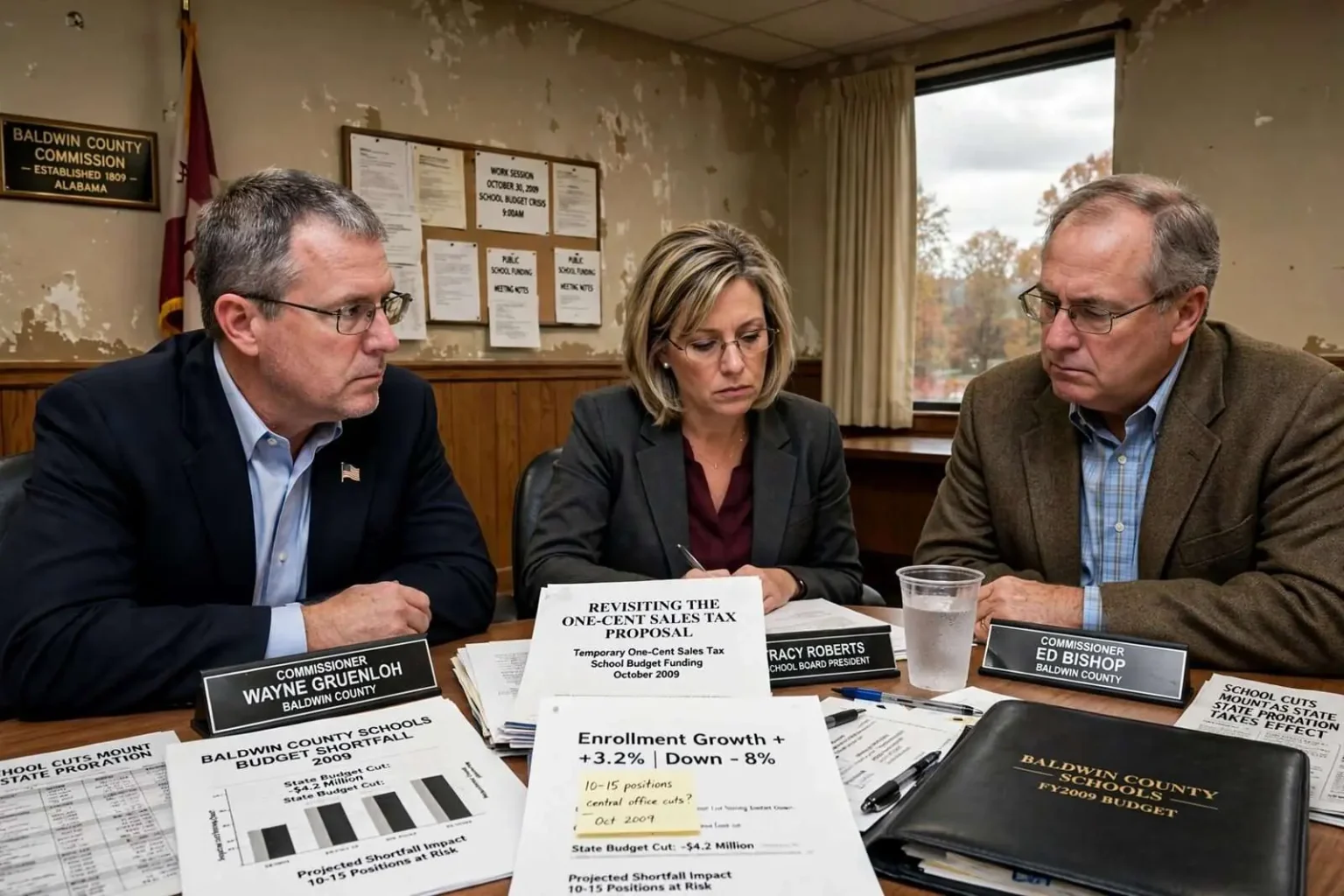
Baldwin County leaders revisited the possibility of a temporary one-cent sales tax in October 2009 as school officials confronted continuing budget cuts and the prospect of additional job reductions. The discussion followed a meeting involving school, county and legislative leaders.
The renewed debate came at one of the most difficult moments in the county’s recent financial history. School systems across Alabama were absorbing the shock of state education budget cuts triggered by the recession, and Baldwin County — one of the fastest-growing systems in the state — found itself squeezed between rising enrollment and shrinking revenue. A temporary one-cent sales tax had emerged earlier as the leading candidate to close the gap, and county leaders were now asking whether the political climate had changed enough to make it possible.
Earlier in the budget crisis, school officials had asked county commissioners to support a sales tax increase, but the idea was set aside after commissioners encountered significant opposition from taxpayers.
The opposition was not surprising in the economic context of the time. Alabama’s economy had been battered by the national recession, unemployment was climbing across the Gulf Coast, and homeowners were watching property values and household budgets contract. A sales tax increase, whatever its merits for school funding, struck many residents as the wrong burden at the wrong time — and commissioners who heard from constituents said so plainly.
Changing Public Response
Commissioners Wayne Gruenloh and Ed Bishop said they were watching whether public opinion had shifted as residents saw the effect of cuts in Baldwin County schools. Gruenloh said he had encountered more people who appeared open to the proposal, while Bishop said the response remained divided. Neither commissioner committed to supporting or opposing the tax at that point.
The comments captured the delicate position county commissioners occupied. School funding questions in Alabama are formally the state’s responsibility, but county commissions hold the authority to levy certain local sales taxes, which made Baldwin County’s board an unavoidable stop for any proposal to bail out the school budget. Commissioners who voted for a tax risked the backlash of taxpayers; those who voted against it faced the consequences of visible cuts to the county’s schools.
What had changed between the failed first attempt and the October revisiting was visibility. When the tax was first proposed, the cuts it would prevent were abstract; by the fall, residents were seeing the effects of the budget crisis in concrete terms — programs reduced, positions eliminated, schools tightening operations — and some of the people who had opposed the tax in the abstract were reconsidering once the alternative became visible.
That dynamic is a familiar one in local government: tax proposals rarely gain ground until the service they fund is perceived to be in actual danger. Gruenloh’s report of finding more openness, alongside Bishop’s caution that opinion remained divided, meant the county board could not yet count the votes — or the public patience — a tax proposal would need.
Their comments reflected the central question facing county leaders: whether a temporary increase could provide enough revenue to protect school operations without placing another burden on residents during a difficult economy.
The arithmetic behind a one-cent sales tax in a county of Baldwin’s size is substantial. With retail sales spread across the county’s growing commercial corridors — the Daphne-Fairhope corridor on the Eastern Shore, the hubs along Interstate 65, and the Gulf-facing communities to the south — even a single penny on the dollar generates significant annual revenue. Committed to schools for a defined period, such a tax could have replaced much of what the state cuts had taken from the system’s budget, and its temporary character was designed to answer the objection that tax increases never go away.
Personnel Cuts and Local Support
School Board President Tracy Roberts said the central office could face a list of roughly 10 to 15 positions for reduction at an upcoming board meeting. The personnel concerns came amid wider efforts to stabilize school finances.
Position reductions at the central office level carry consequences that reach into every school in the system. Support staff, coordinators and administrative personnel cut from the central office either disappear entirely or leave individual schools to absorb duties they were never staffed for. Coming on top of earlier budget reductions, the prospect of 10 to 15 more jobs at stake underscored how far the crisis had progressed — and how much revenue a one-cent tax was being asked to replace.
The timing compounded the strain. Alabama’s education budget operated on a fiscal year that began in October, and school systems had entered the fall of 2009 with proration — the state’s mechanism for cutting appropriations mid-year — already a reality. Baldwin County’s enrollment growth, normally the system’s greatest strength, made the cuts harder: new students arrived each year carrying state funding based on formulas that the recession had undermined, leaving the system to absorb growth without growth money.
There was also a positive development for students in Daphne. The music group Three Doors Down donated $10,000 to Supporting Educational Enrichment in Daphne’s Schools, known as SEEDS. The organization said the money could help fund a reading tutor and part-time assistance for library and computer programs at Daphne High School.
The donation arrived as a reminder that private giving was trying to fill some of the space the state budget retreat had opened. A $10,000 gift does not replace a million-dollar appropriation, but directed to a reading tutor and library and computer support at Daphne High, it addressed needs that cuts would otherwise have eliminated outright. Community education foundations like SEEDS exist precisely for such moments — channels through which local businesses, families and, in this case, a nationally known rock band with Alabama roots could put money directly into classrooms.
The Work Session Ahead
County commissioners scheduled an Oct. 30 work session on the school budget crisis with school board members and legislators.
The format of the meeting mattered. Work sessions, as opposed to formal votes, are where proposals are aired and positions tested — and the inclusion of state legislators alongside county commissioners and school board members acknowledged the layered structure of Alabama school finance. Local sales tax authority sat with the county commission; the deeper funding shortfall sat with the state education budget; and the cuts being absorbed sat with the school board. Any durable solution required all three tables to be talking.
For the legislators involved, the meeting offered a first-hand account of what state cuts were doing to a system that had doubled in size over a generation. Baldwin County’s legislative delegation, representing one of the fastest-growing counties in Alabama, had a political stake in the outcome: constituents who watched their schools cut year after year were the same constituents who would decide whether the delegation returned to Montgomery.
The Stakes for Baldwin County Schools
The context behind the fall 2009 debate stretched back years. Baldwin County’s public schools had grown relentlessly as families moved to the county’s Eastern Shore communities, its Interstate 10 and 65 corridors and its beach-adjacent towns, and that growth had brought a corresponding need for new classrooms, teachers and administrators. When the state’s education budget collapsed with the recession, the system faced the unusual position of needing to expand and contract at the same time — building for new students while cutting the staff and programs that served them.
Sales tax funding carried particular significance for schools in Baldwin County because of how Alabama finances education. Property taxes in Alabama are among the lowest in the nation, which leaves local school systems heavily dependent on state appropriations — the very source of the proration that hit systems statewide in 2009. A local sales tax was one of the few significant revenue levers available to county government, which is why the question kept returning to the county commission despite the political resistance.
The “temporary” framing of the proposed one-cent increase was itself a response to that resistance. taxpayers who opposed permanent taxation showed more flexibility toward levies with a defined expiration, and school officials argued that the system’s need — recovering from state cuts that were officially projected to be cyclical — was inherently temporary as well. Whether that promise would hold in future budget cycles was among the questions skeptics raised.
What the Debate Showed About Local Government
The October 2009 episode illustrated the constrained choices local officials face in a state where school funding is centralized but tax authority is fragmented. School boards can identify needs but cannot levy taxes; commissions can levy certain taxes but are not responsible for schools; legislators control the state budget but answer to constituents who resist any tax, state or local. The result, in Baldwin County, was a conversation that moved among three bodies without any of them holding all the tools to solve the problem.
Against that backdrop, the smaller gestures carried symbolic weight. The Three Doors Down donation to SEEDS showed private actors stepping into a public funding gap; commissioners’ careful non-committal language showed elected officials reading their constituents in real time; and the scheduled Oct. 30 work session showed the machinery of local government doing what it could — convening everyone with a stake and asking whether the community was willing to pay for its schools.
How the county ultimately resolved the crisis would unfold in the months and budget cycles that followed. What the October debate made plain was the shape of the choice: a one-cent temporary sales tax on one side, and on the other, a continuation of cuts that were reaching the central office payroll — 10 to 15 positions at a time — and reaching into classrooms that private donations could only partially protect.