Mobile’s Four-Term Mayor Ruled Out the School Board, and Left the Door Open on Governor
Former Mayor Mike Dow said his wife would tolerate only one more campaign, and it would not be for the school board. In a long reply, he laid out his views on candidate recruitment and Mobile's 'new politics.'
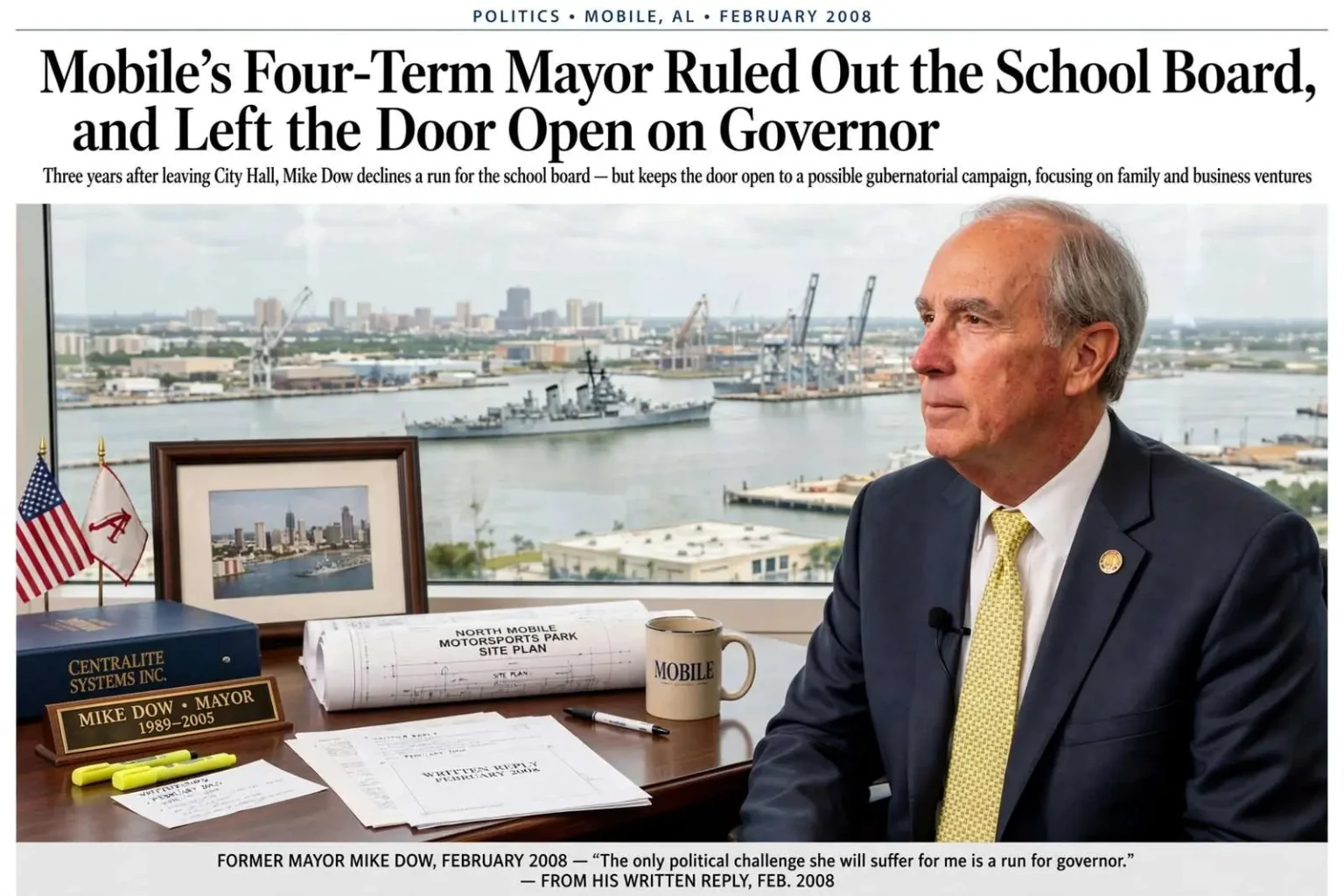
Three years after leaving City Hall, Mike Dow remained one of the most consequential figures in Mobile politics — which is why the question kept coming up. Would the four-term mayor, who did not seek re-election in 2005, run for something again?
Asked in February 2008 whether he was interested in a seat on the Mobile County school board, Dow gave a short answer and a long one. The short answer was no. The longer answer, delivered in a sprawling written reply, was more revealing.
Dow had led the city for four terms, spanning 1989 to 2005, longer than any Mobile mayor before him, and his departure left an unusual vacuum. He had not been driven out by scandal or defeated at the ballot box; he had simply stepped away at the peak of his influence, which made every subsequent election — school board, county commission, mayor — an occasion for speculation about his return. The school board question was not idle: county school board seats are elected positions in Alabama, and the Mobile County system, the largest in the state, was at that moment a battleground over funding, leadership and the pace of reform.
‘The only political challenge she will suffer’
“As to my being on the school board, my wife informed me that a run for governor is the only mental and physical political challenge that she will suffer for me,” Dow wrote. He was, he said, enjoying working from 4 in the morning until 6 at night and hugging his family each night and all weekend.
The joke carried its own message about the price of public office. Four terms of mayoralty had taught the Dow household what a campaign and a city administration cost a family — the evening meetings, the weekend events, the phone that never stops — and the wife’s stipulation, delivered with affectionate finality, set the terms of any future run: nothing smaller than the state’s top office would justify the disruption.
He would surface politically again, he added, when Centralite Systems Inc. — a wireless lighting control company he and his brother-in-law intended to take public — was a public company, and when he could go to races at a proposed Mobile speedway.
Those two ventures, along with a motorsports park planned for the north Mobile County area, occupied most of his attention. The racetrack project and the steel plant rising at Calvert were, at that moment, the twin engines of expectation in north Mobile County.
Centralite was the kind of company Mobile’s civic leadership liked to hold up as the future: a locally grown technology manufacturer building wireless lighting controls — devices that let commercial and residential buildings manage their lighting automatically, saving energy — with national customers and ambitions of a public stock offering. Dow’s involvement as an executive, rather than an investor at arm’s length, showed where his energy had gone after City Hall: into building the kind of company his administration had spent years trying to recruit.
The speedway project lived in the same world of north Mobile County expectation. A major motorsports facility near the Interstate 65 corridor would draw visitors, hotel stays and national attention, and its promoters had pitched it as an anchor for the county’s northern growth. Alongside the ThyssenKrupp steel complex taking shape at Calvert on the Tombigbee River — thousands of construction workers, then permanent jobs, and the housing and services that follow both — the racetrack made north Mobile County the axis of speculation about where the region’s next growth wave would land.
How he thought about recruiting candidates
The bulk of Dow’s answer was not about himself. It was about the difficulty of finding people willing to run for office at all.
He recalled running for mayor in the first place because no other candidate had emerged with, as he put it, the vision and the management and organizational skills to lead the city into global competition. He described calling a prominent Mobile businessman before the 1989 mayoral qualifying deadline to encourage him to run, and offering to serve on the city council under him. The man declined, worried he would lose his business.
“Finding candidates is hard,” Dow wrote. “Someone has to care enough to run.” The right candidate, he argued, needed professional skills and had to be at a point in life that allowed the time and personal commitment the job demanded. He said he was considering helping organize a candidate search for the school board rather than running himself.
The 1989 anecdote explained his entire approach to public service. Dow had not come up through party politics; he had been recruited into a race he entered because nobody else would, as a young organizer determined to shake a city he believed had drifted. The businessman who declined his offer — afraid a council seat would cost him his livelihood — embodied the obstacle Dow spent a career fighting: in Mobile as in most cities, the people with the skills the job requires are exactly the people with the most to lose by taking it.
He pointed to Mobile’s sister city of Ichihara, Japan, where he had been struck to find a city council composed largely of successful retired businessmen who were paid well and treated public service as a second career. He said he had appointed similar people to boards and staff positions as mayor, and that the city had benefited.
The sister-city comparison was more than travel-chat. Dow’s administration had cultivated the Ichihara relationship for years — exchanges between the two port cities, student visits and business delegations — and he treated the Japanese city’s civic model as a working lesson rather than a curiosity. A council of retired professionals serving as a paid second career solves the problem he had just described: it draws on people with proven management experience, at a stage of life when the personal cost is lowest, with compensation that removes the financial penalty. His appointments of similar figures to Mobile’s boards and staff were the American adaptation of the same idea.
The ‘new politics’ argument
Dow closed with the theme that defined his tenure. Mobile, he argued, had moved past the paralyzing Democrat-versus-Republican division common at the state and federal levels, and past racial and geographic division as well, toward what he called a politics of possibilities — strategic planning, consensus, shared goals and public-private partnerships.
It was a self-flattering account, and critics of his administration would have contested parts of it. But the record he was pointing to was real: the strategic plan process he helped launch in the late 1980s, the school funding vote, the downtown revival, the convention center and the Battle House restoration, and the industrial recruitment that ultimately delivered Austal, ThyssenKrupp and the Brookley aerospace push.
Each of those items had been a fight in its time. The strategic plan — a citywide visioning exercise that brought neighborhoods, businesses and institutions into a single long-range document — was Dow’s founding project, and it became the template for how the city and county planned growth for two decades. The school funding vote was a countywide referendum to raise money for the public schools, a political lift in any jurisdiction. The downtown revival rebuilt a city center that had emptied into the suburbs, anchored by the restored Battle House hotel and a convention center on the waterfront. And the industrial recruitment — Austal’s fast-ferry and shipbuilding operation, the ThyssenKrupp steel complex won for north Mobile County, and the campaign to turn the old Brookley Field airbase into an aerospace industrial park — was the portfolio on which Mobile’s modern economy was being built while Dow wrote his reply.
The “new politics” framing was also an argument about what Mobile’s experience proved. A majority-minority city with a mixed metropolitan political culture had, in his telling, demonstrated that race and party did not have to organize local public life — that coalitions could be built around plans rather than identities. Whether that claim overstated the consensus or understated the conflicts that still ran beneath it was the standard argument of Mobile politics, and it would outlast Dow’s City Hall years.
He also issued a warning that reads clearly today. Mobile needed workforce development for students who did not go to college, he wrote, if the region intended to stay on its economic path — the path that, in his words, hires more police, builds more parks and fills more potholes.
The warning connected two things that political conversation usually kept apart. The region’s economic development strategy — steel, shipbuilding, aerospace — depended on skilled industrial labor, and the school system was where that labor came from or failed to. If the region could not supply welders, machinists, pipefitters and technicians, the plants it recruited would import their workforces or stall their expansions, and the tax base that paid for police, parks and potholes would grow thin. Dow’s formulation made workforce development not an education issue but the load-bearing wall of the entire civic agenda.
The governor’s race that never came
Dow never ran for governor. Centralite continued as a private company; the Mobile speedway never materialized. But the school board question, and the answer it produced, captured a durable feature of the city’s politics: a former mayor with an unfinished agenda, and no clear successor willing to pick it up.
The unfinished pieces of Dow’s agenda aged unevenly. Workforce development became the region’s standing preoccupation, institutionalized in the alliance of school systems, two-year colleges and employers that spent the following years building training pipelines for the industries the city had recruited. Downtown’s revival continued, and the Brookley aerospace park grew into one of the region’s largest employment centers as the Airbus assembly line arrived years later on the ground Dow’s generation had cleared. The speedway, by contrast, died quietly, and north Mobile County’s growth took the shape of subdivisions, schools and industry rather than racing.
As for the man himself, the February 2008 reply stands as the fullest statement of how a four-term mayor understood what he had done and what remained. He would not sit on the school board. He would help find the people who could. And if his wife ever released him for the only challenge she would allow, the state would hear from him. It never did — but the city he left behind ran for years on the politics of possibilities he had spent two decades assembling.