Prichard Police Used Utility-Bill Offer in 2009 Warrant Operation
Prichard police attempted to draw people with outstanding warrants to City Hall in 2009 with letters offering utility-bill assistance; two of 71 targeted recipients arrived.
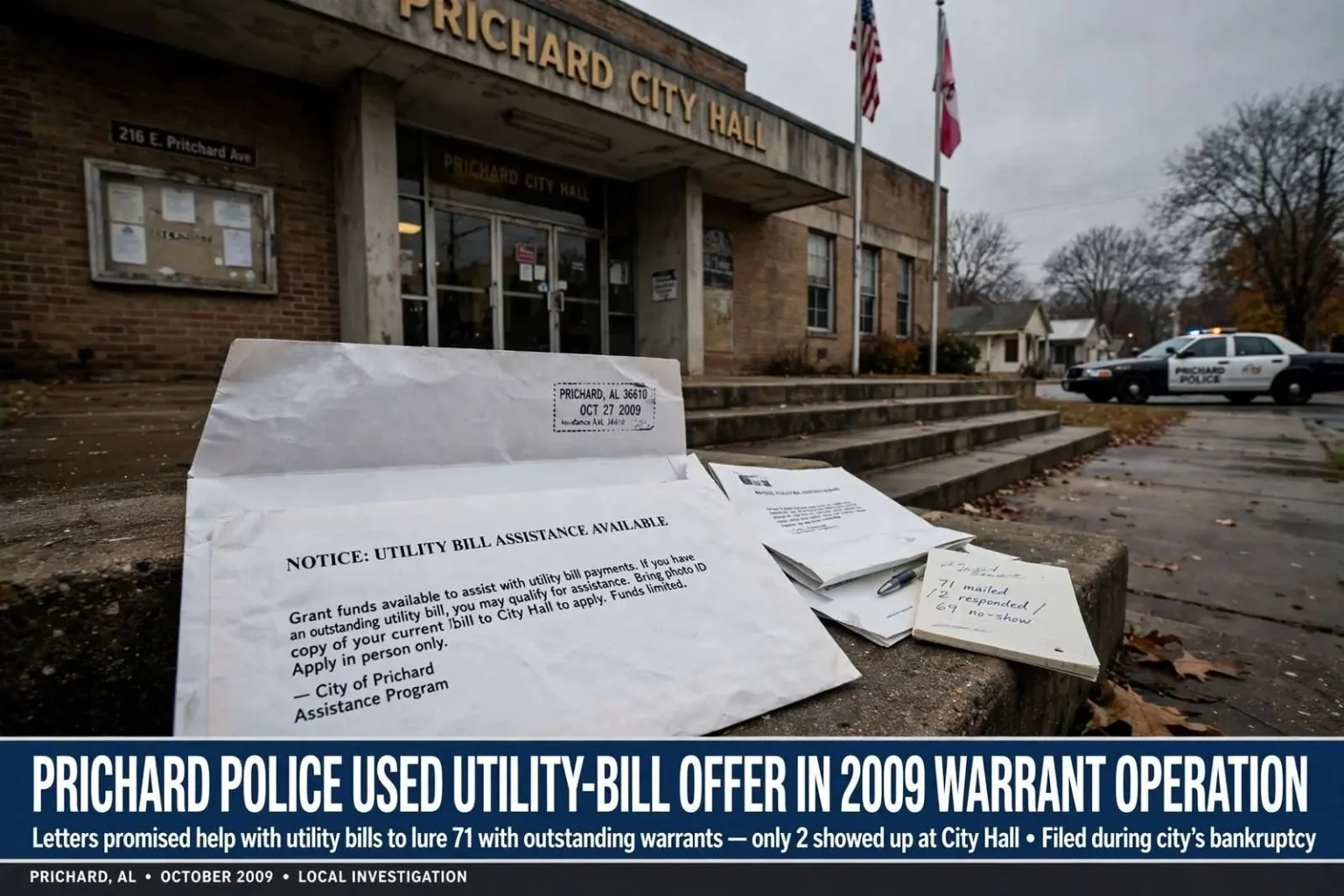
Prichard police tried an unusual warrant operation in late October 2009: letters sent to people with outstanding warrants offered what appeared to be help paying utility bills. The unsigned notices told recipients that grant funds could help with a bill if they came to City Hall with identification and a copy of the bill. Police planned to arrest recipients who appeared and had outstanding warrants.
City spokesperson Latoya Veal said authorities were looking for a creative way to bring suspects in. The operation targeted 71 people, but only two arrived, according to the report. The effort came days after Prichard filed for bankruptcy, a circumstance the report noted could have made the promise of available city funds less believable.
How the Operation Worked
The mechanics of the scheme were simple. Notices went out to a list of people known to have outstanding warrants, promising assistance with a utility bill if the recipient came to City Hall in person, bringing identification and a copy of the bill in question. The letters were unsigned, so recipients had no name to attach to the offer — and no way to verify it. The pitch was designed to sound like a municipal assistance program, the kind of grant-funded help that cities do occasionally extend to struggling residents.
What waited inside City Hall was different: police officers ready to arrest anyone who showed up and matched a name on the warrant list. The plan inverted the usual rhythm of warrant service. Instead of sending officers to knock on doors across the city — time-consuming, sometimes dangerous work that often ends with the suspect not home — the department asked the suspects to bring themselves to a single location at a predictable time.
By that measure, the operation’s yield was thin. Of the 71 people targeted, only two arrived, according to the report. Whether the others were suspicious, had moved, never received the letter or simply did not believe the offer is not recorded. Two arrests is a modest return for a citywide mailing, but the department’s thinking, as Veal explained it, was about creativity — testing a new approach to a stubborn problem.
The Context: A City in Bankruptcy
Timing may have doomed the effort from the start. The operation came just days after Prichard filed for bankruptcy, an event that dominated local news and made the city’s finances a subject of daily conversation. In that climate, a letter promising grant money to help pay utility bills arrived with a credibility problem: residents had just watched their city declare it could not pay its obligations, and the report noted that circumstance could have made the promise of available city funds less believable.
Prichard’s bankruptcy was not a surprise to those who followed municipal finances on the Gulf Coast. The small city in Mobile County had struggled for years with a shrinking tax base, pension obligations and the legacy of industrial decline, and its filing was among the most notable municipal bankruptcies in Alabama history. Residents were acutely aware of the city’s condition, and city hall’s ability to offer anything requiring money was a matter of public skepticism.
That skepticism was a reasonable read of the notices. Municipal assistance programs do exist, but they are typically announced publicly, with named departments and application procedures — not through unsigned letters asking people to show up in person. The failure of 69 of 71 recipients to take the bait suggests most of the recipients read the letter with the same wariness the city’s financial news had taught them.
The Ethics and Economics of Warrant Sweeps
The account documents a localized 2009 law-enforcement tactic and does not identify the individuals targeted or describe the underlying allegations. It also does not report the dispositions of the warrants — whether the two people who appeared were arrested, what charges lay behind their warrants, or how their cases concluded. That leaves the episode as a snapshot of method rather than a full account of outcome.
Warrant backlogs are a chronic problem for cities like Prichard. Outstanding warrants accumulate for everything from failure to appear on minor charges to more serious offenses, and each one represents someone the courts expect to see. Clearing the backlog by traditional means — house calls, traffic stops, periodic sweeps — costs officer hours that a small department struggles to spare, which is why departments periodically experiment with approaches like the utility-bill letter.
The tactic also raises questions that police departments have debated in other contexts. A letter that invites people to City Hall on a false premise sits uneasily with the trust-building community policing aims for, particularly in a city where relations between residents and city government were already strained by the bankruptcy. Defenders of such operations argue that the people targeted had, after all, failed to answer court summonses — that the letter simply offered an easier appointment than the one they had missed.
Prichard’s Larger Struggles
The episode is best understood against the backdrop of Prichard’s situation in 2009. The city of roughly 28,000 people sits just north of Mobile, a community shaped by the shipbuilding and industrial boom of the mid-20th century and by the long decline that followed. By the time of the bankruptcy filing, Prichard had become a case study in the fiscal challenges facing small Southern cities: eroding property values, an aging population, infrastructure needs and pension costs that outpaced revenue.
The bankruptcy’s effects reached every corner of city operations. Departments tightened budgets, and the police department — like its counterparts in other struggling cities — was asked to do more with less. Operations like the utility-bill letter reflect that pressure: an attempt to accomplish a core law-enforcement task with essentially no cost, using paper and the element of surprise instead of overtime and task-force manpower.
For residents, the bankruptcy and the warrant operation together painted a picture of a city straining at its seams. Grant funds, the letters claimed, could help with a utility bill — a reminder that many Prichard households were themselves struggling to pay for basic services, even as the government that might have helped them was failing to pay its own obligations.
A Footnote With Lessons
More than a decade later, the 2009 operation stands as a footnote in Gulf Coast law-enforcement history, but a useful one. It documents how a cash-strapped department improvised, how the public responded, and how quickly creative tactics run into the limits of credibility. The two arrests — two names off a list of 71 — are the measure of what the approach achieved.
It also captures a moment in Prichard’s story that broader accounts of the bankruptcy sometimes miss: the texture of daily government in a city in fiscal crisis, where a police department was drafting letters about utility assistance while the treasurer warned there was no money. The unsigned notices, the two arrivals at City Hall and the skepticism of the other 69 recipients are small details, but they are the kind of detail that shows what municipal decline actually looked like on the ground in Mobile County in the fall of 2009.
Warrant Service in Small Cities
To appreciate why a department would try something like this, it helps to understand how warrant service works in a city of Prichard’s size. A warrant is only paper until someone acts on it, and acting on it requires locating a person who may not want to be found. Officers assigned to warrant service spend their days checking addresses, following tips and staking out known haunts, and each attempt consumes time that competes with calls for service. Small departments, where a handful of detectives may cover the entire warrant docket, feel that competition most sharply.
Creative approaches have a long history for exactly that reason. Departments in other cities have mailed concert tickets, claimed raffle winnings or sent fake party invitations to lure wanted people to a controlled location. The utility-bill gambit belongs to the same family: a pretext designed to appeal to the recipient’s self-interest and get them to walk willingly through the door. Prichard’s version had the added wrinkle of a promise that would cost the city nothing — the “grant funds” were never real, and no money ever changed hands.
The results elsewhere have varied, but the common thread is that pretext operations work best when the pretext is believable. In Prichard’s case, the bankruptcy news cycle had already primed residents to doubt anything promising city money, and the unsigned letter offered no reassurance. The two arrivals likely represent the recipients least plugged in to the news — or the most trusting.
The Documentary Record
Because the account does not identify the targeted individuals, the charges behind the warrants, or the outcomes for the two people who appeared, the operation survives only as a procedural sketch. That kind of gap is common in the historical record of small-city law enforcement: operations are planned and executed, a spokesperson describes the concept, and the paperwork fades into court files that few ever pull. What remains is the shape of the tactic — the letters, the promise, the City Hall rendezvous — and its bottom-line result.
For researchers of Alabama municipal history, the episode offers a window into the intersection of two realities in 2009 Prichard: a police department with too many warrants and too few officers, and a city government whose finances were so strained that even a fake offer of help had a hollow ring. The operation was, in its way, a rational experiment — cheap, simple and aimed at a real problem. Its failure was equally instructive, showing that the public’s trust, like the city’s budget, had little left to draw on.