Nodine Asks to Move Murder Retrial, Citing Saturation of Publicity
Former Mobile County Commissioner Stephen Nodine asked that his murder retrial be moved out of Baldwin County, arguing that intense publicity had inflamed opinion against him and made an impartial jury impossible.
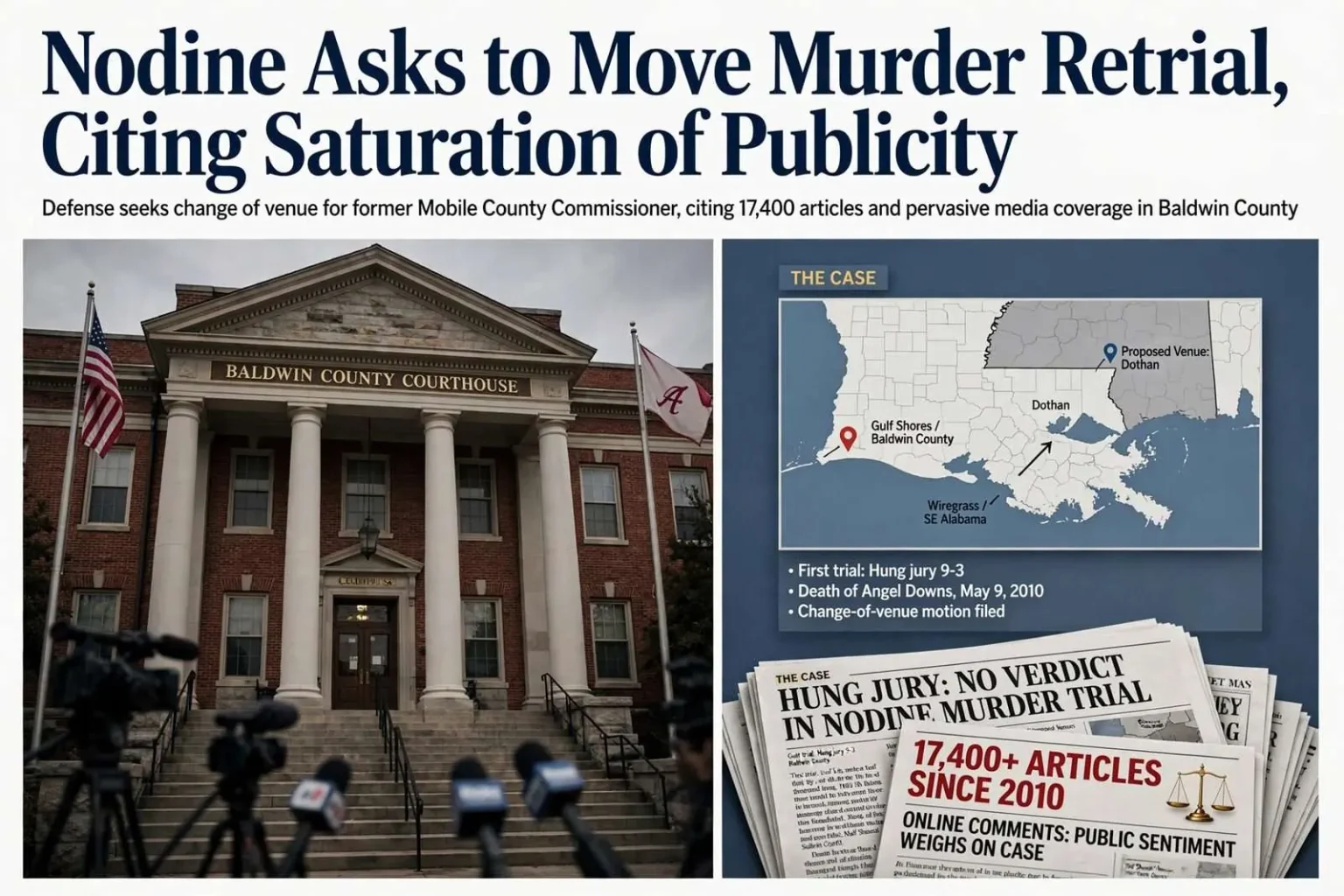
Former Mobile County Commissioner Stephen Nodine, accused of murdering his paramour two years earlier, asked that his retrial be moved elsewhere, contending that the flood of publicity surrounding the case had made it impossible to seat an impartial jury in Baldwin County. The motion placed one of the Gulf Coast’s most closely followed criminal cases back before the court, not on questions of guilt or innocence but on the more procedural matter of where a second trial could fairly be held.
The motion
Nodine’s motion argued that some 17,400 articles had been published in connection with Nodine and the alleged murder of Angel Downs, who was found dead at her Gulf Shores townhouse on Mother’s Day, May 9, 2010. The sheer volume of coverage, the defense argued, was not the sort of passing news interest that courts routinely manage with routine jury instructions, but a sustained saturation that had reached virtually every corner of the county where the trial was to be held.
His defense maintained that Downs had died of a self-inflicted gunshot wound to the head. That theory of the case, presented at length during the first trial, framed the proceedings as a contest between two irreconcilable accounts of the same death — and ensured that public opinion on the case would be strong, sharply divided and freely expressed across the region’s news outlets and, increasingly, their online comment sections.
An earlier trial had ended with a hung jury, reportedly split 9-3 in favor of conviction. The deadlock meant the case returned to the court unresolved, with both sides facing the expense and uncertainty of a second trial. Deadlocked juries in high-profile murder cases routinely prompt change-of-venue motions from the defense, which argues that a second attempt in the same courthouse faces the same saturated atmosphere that shaped the first.
To illustrate the atmosphere it said had taken hold, the defense cited derogatory comments posted in response to online articles, including remarks branding Nodine “a scumbag” deserving death and “a druggie, trashy, woman-abusing murderer.” Online reader commentary, the motion suggested, offered a raw sample of public sentiment that the traditional measure of media coverage — column inches and broadcast minutes — had failed to capture. The comments, drawn from the very articles the case had generated, became exhibits in the argument that prejudice had spread beyond the news and into everyday public discussion.
A trial free of such prejudice, his lawyers argued, could only be held at a remove from Baldwin County and the counties nearby. The request went beyond Baldwin’s borders deliberately: a venue change that simply moved the trial one county over would, the defense contended, import much of the same coverage and the same public sentiment, since the case had been covered intensively across the entire Mobile Bay region.
The prosecution’s stance
The defense noted that even the prosecution — by then headed by Baldwin County District Attorney Hallie Dixon rather than her predecessor, Judy Newcomb — recognized the risk of obtaining a conviction only to see it overturned on appeal because of an overriding atmosphere of prejudice. Appellate courts in Alabama and across the country have reversed convictions where record evidence shows that pretrial publicity deprived a defendant of a fair trial, and the expense of a second trial gave prosecutors their own incentive to ensure the second one survived review.
The transition from Newcomb to Dixon had itself been part of the case’s long story, with the office changing hands between the first trial and the second. A new district attorney taking over a case of this profile must weigh the existing record, the previous trial’s lessons and the resources a retrial demands — and, in this instance, the venue question that now sat at the front end of all of it.
Should the trial be relocated, Dothan had been mentioned as the most likely site for a second attempt. A move to the Wiregrass city would put the retrial roughly a hundred miles from the Gulf Shores townhouse and the Baldwin County courthouse, in a media market with its own distinct identity. Defense lawyers view that distance as protective; the practical complications — transporting witnesses, attorneys and evidence hundreds of miles for the length of a murder trial — are the price either side pays for a venue the court accepts as untainted.
A closely watched case
The Nodine case had gripped the region for two years, drawing sustained coverage and fierce public debate. Nodine’s political career — a Mobile County commissioner with statewide ambitions before his arrest — meant the case involved a familiar public figure, and the circumstances of Downs’ death on a holiday Sunday kept the story at the top of the local news for months. Few cases in recent Gulf Coast memory had combined politics, tragedy and legal drama so completely.
A former county commissioner accused in the death of a woman with whom he had been involved, tried once to a deadlocked jury, made for a saga that few in Mobile and Baldwin counties had failed to follow. The first trial produced daily coverage, a stream of dramatic testimony and a verdict that resolved nothing, ensuring that the run-up to the second trial would draw equal attention. Local talk radio, social media and the comment sections beneath every story kept the debate alive between court dates.
Change-of-venue requests are a routine tool of criminal defense, but they succeed only when the record shows more than mere notoriety. Courts look for evidence — circulation figures, survey data, the content of published commentary — that prejudice is actually pervasive, and judges are generally reluctant to move a trial out of the community where the events occurred. The 17,400-article figure and the cited comments were the defense’s attempt to clear that threshold with volume and specificity.
Alabama law gives trial judges several tools short of relocation, including extensive jury questionnaires, individual voir dire of prospective jurors, sequestration and importing a jury from another county. A motion like Nodine’s asks the court to choose among those options — and the choice matters to both sides, since a jury brought in from elsewhere or a trial held elsewhere reshapes the logistics and the atmosphere of the entire proceeding.
The change-of-venue request marked the latest turn as both sides prepared for a second trial, with the question of where it would be held now before the court. Prosecutors preparing to present the case a second time, and defense lawyers preparing to answer it again, each built their strategy around the jury they expected to face — and for the moment, no one could say where that jury would be drawn from or what it would have already read.
For a defendant who argued that the coverage itself had poisoned the well, the motion sought a fresh setting in which, his lawyers contended, his right to due process could be protected. The Sixth Amendment guarantee of an impartial jury, the defense argued, is only as meaningful as the court’s willingness to move a trial when impartiality can no longer be found at home — and the Nodine case, by virtue of its two years of saturation coverage, had become a test of exactly that principle on the Gulf Coast.
Whatever the court decided, the motion ensured that the case’s next chapter would begin not with testimony but with logistics: questionnaires, courthouse arrangements in a host county, and the slow work of seating twelve jurors who, whatever they had heard over two years of headlines, could weigh the evidence as if they had heard none of it.
The dynamics of the venue fight reflected the case’s unusual footprint. Many high-profile trials draw heavy coverage in a single media market; the Nodine case sat astride two — Mobile’s, with its television stations and daily paper, and Baldwin County’s own rapidly growing local press — plus the talk radio circuit that spans the bay. A prospective juror in Foley, Fairhope or Gulf Shores encountered the case through the same outlets as one in downtown Mobile, which is why the defense aimed its request beyond Baldwin County itself and the counties adjacent to it.
The 9-3 split from the first trial loomed over every strategic calculation on both sides. A jury that comes within three votes of conviction, and then fails to reach unanimity, leaves a retrial with an obvious question: did the holdouts represent a real defense, or a lone pocket of doubt? Prosecutors preparing a second presentation typically revisit the testimony that moved the minority; defense lawyers typically protect it. Both exercises assume a jury pool similar to the first — an assumption the venue motion directly challenged.
For Downs’ family and supporters, the venue debate was a painful detour. Each hearing on where the trial would happen — rather than what happened on Mother’s Day 2010 — extended the case’s timeline and kept its most painful details in the news. The tension between a defendant’s fair-trial rights and a community’s desire for local resolution is inherent in every change-of-venue fight, and it rarely resolves without someone feeling the process has been put ahead of the outcome.
The economics of a retrial weighed on the process as well. A murder trial moves at enormous public expense, and relocating one multiplies it — courtroom space in a host county, travel and lodging for witnesses and investigators, and the coordination of evidence between courthouses. Baldwin County officials, like judges everywhere, had to weigh those costs against the appellate risk of pushing ahead in an atmosphere the defense argued was fatally compromised.
And the case’s two-year arc had already tested the region’s institutions. A county commissioner’s career ended, a district attorney’s office changed leadership mid-case, a jury deadlocked, and the region’s news organizations — and their readers — rehearsed the case’s competing narratives thousands of times over. The venue motion was, in the end, a request to measure exactly that: how much a story told 17,400 ways had shaped the place where it would be told one more.