Downtown YMCA Members Sue to Block Move From Water Street
Members of the Moorer Branch YMCA sued to stop the relocation of the downtown Mobile fitness facility from Water Street to a smaller space in the Kress Building, alleging irregularities in the debt-laden Y’s plans.
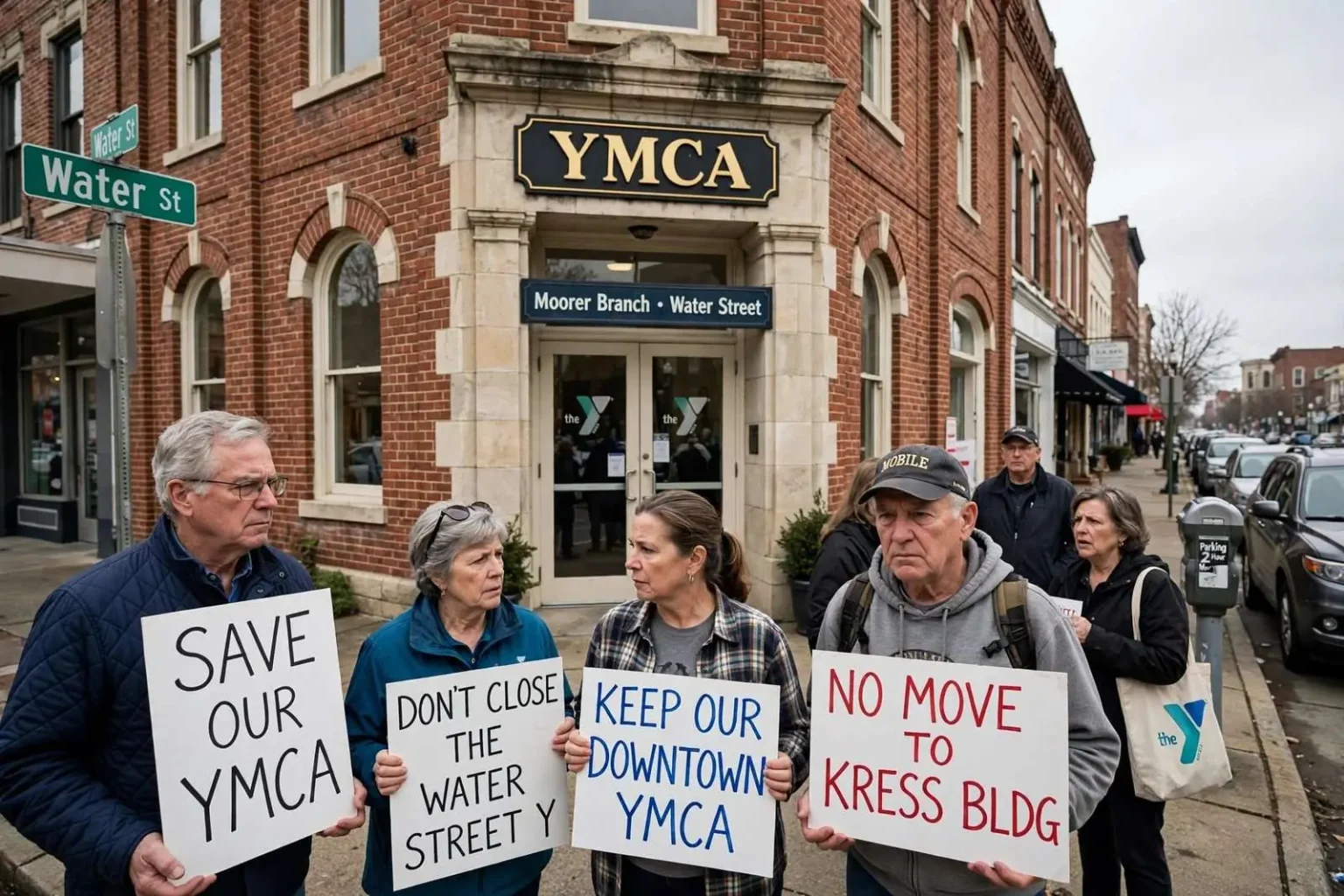
A group of members of the Moorer Branch YMCA went to court to block the relocation of the downtown Mobile fitness facility, setting up a hearing in Mobile County Circuit Court over the future of the Water Street institution. The fight pits a loyal downtown membership against the board of an organization struggling under debt, with a landmark building and a smaller successor proposal at the center of the dispute.
The lawsuit
The plaintiffs — Dan McCleave, Jean Arnold and Dr. David Martin III — brought the suit as representatives of members of the Moorer Branch of the YMCA of South Alabama. They asked Judge Rusty Johnston to bar the organization’s board of directors from moving the branch from its Water Street home to a smaller venue in the Kress Building on Royal Street. A hearing was set for the morning of June 1.
Named as defendants were the YMCA of South Alabama, its board of directors, board chairman Ted Bennett, chief executive Mark Hanke and Kress Investments. The suit alleged a variety of irregularities in what the plaintiffs described as a secretive effort to sell out the downtown Y’s members to the benefit of other branches, particularly those in Baldwin County. Hanke declined to comment.
Suits of this kind ask a court to do what boards generally decide for themselves: stop a relocation before it happens. The members’ route into court runs through their status as the people whose dues fund the organization, and their argument, in essence, is that a decision of this magnitude — closing the downtown facility that has anchored their workouts, classes and social lives — was made without the openness members were entitled to expect. Whether the judge agrees will depend on the governance documents and the record of how the board reached its decision.
A Y under financial strain
The dispute unfolded against the backdrop of significant financial pressure on the YMCA of South Alabama, which had struggled under the weight of about $5 million in debt. The existing Moorer Branch building had been appraised at roughly $1.7 million, and its maintenance issues had reputedly contributed to the organization’s difficulties.
For a regional Y association, a debt load of that scale shapes every operational decision. Facility maintenance on an older downtown building — roofs, mechanical systems, pools, locker rooms — competes directly with programming budgets and with the capital needs of branches elsewhere in the system. From the board’s perspective, concentrating resources on a smaller, cheaper downtown footprint is arithmetic; from the members’ perspective, it is the dismantling of an institution they have paid to sustain.
What the members say is at stake
For the members who filed suit, the concern was tangible: a move to a smaller facility, they argued, would cost them amenities they valued, including covered, on-site parking. In a downtown where street parking is metered and lots can charge by the hour, that amenity is not a luxury for members who stop in before work, at lunch or after the business day ends — it is the difference between a practical fitness option and an inconvenient one.
The complaint framed the relocation not as a routine operational decision but as one that shortchanged the downtown membership. A smaller venue in the Kress Building would mean less workout space, fewer program offerings and, in the members’ view, a facility designed around cost rather than service. Members point out that the downtown branch draws a distinct population — office workers, downtown residents, retirees who walk to the facility — that a smaller Royal Street site cannot serve the same way.
The allegation that the move benefits other branches, particularly those across the bay in Baldwin County, touches a familiar sore spot in regional institutions. Mobile-based organizations with members on both sides of Mobile Bay routinely navigate tension between the older, urban core and the faster-growing suburban east. The plaintiffs’ framing casts the downtown branch as the fund-raising and dues base whose value is being redirected; the board’s counter, implicitly, is that a system under $5 million in debt must allocate resources where they go furthest.
The Kress Building
The proposed new home, the Kress Building on Royal Street, is a piece of downtown Mobile’s retail history — a former S.H. Kress five-and-dime store from the era when the chain anchored main streets across the South. Buildings like it have been redeveloped into offices, restaurants and apartments as Royal Street and the surrounding blocks revived. Converting space in a historic structure to fitness use presents its own questions: floor loads, ventilation, ceiling heights and the parking problem the plaintiffs emphasize are all harder to solve in a century-old commercial building than in a purpose-built facility with its own lot.
Kress Investments’ presence among the defendants indicates the property side of the transaction is already in motion — a lease or purchase arrangement that members’ suit would, if successful, disrupt. That gives the June 1 hearing real commercial urgency: deals of this kind carry deadlines, and a court order blocking the relocation could unwind or delay them.
The YMCA’s role downtown
The Moorer Branch has anchored the downtown fitness scene for decades, serving a membership that includes downtown office workers on lunch-hour schedules, residents of the adjacent neighborhoods and long-timers for whom the branch is a daily routine. Y branches historically function as more than gyms: they host child care, senior programs, swimming instruction and community meetings, and a downtown branch in a city like Mobile sits within reach of populations — including lower-income residents and workers without cars — that suburban branches serve less conveniently.
That broader mission is part of why the members chose court rather than a resignation letter. In their view, closing the downtown branch removes a civic institution, not merely a fitness center, and the decision deserved public deliberation rather than what the complaint describes as a secretive process.YMCA governance normally operates through a board of volunteers drawn from the community; when members feel a board has departed from its own rules or from fair dealing, litigation is the remaining check.
What the hearing will decide
The June 1 hearing before Judge Johnston is not the full trial of the dispute but the moment when the court decides whether to freeze the relocation while the case proceeds. Plaintiffs seeking such orders must show a likelihood of success on the merits and irreparable harm — here, the claim that once the downtown branch closes and the move completes, nothing a later court ruling could restore the members’ facility or their amenities. Defendants will argue the board acted within its authority and that the organization’s finances justify the move.
What was at stake extends beyond the parties. The clash captured a familiar tension for aging urban institutions caught between financial reality and the loyalties of longtime patrons. The Moorer Branch had anchored the downtown fitness scene, and its members were unwilling to see it downsized without a fight. With the hearing set and the defendants on notice, the future of the Water Street institution now rests with Mobile County Circuit Court — and with whether the YMCA of South Alabama’s board can persuade a judge that its plan for downtown is a renewal rather than a retreat.
Downtown Mobile’s own trajectory shapes the context. The central business district has worked for years to rebuild a resident base and street life after decades of suburban migration, and institutions like the Moorer Branch are part of what makes downtown living and working practical. City planners and downtown business groups have consistently argued that amenities — gyms, groceries, parks and schools within walking distance — are what convert office towers into neighborhoods. A smaller downtown Y, on that reading, is not just a membership dispute but a step backward for the district’s revitalization narrative.
The case also illustrates the legal position of members in nonprofit organizations. YMCA members are not shareholders with ownership rights; their leverage comes from the organization’s own bylaws, its articles of incorporation and the duty of care directors owe under Alabama nonprofit law. Plaintiffs who allege that a board acted secretly or for improper purposes are asking the court to enforce those internal rules. That standard gives the June 1 hearing a narrow focus — not whether the move is wise, but whether the board’s process and authority withstand scrutiny.
For the parties, time is the pressure point. Facility moves, property transactions and staff reassignments create facts on the ground that courts are reluctant to unwind, which is why the plaintiffs moved quickly to file and why the hearing arrived so soon after the suit. Whatever Judge Johnston decides, the case has already accomplished one thing: a decision that might otherwise have been announced as a done deal will now be litigated in public, with the downtown membership’s questions about debt, amenities and priorities answered under oath rather than in a press release.