Nodine Defense Points to Drug Theft in Baldwin Coroner’s Office
An attorney for Stephen Nodine demanded scrutiny of a theft of evidence drugs from the Baldwin County coroner's office, seeking to link it to the medications of Angel Downs as a retrial loomed.
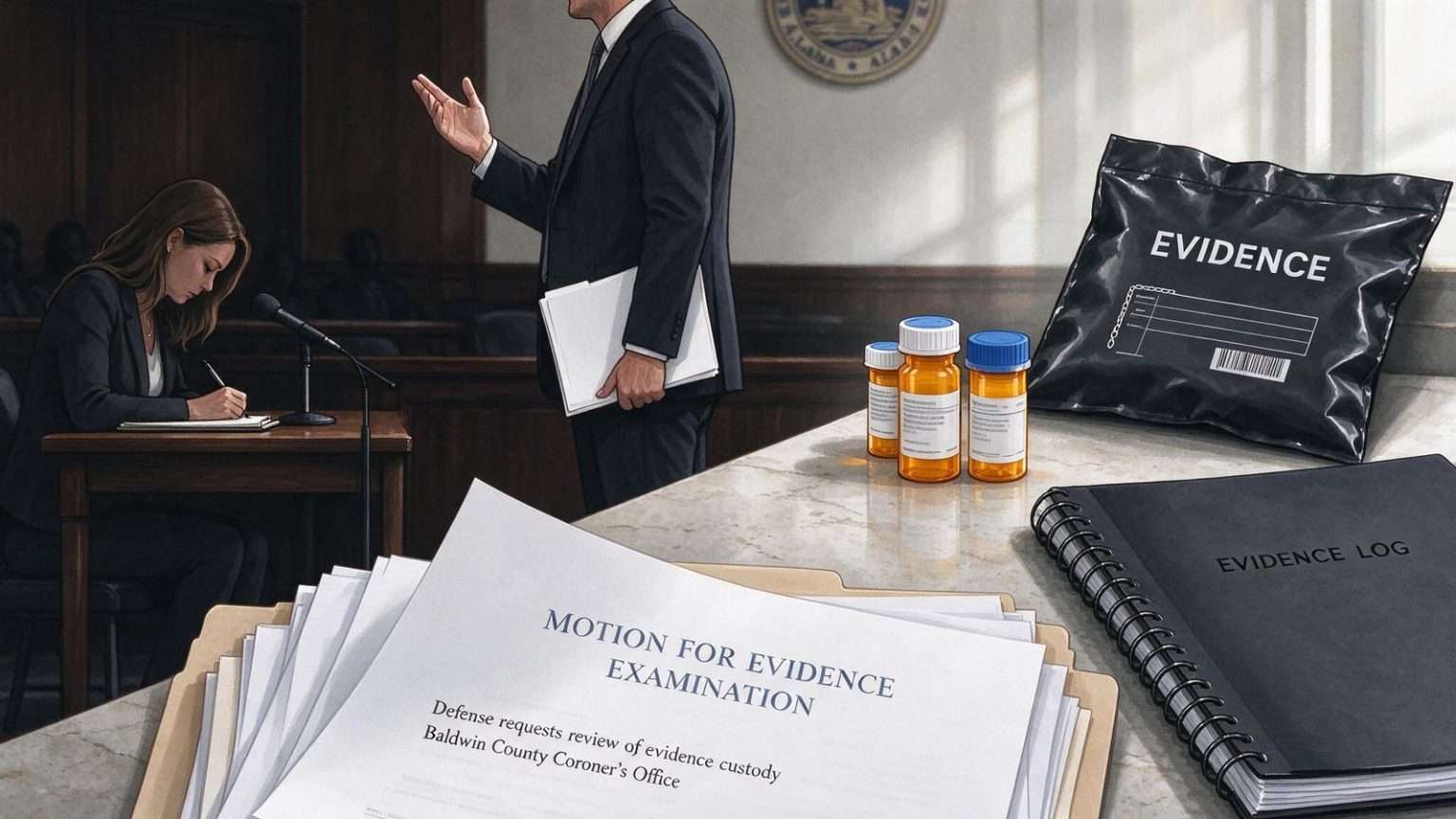
An attorney for accused murderer and former Mobile County Commissioner Stephen Nodine demanded an examination of information that might connect evidence in the case to the firing of an employee in the Baldwin County coroner’s office, adding another twist to an already tangled prosecution. The motion arose as the case moved toward a possible retrial, a stage at which both sides re-examine every link in the chain of evidence that produced the first verdict, and the defense used that opening to shine a light on the office that had recovered the case’s most sensitive materials.
Nodine stood accused of killing his paramour, Angel Downs, 45, who died of a gunshot wound to the head in the driveway of her home off Fort Morgan Road in Gulf Shores. Witnesses reported seeing Nodine driving away shortly after neighbors heard gunfire. The case had already produced one trial, one hung jury, a change of district attorneys and months of public attention across the two counties, and each new filing kept it in the headlines that the first trial had generated.
A theft in the coroner’s office
At the center of the new motion was Donna Taylor, an administrative secretary in the coroner’s office who had pleaded guilty to unlawful possession of a controlled substance. Taylor had been arrested while leaving work and charged with stealing drugs and prescriptions that had been marked as evidence from death investigations. Drug Task Force officers who arrested her found prescription pills and a small amount of methamphetamine in her purse, according to authorities, and she was fired the day after her arrest.
The arrest raised an uncomfortable question for an office whose credibility depends on the integrity of its evidence: if a secretary could walk out of the coroner’s office with evidence-grade pills, what checks existed on the handling of medications collected at death scenes? Authorities acknowledged that the drugs found in Taylor’s possession had been sent to the coroner’s office as part of an undercover investigation reportedly requested by her boss, Coroner Stan Vinson. That acknowledgment meant the pills in her purse had been planted for a sting, but it did not answer the defense’s larger question about what else had passed through the office’s hands.
Coroner’s offices in Alabama occupy a peculiar position in the evidence chain. They take custody of bodies, medications and personal effects at death scenes, frequently before police investigators have finished their work, and their records and testimony become foundational to any later prosecution. A theft conviction inside such an office gives defense counsel a ready-made argument that custody procedures deserve scrutiny, particularly in a case where the medications of the deceased played a visible role at trial.
The defense’s question
Nodine’s lawyer argued that the defense was entitled to know whether the coroner or his staff had, at any point, possessed Downs’ prescription medications, and what the investigation into Taylor’s actions had revealed about the possible theft or misuse of those medications before trial. The demand framed the issue as one of discovery: the state’s files on the Taylor investigation, the defense contended, belonged in the defense’s hands because they bore directly on the reliability of the evidence the prosecution intended to present a second time.
The question carried weight because Downs’ medications had figured in the earlier trial. According to testimony, she had been prescribed numerous drugs, and her prescription and alcohol use had been characterized by the defense as evidence of a person not caring for her health, even as self-destructive. That portrait was central to the defense theory in the first trial, which sought to cast doubt on the state’s account of how and by whom the fatal shot was fired, and any suggestion that her medications had left the coroner’s custody before they were analyzed or presented in court would have given that theory new force.
Vinson, the motion noted, had been the coroner in the case and, according to trial testimony, had recovered Downs’ body and her belongings from the scene. Because the coroner personally handled the materials the defense wanted traced, the motion effectively put his office’s practices on trial alongside Nodine. Everything from the logbook entries documenting the medications to the storage arrangements in the office’s evidence area became relevant to whether the items a jury saw in the first trial were the same items collected on the night of the death.
Evidence-handling cases of this kind are not rare in Alabama courts, but they are consequential. Defense attorneys routinely request chain-of-custody records for drugs, blood samples and medications, and gaps in those records can support suppression motions, cross-examination about tampering, or argument that the state cannot prove the integrity of its own exhibits. A guilty plea by an office employee to stealing evidence drugs, however, goes beyond a mere gap in paperwork; it supplies a documented instance in which that office’s custody failed.
A case in transition
The prosecution had passed from one district attorney to another. The first trial, led by former Baldwin County District Attorney Judy Newcomb, ended with a hung jury. The task of retrying Nodine fell to newly elected prosecutor Hallie Dixon, who indicated she would take the matter back before a grand jury in light of new evidence. The handoff between administrations is always a delicate moment in a capital-attention case, because each prosecutor inherits another’s investigative file, another’s witness list and another’s theory of the case, and the incoming office must decide what to keep and what to rebuild.
Observers anticipated that a superseding indictment might give a jury a broader range of options, including lesser offenses short of murder. That structure matters in a case like this one, where a hung jury often signals that at least some jurors doubted the state’s most serious charge, and a menu of lesser counts gives a divided panel somewhere to land short of acquittal. Prosecutors use superseding indictments to refresh cases with new evidence, correct defects in earlier charging papers, or recalibrate what they believe a jury will actually accept.
The defense, for its part, hoped the new evidence would exonerate Nodine and lead to dismissal of the charges. Through a spokesperson, the district attorney’s office declined to comment on the defense motion. The silence was standard practice for an office heading back to a grand jury, where proceedings are secret, but it left the public record of the dispute one-sided, with the defense’s filings narrating the coroner’s office episode while the prosecution reserved its answers for the courtroom.
Awaiting a retrial
No date had been set for a retrial. The motion added the coroner’s office episode to a growing list of complications surrounding a case that had already commanded intense public attention across Mobile and Baldwin counties. Between the first trial and any second one, the case had accumulated a change of prosecutors, a grand jury review, and now an evidence-integrity dispute touching the office that had collected the deceased’s belongings, and each addition extended the timeline that victims’ families, defendants and witnesses all must endure.
For the defense, the theft of evidence drugs offered a potential avenue to raise doubts about the handling of the medications tied to Downs. For the prosecution, it represented one more challenge to navigate as it prepared to bring the case before a grand jury again. The coming months would determine how much the episode would shape the path toward any second trial, and whether the questions raised in the motion would end in a hearing on the evidence, a negotiated resolution, or simply another layer of complication in a case that had never lacked for them.
The coroner’s role and the Drug Task Force
The Baldwin County coroner’s office, like coroner’s offices across Alabama, is responsible for investigating deaths that fall outside ordinary medical expectations, taking custody of the deceased and of medications and personal effects found at the scene. In a county that stretches from the bustle of the Eastern Shore to the beach communities of Gulf Shores and Orange Beach, the office handles hundreds of death investigations a year, ranging from traffic fatalities on the county’s highways to the unattended deaths that occur in homes and hotels across the coastal plain.
The Drug Task Force officers who made the arrest in the Taylor case represent a different arm of the county’s law enforcement apparatus, a multi-agency unit that pools investigators from municipal police departments and the sheriff’s office to work narcotics cases across jurisdictional lines. Undercover operations of the kind that placed marked evidence drugs in the coroner’s office are a standard tool of such units, designed to test whether employees with access to controlled substances will steal them. The operation succeeded in documenting a theft, but its location, inside a coroner’s office rather than a pharmacy or clinic, guaranteed that the fallout would reach beyond the criminal case against the employee who took the bait.
For prosecutors, an internal theft case is usually contained: the employee is arrested, charged, convicted and replaced, and the agency’s evidence procedures are reviewed internally. But when that same office is the evidence custodian in a pending murder prosecution, the containment fails, and the theft becomes a fact the state must explain in open court. The defense motion in the Nodine case did exactly that, converting a personnel matter into a trial issue.
What happens next in a hung-jury case
Alabama prosecutors facing a hung jury have three broad options: dismiss the charges, negotiate a plea to a reduced offense, or return to a grand jury for a fresh indictment and try the case again. Each carries costs. Victims’ families face another trial, witnesses must testify again, and the state must fund a second round of experts and investigators. The defense, meanwhile, gains time and the chance to mine the first trial’s transcript for the testimony that divided the first jury.
Grand juries in Alabama meet in secret and need only probable cause to indict, a far lower threshold than the proof required for conviction, which is why a prosecutor’s decision to take a case back to a grand jury is usually a reliable sign that charges will be refiled. The open question in the Nodine case was not whether an indictment would return but what shape it would take, and whether the new evidence cited by the incoming district attorney would broaden the state’s case or narrow it.
However the charging decision came out, the coroner’s office motion ensured that evidence custody would be part of the second trial’s landscape. Whether the issue produced a pretrial hearing, a compromise, or simply argument in front of the jury, the episode demonstrated how a small theft case, concluded in an ordinary courtroom on an ordinary docket, could reach into one of the most closely watched prosecutions on the Gulf Coast and complicate the state’s effort to answer the same question a second jury would be asked: what happened in the driveway off Fort Morgan Road on the night Angel Downs died.