Prichard Police Investigated 2007 Barber Shop Shooting
A 2007 WKRG report covered a shooting death outside a barber shop on Martin Luther King Jr. Avenue in Prichard.
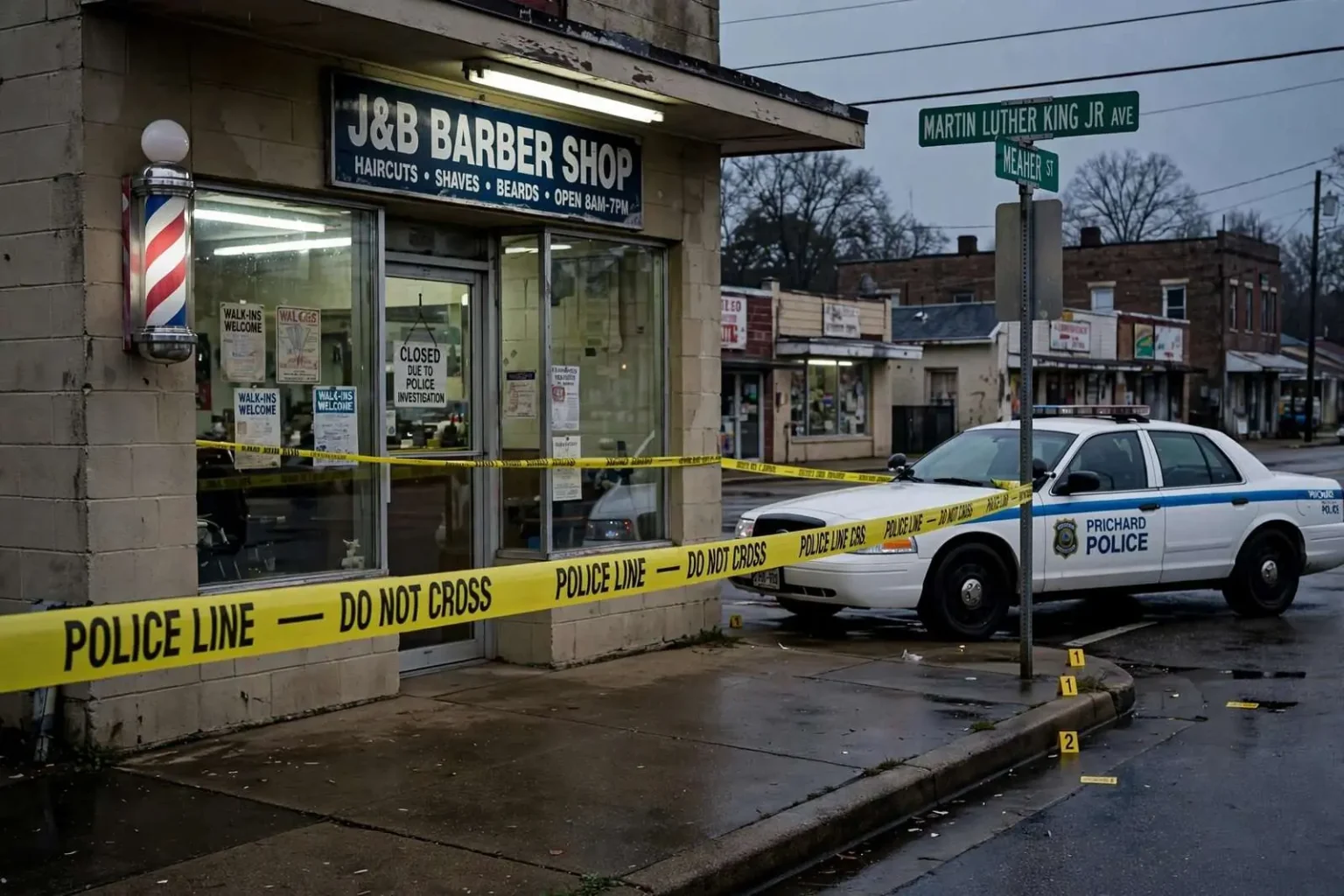
Prichard police investigated a shooting death outside a barber shop on Martin Luther King Jr. Avenue in December 2007, an episode that briefly brought the city’s longtime struggle with violent crime into focus on one of its busiest commercial corridors.
Officers found a man with multiple gunshot wounds near the corner of Martin Luther King Jr. Avenue and Meaher Street, where the victim was pronounced dead after being discovered outside the shop. Police said they had not released the victim’s name or a motive, but were developing suspect information as the investigation moved forward. The location sits several blocks from Glendale Elementary School, a proximity that sharpened community concern about gunfire along a route children travel.
This is a historical account of a preliminary investigation as it was reported in 2007. It does not state final case outcomes, and readers should understand that details available in the first days of a homicide inquiry are often revised as investigators learn more.
Prichard and the MLK Avenue corridor
Prichard sits just north of Mobile in Mobile County, a city of roughly 27,000 residents whose fortunes have risen and fallen with the industries around Mobile Bay. Incorporated in the early twentieth century as a railroad and manufacturing town, Prichard grew rapidly through the postwar decades and then weathered decades of economic decline as factories closed and middle-class residents moved outward. By the 2000s, the city was one of the poorest in Alabama, and its crime rate reflected the strain.
Martin Luther King Jr. Avenue is one of Prichard’s central arteries, running north-south through the city and lined with the small businesses — barber shops, churches, convenience stores, soul food kitchens — that anchor neighborhood commercial life in communities like this one. In December 2007, the avenue’s barber shops were the kind of gathering places that give a street its character, open long hours and serving a regular clientele. A shooting outside one of them struck not just a victim but a public space the whole surrounding neighborhood used.
The intersection with Meaher Street put the crime scene in a residential and commercial mix near the heart of the city. The area’s proximity to Glendale Elementary School — several blocks away — was noted in the investigation’s reporting because of what it meant for the neighborhood: gunfire in the early evening within walking distance of an elementary school is precisely the kind of violence that community leaders in Prichard had spent years organizing against.
The investigation as it stood
Prichard police, working the kind of case that tests a small department’s investigative capacity, said publicly that they had not released the victim’s name or a motive. That silence in the early hours of a homicide investigation is standard: next-of-kin notification comes first, and speculative public statements about motive can poison witness cooperation before it starts. The department said it was developing suspect information, the phrase investigators use when tips and interviews are converging on persons of interest but no arrest is ready.
Homicide investigations in small Alabama cities rely heavily on the same resources their larger neighbors use. Prichard detectives would have canvassed the block around Martin Luther King Jr. Avenue and Meaher Street for witnesses, sought surveillance video from nearby businesses, collected shell casings and processed the scene for forensic evidence, and coordinated with the Mobile County District Attorney’s Office and state forensic labs. Tips from the public, funneled through the department and through Crime Stoppers of Metro Alabama, typically determine whether cases like this one are solved.
Barber shop shootings carry particular weight in small-city policing because of who witnesses them. Shops draw a steady stream of neighbors, and a killing outside one means dozens of potential witnesses — customers waiting for cuts, children walking home from school, business owners watching the street — many of whom are reluctant to talk when the violence is close to home.
Drug activity and the pattern behind the violence
Police said the surrounding area had experienced drug-activity concerns, a detail that placed the shooting within the broader pattern of violent crime in Prichard during those years. The city’s struggles with open-air drug markets along its commercial corridors had been the subject of news coverage, church-led campaigns and law enforcement operations for more than a decade, and residents repeatedly connected the drugs-and-guns economy to the shootings that punctuated life along avenues like Martin Luther King Jr.
The 2000s were a hard stretch for the city on nearly every front. Prichard’s finances collapsed into bankruptcy twice, its population declined, and its police department worked violent crime with limited resources. Community organizations fought back with the tools available: neighborhood watch groups, anti-drug marches, mentoring programs and the persistent pressure of pastors who had watched a generation of young men die on the city’s streets.
What a December 2007 homicide meant locally
For the neighborhood around Martin Luther King Jr. Avenue, the shooting death outside the barber shop joined a grim run of similar losses. Mobile County’s smaller municipalities recorded homicide after homicide in those years, and Prichard’s share of them drew repeated attention from the Mobile County Sheriff’s Office and county prosecutors, who at various points assisted city police with major-case support. Each killing outside a business — a shop, a store, a car wash — chipped away at the willingness of residents to gather along the corridors where the violence occurred.
The reporting of the case also reflected the era’s local news cycle. A shooting like this one was covered in its first days by Mobile’s television stations and newspapers, which carried the basic facts — the location, the condition of the victim when found, the absence of a released name or motive — and then moved on unless an arrest followed. That pattern left many 2000s-era Prichard cases without a public resolution, a gap that families of victims felt acutely and that local journalists revisited in later years when examining the county’s unsolved killings.
The caution built into this account matters for that reason. A preliminary report that a victim’s name and motive had not been released, and that suspect information was developing, describes an investigation in motion — not an outcome. Whether the December 2007 case ended in an arrest, a conviction, or remains unsolved is a matter of record that this account does not establish, and treating early reporting as final would be a mistake that historical summaries of such cases should carefully avoid.
Glendale Elementary and the school-proximity question
The shooting’s location several blocks from Glendale Elementary School placed it within the kind of radius that parents, school officials and city leaders watch closely. Glendale Elementary serves the neighborhood around Prichard’s core, and its students walk and ride buses through the same streets where the city’s drug-related violence concentrated. Incidents near schools in Prichard and Mobile prompted years of advocacy for everything from increased patrols at dismissal times to after-school programs designed to keep children off the corners where the drug economy recruited.
School leaders in Mobile County generally responded to nearby violence with the practical tools available: communication with police, counseling for students affected by killings in their neighborhoods, and coordination with city hall on safety issues. The December 2007 shooting did not involve the school, but its proximity made it part of the conversation that Prichard’s leaders were already having about what life on MLK Avenue meant for the families raising children there.
The barber shop as neighborhood institution
The choice of location — outside a barber shop — says something about both the crime and the community. Barber shops in Black neighborhoods across the South function as more than businesses; they are informal community centers where news travels, opinions are aired and generations mix. Violence at the doorstep of such a place is a violation of one of the few truly public living rooms a neighborhood has, and it is one reason shootings at these businesses have drawn community responses disproportionate to their number.
In Prichard, churches and community groups responded to episodes of violence along the corridor with vigils, anti-violence walks and calls for cooperation with police, arguing that the city’s cases could only be solved if witnesses came forward. The relationship between residents and the police department was itself complicated — shaped by decades of under-resourced policing, the city’s financial crises and the mutual distrust that high-crime environments produce — and every unsolved case along MLK Avenue fed that cycle.
Prichard in the years after
The city that investigated this shooting continued to fight the same battles through the following decade. Prichard’s police department, working with county and federal partners, pursued drug-market enforcement operations; community programs expanded; and the city’s story became one of persistence against odds — a small city with a thin tax base working to make its commercial corridors safe for the businesses and families that stayed.
The December 2007 shooting outside the Martin Luther King Jr. Avenue barber shop remains, in this account, what the reporting of its day could establish: a man found with multiple gunshot wounds near MLK and Meaher, a preliminary investigation with no name or motive released, suspect information developing, and a neighborhood several blocks from an elementary school confronting, once again, the cost of the drug trade on its own corner.