Interstate Car Chase Ended in Mobile County in 2008
A 2008 WKRG report covered a chase that began in Biloxi and ended with two people taken into custody in Mobile County.
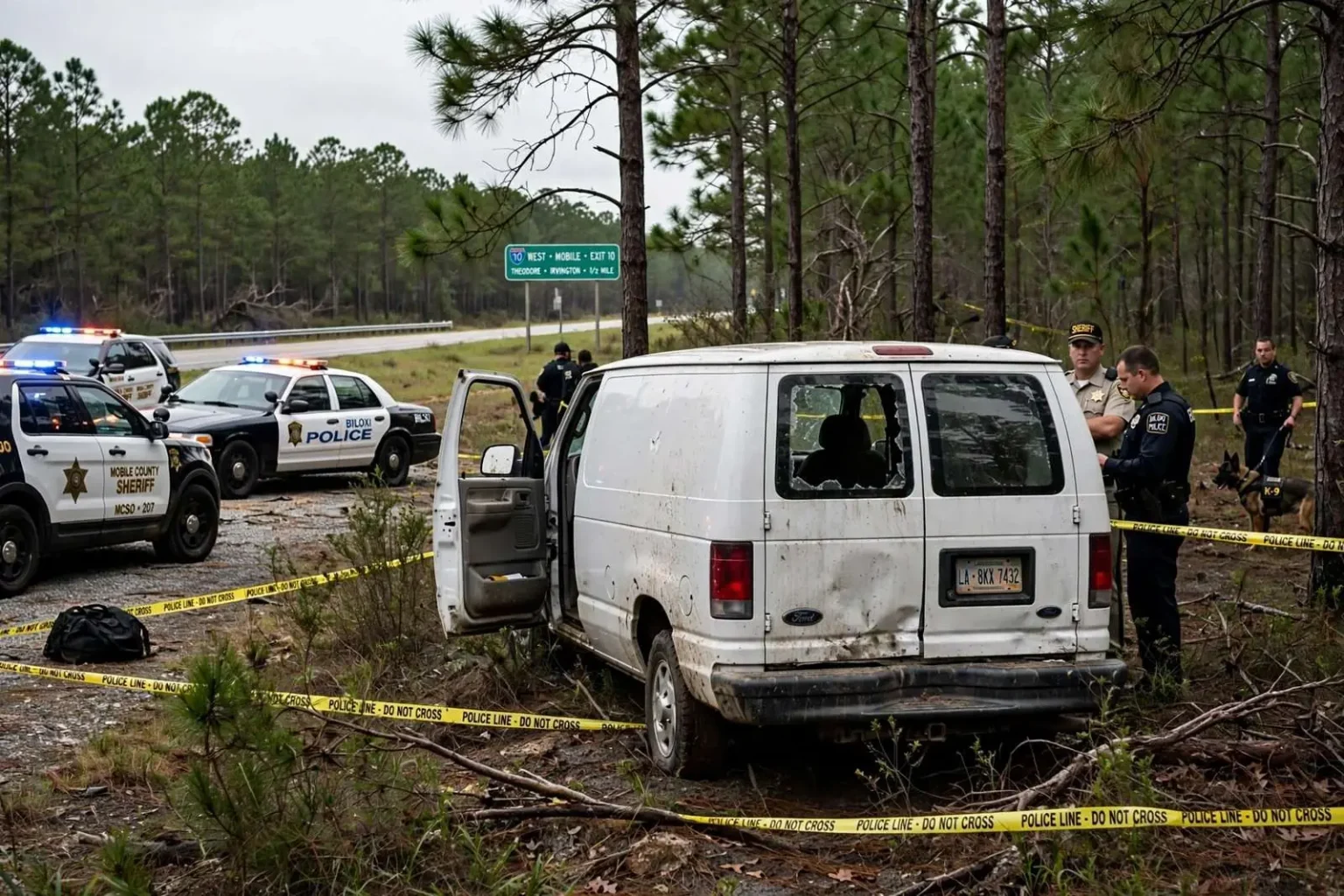
Two people were taken into custody in Mobile County in May 2008 after a vehicle chase that began hundreds of miles of interstate earlier in Biloxi, Mississippi, in an episode that tied together police agencies on both sides of the Gulf Coast, according to a local station’s account of the incident. What started as a routine traffic stop in one coastal city ended with a stolen van abandoned near an interstate exit in Alabama, a dramatic capture in the woods and two suspects in jail across the state line.
Biloxi police said the episode began when a van nearly struck an officer during a traffic stop. Rather than stopping, the driver sped away, fleeing west on Interstate 10 — the coast-hugging interstate that runs from Florida through the Alabama Gulf Coast and across the Mississippi Gulf Coast, linking Mobile and Biloxi along a corridor of roughly 60 miles. Officers from Biloxi pursued, and the chase crossed through Harrison County and then into Alabama, where the pursuit continued along I-10’s stretch through Mobile County.
The Van Stopped, the Search Began
The pursuit ended near Exit 10 in Mobile County, where the driver and passenger bailed out of the van and fled on foot. The passenger was captured immediately by pursuing officers, but the driver disappeared into the tree line near the interstate, prompting a multi-agency search of the nearby woods. Deputies and officers from the agencies now involved in the case — the Mobile County Sheriff’s Office and municipal police departments working alongside the Biloxi officers who had followed the van across two state lines — combed the area until the driver was found hiding in the woods and taken into custody without further incident.
No injuries were reported during the chase or the search, an outcome that those familiar with pursuit statistics know is never guaranteed. Interstates are among the most dangerous settings for vehicle pursuits, with speeds high and traffic heavy, and the fact that a chase running through two states and dozens of miles of highway ended without a crash or injury was itself notable.
What the Van Revealed
Once the suspects were in custody, the paperwork told the rest of the story. Police said the van had been reported stolen from Louisiana, adding a third state to the case file — stolen in Louisiana, spotted in Mississippi, chased through Alabama. The driver was charged with possession of a stolen vehicle, the charge that followed him into the Mobile County justice system. Charges for the passenger, and any additional counts arising from the chase itself, were matters for the prosecutors and courts that took over once the law-enforcement phase ended.
The May 2008 account of the case comes from contemporaneous reporting on law-enforcement statements at the time. It does not state the final court outcomes for the two people taken into custody — convictions, plea agreements or sentences, if any, were matters resolved later and outside the scope of the original coverage.
Pursuits Across Jurisdictional Lines
Chases like this one illustrate a reality of Gulf Coast law enforcement: the interstate system that makes the region easy to travel also makes it easy to flee. A vehicle heading west out of Mobile County is minutes from Mississippi; one heading east is minutes from Florida. Police agencies have long grappled with the fact that a pursuit can outrun any single department’s jurisdiction, which is why cooperation agreements, mutual aid understandings and quick communication between dispatch centers matter as much as the driving itself.
Interstate 10 and the Gulf Coast Corridor
The geography of the chase is worth understanding on its own terms. Interstate 10 is the Gulf Coast’s main artery, running from Jacksonville, Florida, through the Panhandle, across Mobile Bay on the Jubilee Parkway, around south Mobile County and west across the state line into Mississippi, where it passes near Pascagoula, Gulfport and Biloxi before continuing toward New Orleans. For police agencies along that corridor, the interstate is both a lifeline and an escape route — a straight shot that can put a fleeing driver across a state border in less than half an hour.
Exit 10 in Mobile County sits along the stretch of I-10 that crosses the county’s rural southern section, an area of pine forest, farmland and small communities where a driver leaving the interstate finds country roads and woods rather than city streets. It was that terrain that shaped the end of the 2008 chase: two suspects out of the van and into the landscape, one caught at once and the other flushable only by a coordinated search through the woods.
The Multi-Agency Search
The search for the driver showed how such operations typically unfold. When a fleeing suspect takes to foot, the pursuing agencies establish a perimeter around the area, bringing in additional units to hold the edges of the search zone while officers and deputies move through it methodically. K-9 units, when available, are often brought in to track. In the 2008 case, the multi-agency search of the woods near the exit ended with the driver found and taken into custody, completing the two-state capture that had begun with a traffic stop in Biloxi.
For the Biloxi officers whose traffic stop started it all, the outcome validated the decision to pursue — and the coordination that carried the pursuit across the state line. For Mobile County agencies, the case arrived, fully formed, at the end of a chase they had not started: a stolen van from Louisiana, two suspects in custody, and a criminal case to process that had crossed three states in a single afternoon. It was, in the end, a straightforward account of an interstate pursuit that ended where so many Gulf Coast chases end — in the pine woods off I-10 in south Mobile County, with nobody hurt and two people in custody awaiting the courts.
How Pursuit Policies Shape These Chases
Every police department sets its own rules for when to chase and when to hold back, weighing the seriousness of the suspected offense against the danger a pursuit poses to the public. A vehicle that nearly strikes an officer while fleeing a traffic stop leaves little discretion: the driver has committed an assault-level act against a police officer and demonstrated that he will not stop voluntarily. Those factors are precisely what justify continuing a pursuit across jurisdictional lines, and they are what kept Biloxi officers, and then Alabama agencies, on the van’s tail down Interstate 10 until it stopped near Exit 10.
Communication is the invisible thread in any such pursuit. As the van crossed from Biloxi into Harrison County and then into Alabama, dispatchers handed the pursuit from one agency to the next, passing along the vehicle description, direction of travel and the circumstances of the original stop. By the time the van reached Mobile County, the agencies along the route knew what they were dealing with — which is why a passenger could be captured immediately and why a coordinated multi-agency search could flood the woods near the exit before the driver could get far on foot.
Stolen Vehicles on the Interstate
The fact that the van was reported stolen from Louisiana fit a pattern familiar to law enforcement along the Gulf Coast. Stolen vehicles travel the interstate system for the same reason everything else does — it is the fastest route between the region’s cities — and recovery often happens far from the theft location, in a different state entirely, after a traffic stop or an accident brings the vehicle to someone’s attention. A van taken in Louisiana, encountered in Biloxi and abandoned in Alabama traces one of the corridor’s most common arcs.
Possession of a stolen vehicle, the charge the driver faced, is among the offenses that most reliably begins with exactly this kind of encounter: a traffic stop for something routine, a driver who cannot afford the stop, and a flight that converts a property crime into a far more serious case. The passenger, taken into custody at the scene, faced the question of what his role in the flight had been — a determination left to the prosecutors who received the case once the agencies finished their reports.
The May 2008 episode ended the way every agency involved hoped it would: van recovered and returned to the investigative process, two people in custody, an officer who had been nearly struck still safe, and no injuries to civilians, officers or suspects along sixty miles of interstate. The account of the case rests on the statements issued by police at the time; the ultimate disposition of the charges was never part of the reported record, and no final court outcomes were stated in the original coverage.