Historical crime report, published from archived local news coverage.
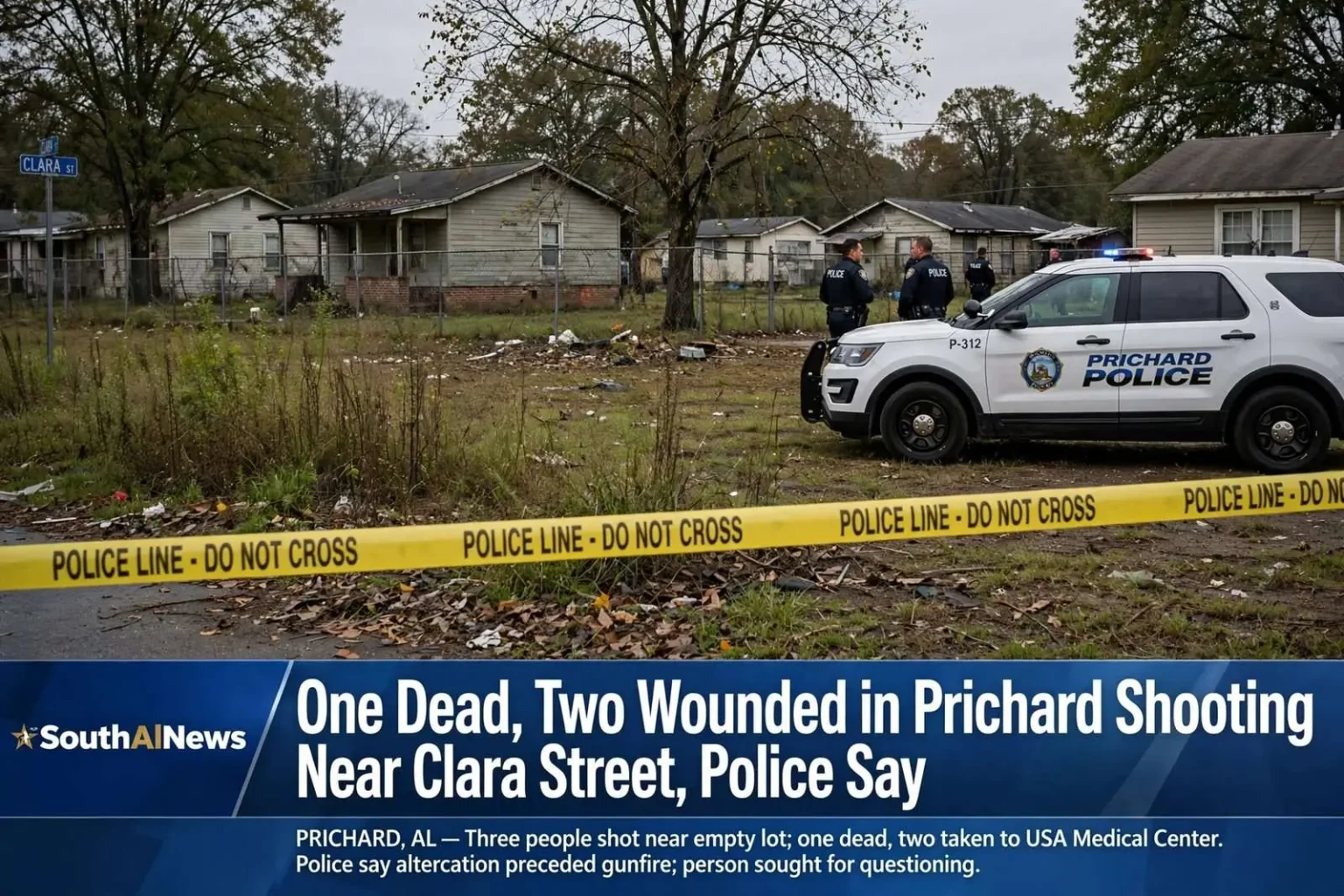
Prichard police said three people were shot near an empty lot on Clara Street in an incident covered by a local station’s archived reporting. The shooting, which unfolded in a residential section of the Mobile County city, left one of the victims with wounds that proved fatal and sent the other two to USA Medical Center for treatment. Details about the conditions of the surviving victims were not available in the archived account, which reflected the preliminary information police released as the investigation was still getting underway.
Clara Street sits in the heart of Prichard, a city of neighborhoods built out in waves through the mid-twentieth century just north of Mobile’s city limits. Like many older communities in the Mobile metropolitan area, Prichard has contended for years with the economic pressures that follow population loss, and its police department has long operated with the challenges of policing a small city surrounded on most sides by larger jurisdictions. An empty lot in a block of homes is a familiar kind of scene in such neighborhoods — vacant ground where activity after dark is unusual enough to draw notice when something goes wrong.
The Victims and the Hospital
Police said one victim later died from the injuries. The other two were taken to USA Medical Center, the University of South Alabama’s hospital in Mobile, which serves as the region’s major trauma center. For victims of shootings across Mobile County, including Prichard and the surrounding communities, USA Medical Center is routinely the destination when injuries are serious, because it maintains the specialists and equipment needed for penetrating trauma that smaller hospitals do not. The transport of two victims there indicated the severity of the incident from the earliest police accounts.
The death of one victim moved the case into the category of a homicide investigation, with all of the procedural weight that carries: notification of the district attorney’s office, a medical examiner’s examination of the deceased, and the collection of evidence from the scene that could ultimately support murder charges. At the time of the archived report, police had not announced arrests, and the account of the investigation was explicitly preliminary.
Witnesses Describe an Altercation
Investigators said at the time that witnesses described an altercation before the shooting. That detail — a dispute preceding the gunfire — is one of the most common threads in non-random shootings, and it shapes how detectives work a case from the first hours: who was involved in the argument, who else saw it, whether the participants knew one another, and whether the conflict had been brewing before it reached the lot on Clara Street. A shooting that follows an identified altercation is treated very differently from a random attack, both in the immediate public safety assessment and in the investigative approach.
Police identified a person they wanted to question and said they were canvassing the area and speaking with potential witnesses. Canvassing is the slow, door-to-door work that often determines whether a shooting case moves forward — officers and detectives going block by block, asking neighbors what they saw or heard, whether cameras on homes or businesses might have captured something, and whether anyone recognized the vehicle or people involved. In a neighborhood like the one around Clara Street, where many residents have lived for years or decades, that kind of ground-level police work is often the only path from an initial tip to a usable account of events.
The archived report also referenced an earlier shooting allegation involving the same person. Investigators declined to characterize the nature of that connection in the account, and no charge arising from it was reported. In shooting investigations, detectives routinely examine whether a suspect or person of interest appears in prior incidents, because patterns of association can help establish motive, identify other witnesses, or corroborate the accounts of people who are reluctant to come forward.
Allegations, Not Verdicts
It bears emphasis that everything in the archived report reflected police information and allegations available at the time. A person identified as someone police wanted to question had not been charged with any crime in connection with the Clara Street shooting when the report was published, and being sought for questioning is not evidence of guilt. American courts presume innocence, and the archived account itself made no finding about who fired the shots or why. Nor does the report establish guilt or reflect any later court outcome; any case that followed would have proceeded through arrest, charging decisions by the district attorney, and the criminal courts, where allegations are tested against evidence and a jury or judge would render the only judgment that counts.
For the family of the victim who died, the distinction mattered less than the loss itself. Homicide cases in small cities carry a particular weight: the victim is likely known to many in the community, the suspect pool is often local, and the fear generated by an unsolved killing on a residential street can linger long after the news cycle moves on. Community cooperation — the witnesses willing to talk to detectives during the canvass — is frequently what separates homicide cases that are solved from those that grow cold.
Prichard and Its Police Department
The Prichard Police Department investigates serious crime within the city with support that varies case by case. Homicides in small Mobile County cities commonly draw assistance from beyond the city’s own detective staff — from the Mobile County Sheriff’s Office, the district attorney’s investigators, or federal partners when the evidence points across jurisdictional lines. The department’s investigative capacity, like the city’s budget, has been shaped by the same economic headwinds that have tested Prichard’s finances for years, making cooperation with other agencies a practical necessity rather than an administrative choice.
The Context Around the Case
The Clara Street shooting occurred against the backdrop of persistent gun violence in the Mobile metropolitan area, which for years has registered homicide counts that strain the resources of every agency in the county. Prichard’s location — bordered by Mobile to the south and by unincorporated communities and Chickasaw to the north and east — means that violence within the city cannot be neatly separated from the wider region’s patterns. Investigating agencies in Mobile County have long said that the same solutions keep presenting themselves: witnesses willing to come forward, and prosecutors and courts able to move cases to resolution before leads fade.
The shooting also illustrates the human arithmetic of a triple shooting for a community of Prichard’s size. Three victims mean three sets of families receiving trauma ward updates, two hospital journeys and one death notification, and a neighborhood where the sound of gunfire near an empty lot becomes the topic of conversation on every porch. For the police department, it means the immediate commitment of patrol officers to secure a scene, detectives to work it, and command staff to answer for the investigation’s progress — all within a department sized for a much smaller volume of major cases.
Archived crime coverage like this also serves a documentary purpose that goes beyond the individual case. Decades from now, the Clara Street shooting will exist in exactly two places: the courthouse file, if the case ever produced one, and accounts like this one that preserve what the public was told at the time. Police reports are not written for history, and few ever reach the public in full, so the local news record — incomplete, preliminary and dated as it is — is often the only public accounting of how a community learned about a death in its midst and how its institutions responded in the first hours and days.
Why the Old Report Reads This Way Today
This article reflects police information and allegations available at the time; it does not establish guilt or report any later court outcome. Old search and contact information has been omitted because it is no longer current. That is the standard practice for republishing archived crime coverage: the original story urged readers with information to call investigators at telephone numbers and tip lines that have since changed, and republishing stale contact details would do no one any good. Anyone with information about a cold case in Prichard today would be directed to the department’s current numbers or to Mobile County-area crime stoppers.
What remains from the archived account is the outline of an evening that ended with one resident dead and two wounded, a neighborhood canvassed by officers looking for answers, and a person of interest whose connection to an earlier shooting allegation was noted but never resolved in the pages of the original report. The rest — the arrests, charges, trials or acquittals that may have followed — belongs to the court record, not to the archived story, and this republication takes care not to blur that line.